Organic (Year 1)
Year 1 Mechanisms
7Explanation of, mechanism, conditions and useful facts for free radical substitution reactions:
Occurs when a halogen reacts with an alkane or halogenoalkane to form a halogenoalkane with one more halogen than the one before (e.g. alkane -> halogenoalkane, halogenoalkane -> dihalogenoalkane).
The conditions are UV light or a high temperature (not heat) of 450-1000 degrees C (always say UV light in exam questions). The UV light is needed to provide the energy to break the C-Cl or Cl-Cl bond.
The free radical (a substance with an unpaired electron, making it highly reactive) acts as an intermediary, meaning it isn’t present at the start or end of the reaction.
Mechanism:
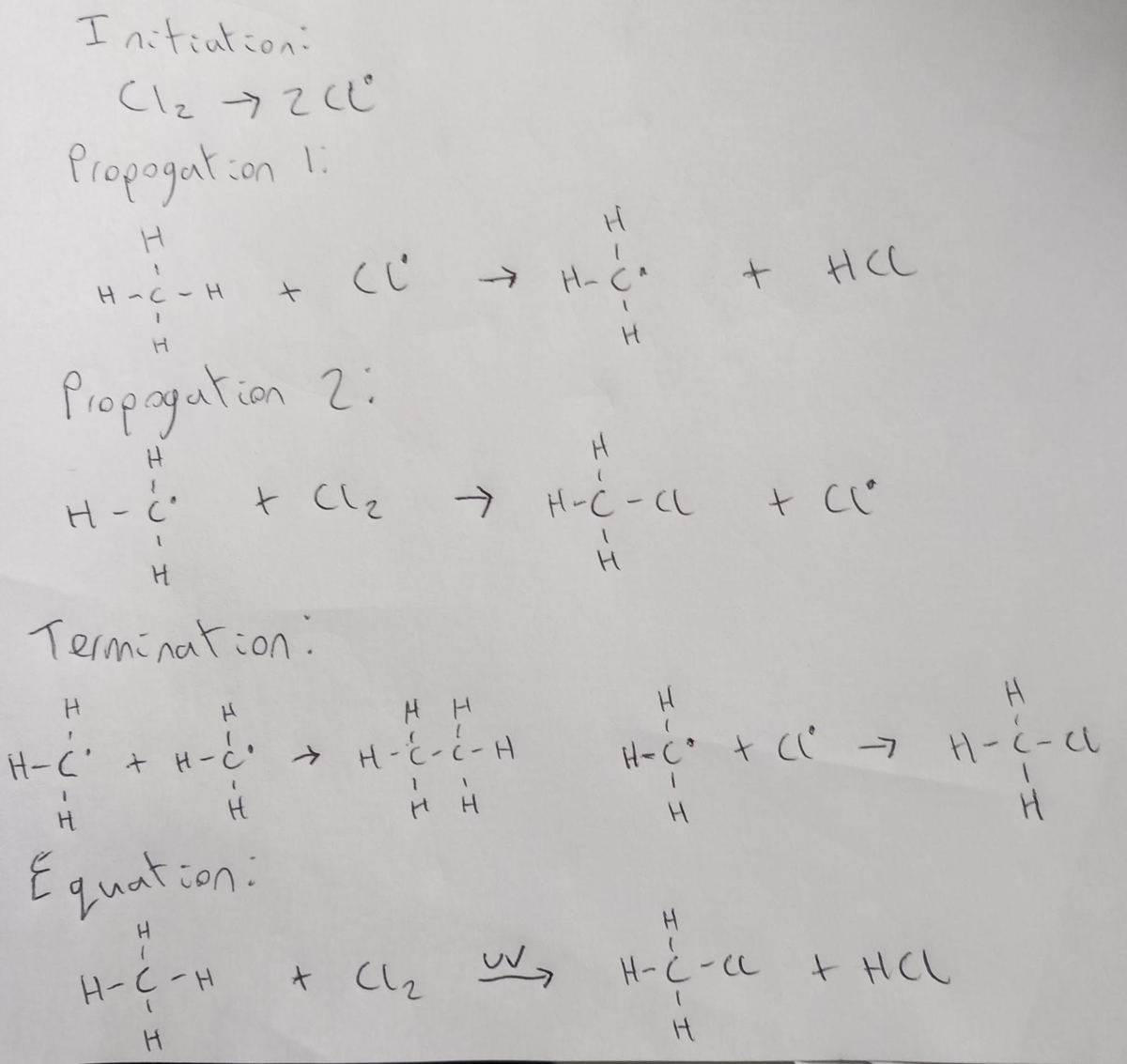
Important things to remember:
-Cl radical + Cl radical -> Cl₂ is not a valid termination step, as Cl₂ is used in the initiation step.
-In a question where you’re asked to show the mechanism going from a halogenoalkane to a trihalogenoalkane (for example), you’re going to have to show 4 propagation steps because you have to show 1 -> 2, then 2 -> 3.
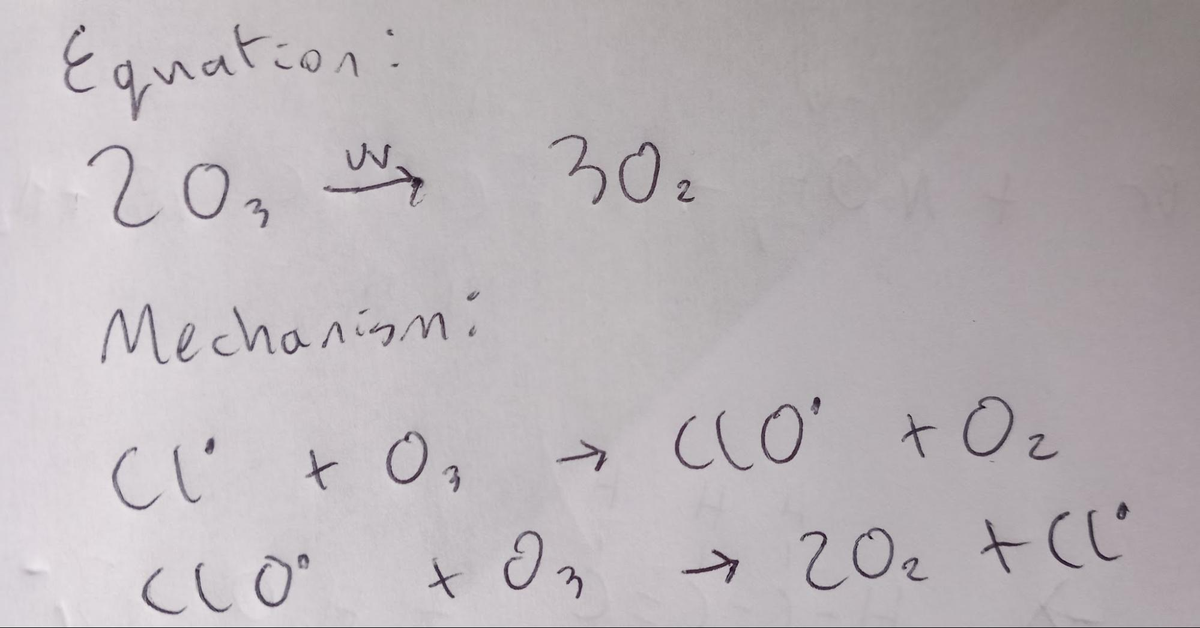
CFCs (chlorofluorocarbons), which are used as refrigerants and aerosols, can deplete the ozone layer when they rise up to the ozone layer and the C-Cl bonds are broken by UV light, causing chlorine free radicals to form.
Sources
June 2013 As Unit 2 Q7(a)(i) (1 marks)
Q:
MS:
January 2010 As Unit 2 Q6(d)(i) (1 marks)
Q:
MS:
2014 As Unit 2 Q5(b)(i) (1 marks)
Q:
MS:
2020 As Paper 2 Q1.3 (3 marks)
Q:
MS:
Specimen As Paper 2 Q5.1 (2 marks)
Q:
MS:
2012 A-Level Unit 5 Q5(c) (1 marks)
Q:
MS:
2022 As Paper 2 Q6.3 (1 marks)
Q:
MS:
2021 A-Level Paper 2 Q9.4 (3 marks)
Q:
MS:
2018 A-Level Paper 2 Q1.3 (2 marks)
Q:
MS:
June 2010 As Unit 2 Q7(a)(i) (4 marks)
Q:
MS:
2014 As Unit 2 Q5(a)(i) (4 marks)
Q:
MS:
June 2012 As Unit 2 Q6(c) (4 marks)
Q:
MS:
2011 As Unit 2 Q1(a)(ii) (1 marks)
Q:
MS:
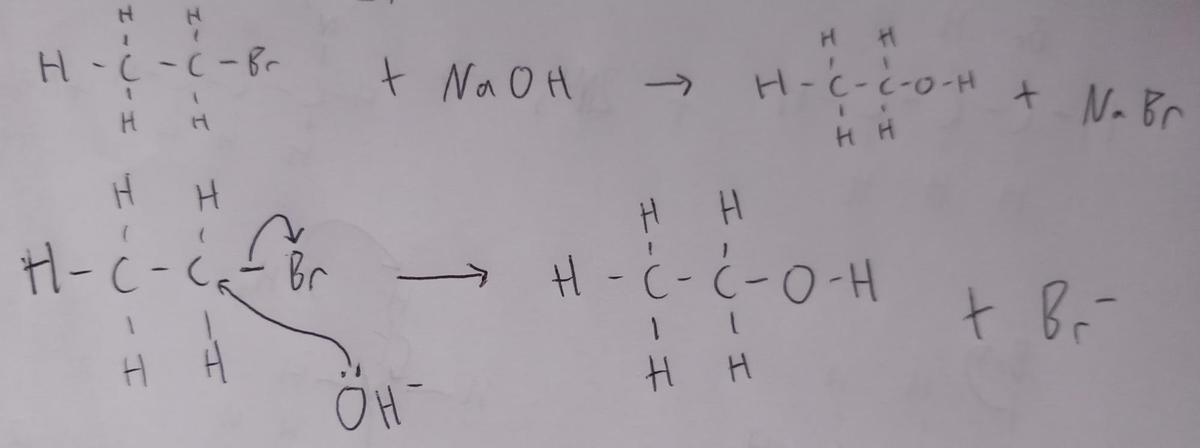
Explanation of, mechanism, conditions and useful facts for nucleophilic substitution reactions with hydroxide ions:
Occurs when a halogenoalkane reacts with sodium hydroxide.
The conditions are warm and aqueous.
The product is an alcohol and sodium halide.
Sources
2023 As Paper 2 Q3.1 (2 marks)
Q:
MS:
June 2010 As Unit 2 Q2(c)(ii) (2 marks)
Q:
MS:
2011 As Unit 2 Q8(b) (2 marks)
Q:
MS:
January 2012 As Unit 2 Q9(b) (6 marks)
Q:
MS:
Explanation of, mechanism, conditions and useful facts for nucleophilic substitution reactions with cyanide:
Occurs when a halogenoalkane reacts with either hydrogen cyanide or potassium cyanide. Potassium cyanide is used in practice as hydrogen cyanide is a gas and cyanide ions are toxic, so there is a high risk of inhaling the dangerous gas if you use hydrogen cyanide. Potassium cyanide is a solid so there is less danger using it.
The conditions are ethanolic and aqueous, but you should always say ‘alcoholic’ if it asks and use aqueous as a back-up.
The product is an alkane nitrile, with a chain length of one more than the reactant (e.g. propane would become butane nitrile)
Mechanism:
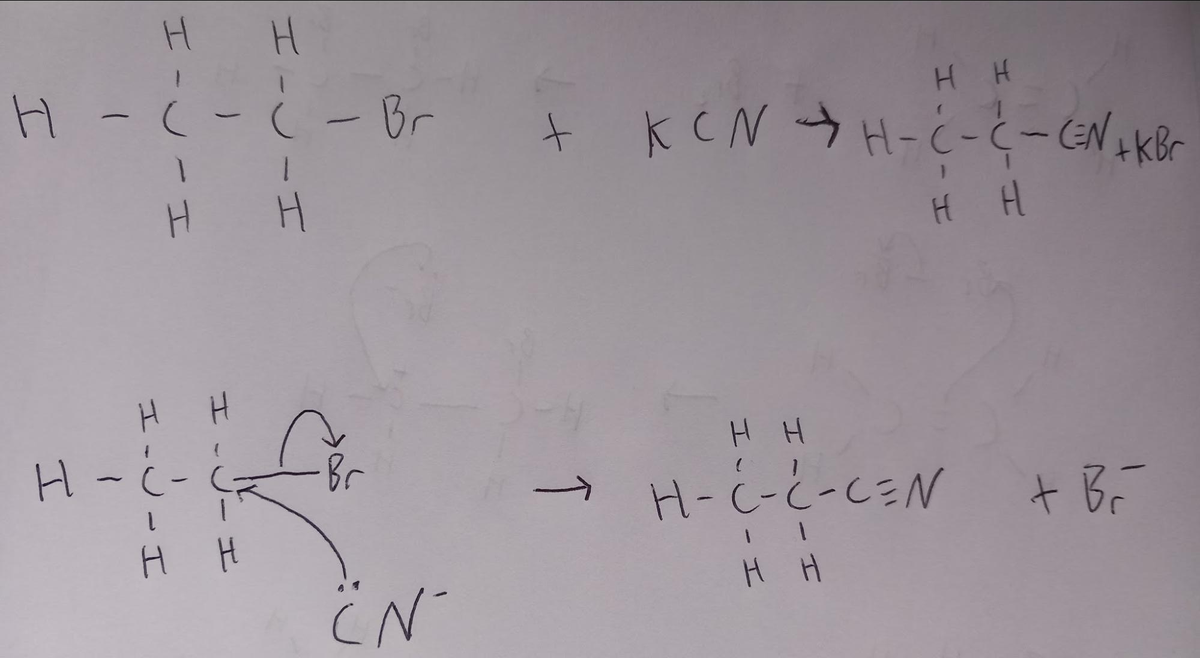
Important things to remember:
-The lone pair on the cyanide ions is on the carbon
-Draw the triple bond between the carbon and nitrogen in the product
-When naming the product, remember the product will have a longer chain length.
Sources
2019 As Paper 2 Q2.1 (2 marks)
Q:
MS:
2016 As Paper 2 Q10 (1 marks)
Q:
MS:
January 2010 A-Level Unit 4 Q9(b) (6 marks)
Q:
MS:
Explanation of, mechanism, conditions and useful facts for nucleophilic substitution reactions with ammonia:
This reaction occurs when a halogenoalkane reacts with 2 molecules of ammonia. The reason 2 molecules are needed is because the first, which acts as a nucleophile, is needed to remove the bromine and substitute for it, and the second, which acts as a base, is needed to accept the H⁺ from the intermediary.
The condition is therefore excess NH₃.
The products are an alkyl amine (e.g. propyl amine) and an ammonium halide.
Mechanism:
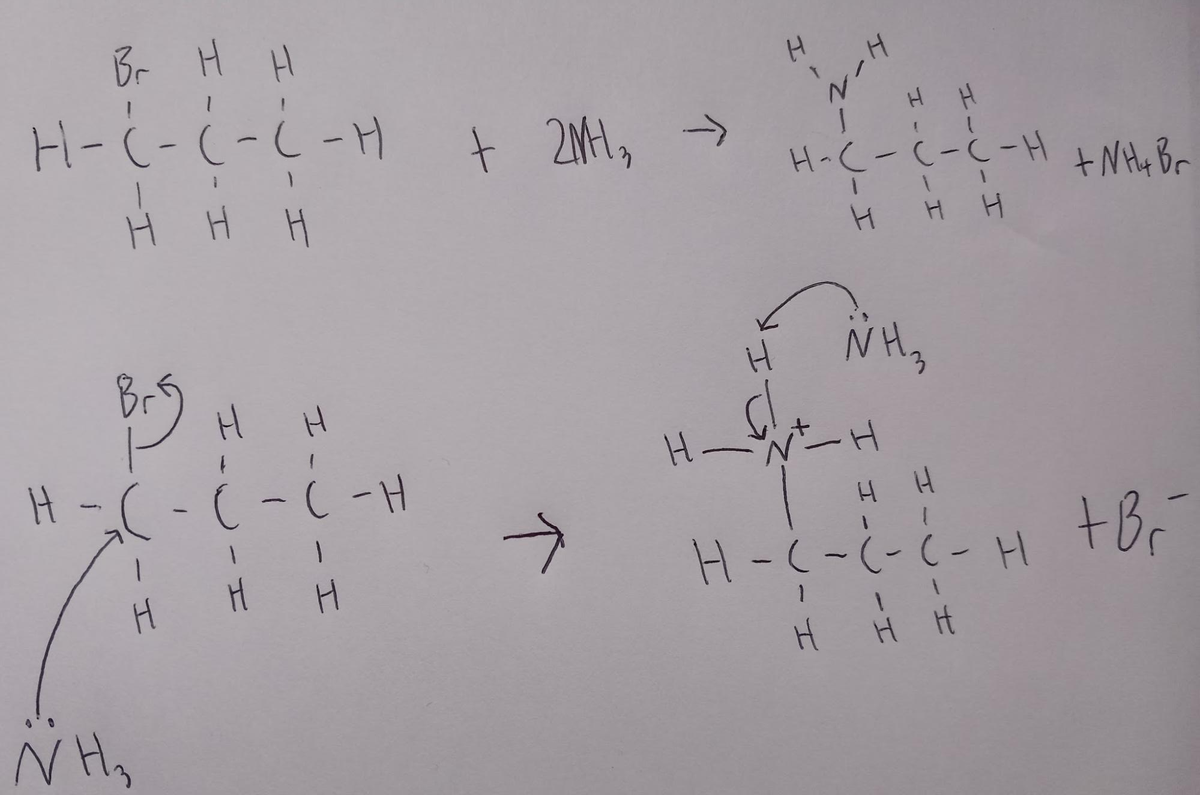
Important things to remember:
-2 molecules of NH₃ are needed
-The NH₃ has no charge
-The intermediary has a + charge on the nitrogen
-The curly arrow goes to the N in the second stage
Sources
2017 A-Level Paper 2 Q1.2 (2 marks)
Q:
MS:
January 2012 A-Level Unit 4 Q10(b) (6 marks)
Q:
MS:
January 2013 As Unit 2 Q8(b) (5 marks)
Q:
MS:
Explanation of, mechanism, conditions and useful facts for elimination reactions with hydroxide ions:
Occurs when a halogenoalkane reacts with hydroxide ions to form an alkene. The hydroxide acts as a base (not nucleophile) as it accepts an H⁺ from the halogenoalkane.
The conditions are hot and ethanolic.
An alkene, sodium (if this was in the reactants) halide and water is formed.
Mechanism:
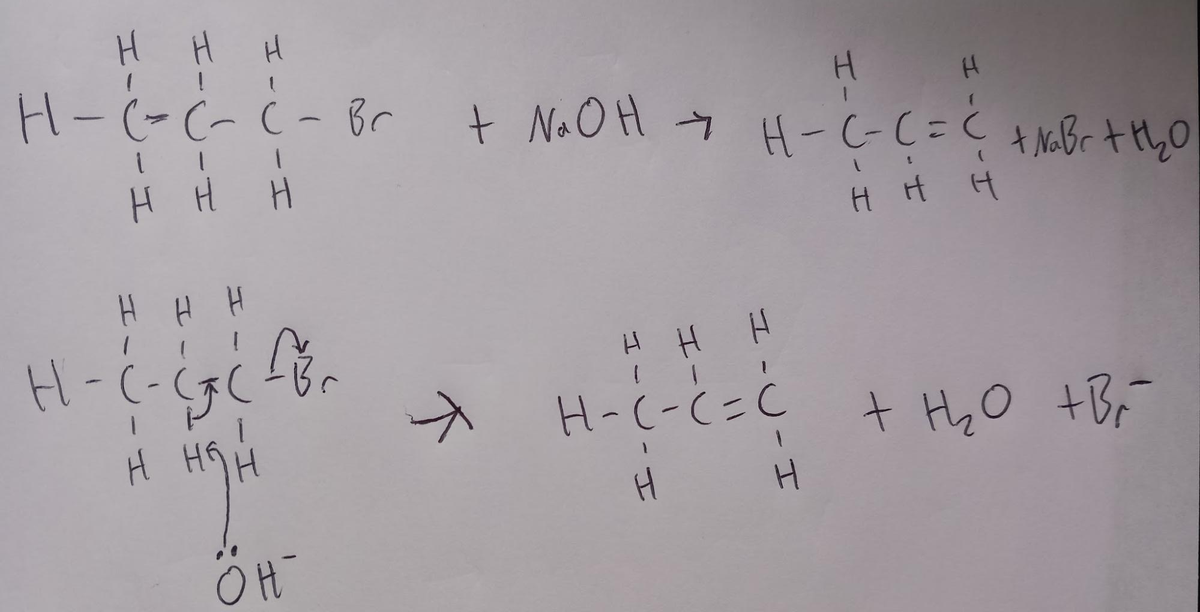
Important things to remember:
-Water is formed
-The H that the OH⁻ attacks is the same H that donates its electron to the C=C bond.
-The carbon that loses the H is adjacent to the carbon that loses the Br
Sources
2018 As Paper 2 Q6.4 (6 marks)
Q:
MS:
2022 As Paper 2 Q22 (1 marks)
Q:
MS:
2011 As Unit 2 Q8(c)(i) (3 marks)
Q:
MS:
Explanation of, mechanism, conditions and useful facts for dehydration of alcohols reactions:
This is an elimination reaction where a water molecule is eliminated from an alcohol, forming an alkene and water. Remember that the name of the mechanism is ‘elimination’, not dehydration.
The conditions are heat (170 degrees C) and concentrated phosphoric or sulfuric acid. The acid is needed as it provides the H⁺ needed in the first step of the mechanisms. It is a catalyst as it remains unchanged at the end of the mechanism.
This reaction cannot occur with tertiary alcohols as the adjacent carbon doesn’t have a hydrogen that can be lost to allow the C=C bond to form.
Mechanism:
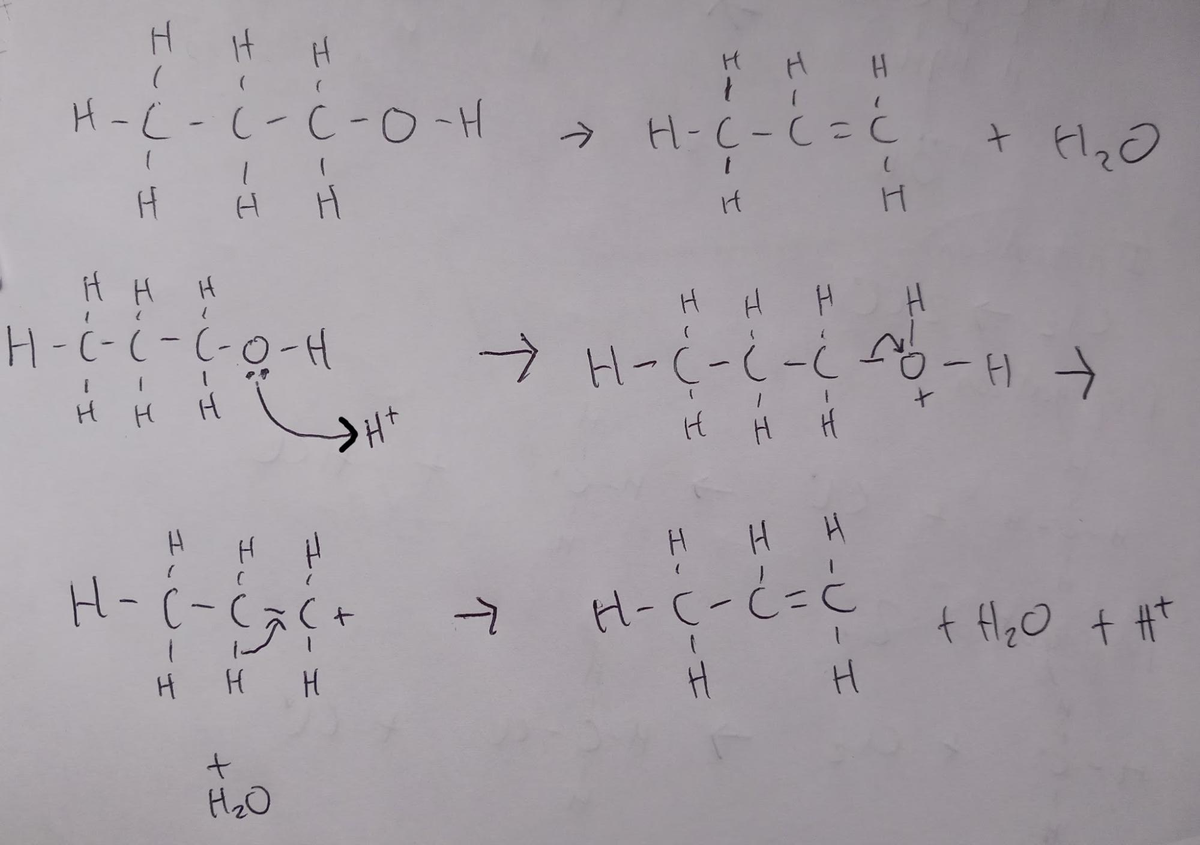
Important things to remember:
-There are two separate cations that form, although you can get away with combining steps 2 and 3 most of the time.
Sources
Specimen A-Level Paper 2 Q4.3 (1 marks)
Q:
MS:
2023 A-Level Paper 3 Q2.5 (3 marks)
Q:
MS:
2024 A-Level Paper 3 Q1.4 (1 marks)
Q:
MS:
Specimen A-Level Paper 2 Q4.8 (1 marks)
Q:
MS:
Explanation of, mechanism, conditions and useful facts for all electrophilic addition reactions:
They occur when an H₂ molecule, a Hydrogen-Halide molecule (usually HBr), a Halide molecule (usually Br₂), or Sulfuric acid react with an alkene. The reactants act as electrophiles, as they accept a pair of electrons from the alkene. The reaction occurs because the electron-rich double bond in the alkene polarises the molecule, creating a delta positive dipole that is attracted to the double bond to form a carbocation, which then attracts the negative ion that has been left over.
Remember that there will be major and minor products for alkenes with a chain length of 3 or greater. The major product will be formed from the secondary (or tertiary) carbocation as it is more stable than the primary (or secondary) carbocation as it contains more electro inductive ‘R’ groups surrounding the carbon with the + charge. Always draw the major product if it doesn’t state which one to draw.
The Hydrogen-Halide (and sulfuric acid) reactions often form optical isomers, as they often produce a molecule with a chiral carbon. Additionally, the mixtures formed are also often racemic as the carbocation is planar, meaning it is equally likely to be attacked from either side by the Halide nucleophile.
The name of reaction, conditions, and products vary depending on the reactant:
| Reactant | Conditions | Products | Reaction Name/ Information |
|---|---|---|---|
| H₂ | Nickel Catalyst | Alkanes | Hydrogenation/ Reduction |
| HBr | N/A | Bromo alkanes | N/A |
| Br₂ | Dissolved in an organic solvent | Dibromoalkanes. | This is the test used to test for alkenes. Dibromoalkanes form a colourless solution, hence why alkenes + bromine water causes a colour change from orange to colourless. |
| Sulfuric Acid | Cold, concentrated sulfuric acid | Alkyl hydrogen sulfates. These can react with boiling water to form alcohols and sulfuric acid. | N/A |
Mechanism for electrophilic addition: (It is basically the same for all reactants, just remember the least electronegative atom joins the alkene first, e.g. hydrogen in HBr)
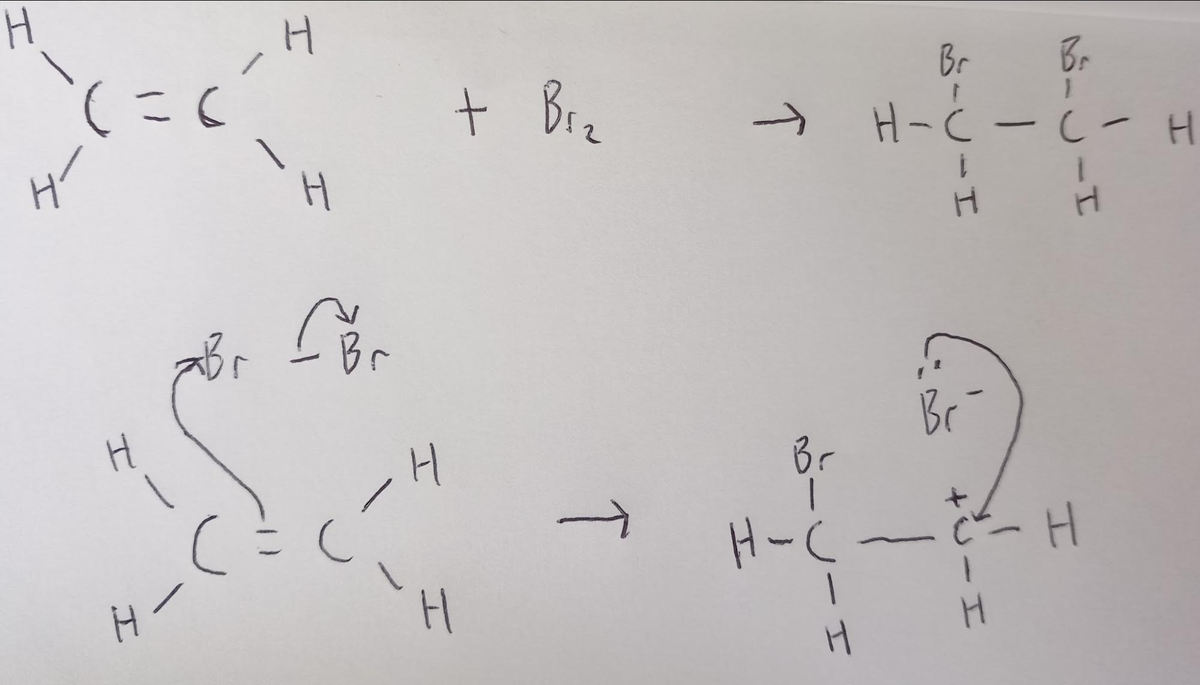
Important things to remember:
-The lone pair and negative charge on the ion
-The positive charge on the carbon
-The fact the curly arrow goes from the lone pair to the carbon (not plus charge) in the second step
Sources
2021 As Paper 2 Q2.2 (3 marks)
Q:
MS:
2012 As Unit 2 Q8(b) (4 marks)
Q:
MS:
2022 A-Level Paper 2 Q3.2 (3 marks)
Q:
MS:
2023 As Paper 2 Q4.2 (4 marks)
Q:
MS:
2017 A-Level Paper 3 Q2.4 (2 marks)
Q:
MS:
2024 As Paper 2 Q4.3 (3 marks)
Q:
MS:
2022 As Paper 2 Q7.7 (2 marks)
Q:
MS:
2016 As Unit 2 Q9(a) (7 marks)
Q:
MS:
2014 As Unit 2 Q7(e)(ii) (2 marks)
Q:
MS:
2018 A-Level Paper 3 Q3.2 (2 marks)
Q:
MS:
2016 As Paper 2 Q3.7 (2 marks)
Q:
MS:
2015 As Unit 2 Q2(b) (3 marks)
Q:
MS:
January 2013 As Unit 2 Q8(a) (5 marks)
Q:
MS:
2010 As Unit 2 Q6(a)(ii) (1 marks)
Q:
MS:
Introduction to Organic Chemistry, Nomenclature and Isomerism
9Explanation of fractional distillation: (6 points)
- Crude oil is heated and vaporised.
- Fractions have different boiling points.
- Boiling point depends on size, where shorter hydrocarbons have lower boiling points.
- There is a temperature gradient where it is hotter at the bottom.
- Higher boiling point fractions condense nearer the bottom.
- As a higher boiling point means they liquify more quickly from gas.
Sources
Not from a mark scheme, but useful content to know.
Fraction definition:
A mixture of compounds with similar boiling points and chain length.
Sources
2021 A-Level Paper 2 Q2.1 (1 marks)
Q:
MS:
2023 As Paper 2 Q2.1 (1 marks)
Q:
MS:
Explanation for why a compound shows geometric isomerism: (2 points)
- The carbons cannot rotate about the C=C.
- Each carbon in the C=C has two different groups attached to it.
Sources
2025 A-Level Paper 2 Q2.1 (3 marks)
Q:
MS:
2018 A-Level Paper 2 Q3.6 (2 marks)
Q:
MS:
Format for explaining why something is a Z isomer using the Cahn-Ingold-Prelog: (3 points)
- For the right-hand C in the C=C bond, atom X has a higher atomic number than atom Y, meaning group X takes priority.Note: make sure you refer to ‘atomic number’.
- For the left-hand C in the C=C bond, atom A has a higher atomic number than atom B, meaning group A takes priority.Note: if the two atoms bonded to one of the Cs in the C=C bond, consider the atoms one bond further away.
- The highest priority groups, X and A, are on the same side of the C=C bond so it is a Z isomer.
Sources
Specimen As Paper 2 Q1.3 (6 marks)
Q:
MS:
How should you represent E/Z isomers skeletally?
Represent Z isomers like this:
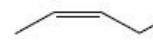
Represent E isomers like this:

Note: the key part is that you do not include any hydrogens. Never include hydrogens in skeletal formulas.
Sources
From the mark scheme I've screenshotted (can't find it now).
What notation should you use for writing bonds in an answer?
Always refer to them as ‘Carbon-chlorine bonds’ or ‘C-Cl’, not ‘carbon chlorine bonds’.
Sources
2021 A-Level Paper 2 Q9.2 (1 marks)
Q:
MS:
4 characteristics of compounds in the same homologous series:
- They have the same general formula, where successive members differ by CH₂.
- They have the same functional group.
- They are chemically similar, so react in (pretty much) the same way.
- They exhibit a trend in physical properties e.g. increasing boiling point going down the series.
Sources
Legacy Unit 1, January 2011 Q6(a) (2 marks)
Q:
MS:
Definition of stereoisomers: (2 points)
- Compounds with the same molecular and structural formula.
- But a different spatial arrangement of atoms.
Sources
2022 A-Level Paper 3 Q03.2 (2 marks)
Q:
MS:
Definition of structural isomers: (2 points)
- Compounds with the same molecular formula.
- But different structural formulae.
Sources
Legacy Unit 1, June 2013 Q2(a)(i) (2 marks)
Q:
MS:
Alkanes
9Explain how oxides of nitrogen form in engines: (2 points)
- They form when oxygen and nitrogen from the air.
- React at high temperatures.
Sources
2020 A-Level Paper 3 Q1.1 (2 marks)
Q:
MS:
2018 As Paper 2 Q4.4 (2 marks)
Q:
MS:
2014 As Unit 1 Q5(c)(i) (2 marks)
Q:
MS:
Two negative effects of releasing SO₂ into the atmosphere:
- Acid rain.Note: this damages buildings and ecology.
- It causes respiratory problems.
Sources
2017 As Paper 1 Q6.2 (2 marks)
Q:
MS:
2 environmental issues caused by NO:
- Acid rain.
- Respiratory issuesNote: same as SO₂.
Sources
2023 As Paper 2 Q2.6 (2 marks)
Q:
MS:
2020 A-Level Paper 3 Q1.2 (1 marks)
Q:
MS:
3 reasons free radical substitution usually produces a low yield of the desired product:
- Usually further substitution of the desired product occurs.
- Substitution can occur in different positions to the position required for the desired product.
- Radicals can combine to form long chain products.
Sources
2025 A-Level Paper 2 Q1.3 (2 marks)
Q:
MS:
Why does UV light cause free radical substitution?
It provides the energy to break the Cl-Cl bond and produce the chlorine free radicals.
Sources
2020 As Paper 2 Q1.3 (3 marks)
Q:
MS:
January 2012 A-Level Unit 5 Q5(c) (1 marks)
Q:
MS:
Why can calcium oxide be used to prevent SO₂ from entering the atmosphere?
CaO is basic and SO₂ is acidic, so they react together in a neutralisation reaction to form a salt.Note: this is flue gas desulphurisation.
Sources
Legacy Unit 1, June 2011 Q6(b) (3 marks)
Q:
MS:
Why is cracking used in industry?
To make products which are in greater demand.Note: both shorter chain alkanes and alkenes are in greater demand than long chain alkanes.
Sources
Legacy Unit 1, June 2011 Q7(c) (3 marks)
Q:
MS:
Why are high temperatures needed for cracking?
A lot of energy is needed to break the C-C and C-H bonds.
Sources
Legacy Unit 1, June 2011 Q7(c) (3 marks)
Q:
MS:
4 differences between catalytic and thermal cracking:
- Thermal occurs at a higher temperature.
- Thermal occurs at a higher pressure.
- Catalytic uses a zeolite catalyst.
- Thermal produces a high percentage of alkenes, whereas catalytic produces a high percentage of motor fuels and aromatics (alongside the shorter chain alkanes)
Sources
January 2012 As Unit 1 Q3(c)(ii) (2 marks)
Q:
MS:
Halogenoalkanes
8What 2 factors influence the reactivity of halogenoalkanes and which is more important?
- Bond enthalpy. This is the most important factor and decreases going down group 7, where a C-I bond requires less energy to break than a C-Cl bond, meaning iodoalkanes are more reactive than chloroalkanes.
- Bond polarity. This also plays a role as it means the carbon has a greater positive charge, meaning the lone pair on the nucleophile is more attracted to it, but it is less influential than bond enthalpy so is trumped.
Sources
June 2010 As Unit 2 Q2(b) (1 marks)
Q:
MS:
2015 As Unit 2 Q5(b)(ii) (1 marks)
Q:
MS:
2 reasons the nucleophilic substitution of bromoethane with cyanide ions must be conducted in an organic solvent, not water:
- Ethanol would form in water as the hydroxide ions would act as a nucleophile.
- Bromoethane is insoluble in water.
Sources
2024 As Paper 2 Q7.5 (1 marks)
Q:
MS:
Why is excess ammonia needed in nucleophilic substitution reactions?
The first ammonia acts as a nucleophile and the second acts as a base.
Sources
Not from a mark scheme, but useful content to know.
How can halogenoalkanes contribute to global warming? (2 points)
- The molecules have polar bonds, which absorb infrared radiation and then vibrate.Note: always name the polar bond, e.g. C-Cl.
- This means the infrared radiation emitted by the Earth does not escape from the atmosphere, as the energy is transferred to other molecules in the atmosphere by collisions.Note: this explanation also applies to greenhouse gases like CO₂.Note 2: not all mark schemes mention the second point, but always include it.
Sources
2021 As Paper 2 Q4.6 (2 marks)
Q:
MS:
2019 A-Level Paper 2 Q11.6 (2 marks)
Q:
MS:
If you’re asked why a substance doesn’t cause ozone depletion, what should you say?
You should say it’s because the substance doesn’t contain a chlorine atom, more specifically a C-Cl bond.
Sources
2016 As Paper 2 Q5.3 (1 marks)
Q:
MS:
2022 A-Level Paper 2 Q2.5 (2 marks)
Q:
MS:
January 2011 As Unit 2 Q1(d) (1 marks)
Q:
MS:
4 reasons why CFC use was not restricted until years after the first research on its potential harm to the ozone layer was published:
- There was a lack of evidence that ozone was being depleted.
- There was a lack of alternatives to CFCs.
- There was a commercial interest to continue use CFCs.
- It was hard to obtain international agreement on a ban.
Sources
2021 As Paper 2 Q04.5 (1 marks)
Q:
MS:
Nucleophile definition:
An electron pair donor.
Sources
Legacy Unit 4, January 2013 Q8(b) (3 marks)
Q:
MS:
Explain why a halogenoalkane is attacked by a nucleophile: (3 points)
- The halogen is more electronegative than the carbon it is bonded to, forming a polar bond.
- This makes the carbon partially positive, causing it to attract the lone pair on the nucleophile.
- The nucleophile then donates the lone pair to the partially positive carbon.
Sources
2018 A-Level Paper 2 Q02.2 (3 marks)
Q:
MS:
Alkenes
3Explain why there is an attraction between a C=C double bond and Br₂: (3 points)
- The C=C double bond is an area of high electron density.
- This polarises the Br₂.
- The delta positive Br is attracted to the double bond.
Sources
2021 As Paper 2 Q2.2 (3 marks)
Q:
MS:
Explanation of why something is the major product of an electrophilic addition reaction: (3 points)
- It is formed from a secondary/ tertiary carbocation.
- This is more stable than the primary/ secondary carbocation.Note: sometimes it will be tertiary vs. secondary, usually it will be secondary vs. primary.
- Due to the greater inductive effect from more C groups surrounding the C⁺.
Sources
2017 A-Level Paper 3 Q2.4 (2 marks)
Q:
MS:
2016 As Unit 2 Q9(a) (7 marks)
Q:
MS:
An alkyl hydrogen sulfate is formed from the electrophilic addition reaction between an alkene and sulfuric acid. What reaction can occur with this product and what are the conditions?
Alkyl Hydrogen Sulfate + Water -> Alcohol + Sulfuric acid. The condition is that the water must be boiling.
Sources
Not from a mark scheme, but useful content to know.
Alcohols
104 conditions for the hydration of ethene for the production of ethanol:
- Excess ethene.
- 60 atm (6000kPa) pressure.
- 300 degrees C.
- Concentrated phosphoric acid catalyst.
Sources
January 2012 As Unit 2 Q9(c) (4 marks)
Q:
MS:
3 reasons the nucleophilic substitution of haloalkanes isn’t used to produce ethanol in industry:
- The yield is very low.
- The rate of reaction is very slow.
- The haloalkane is expensive.
Sources
January 2012 As Unit 2 Q9(b) (6 marks)
Q:
MS:
How is ethanol separated from the batch after fermentation?
Fractional Distillation.
Sources
2025 A-Level Paper 3 Q24 (1 marks)
Q:
MS:
Biofuel definition:
A fuel derived from living matter.
Sources
Not from a mark scheme, but useful content to know.
Definition of carbon neutral: (2 points)
- No net emissions of CO₂.
- To the atmosphere.Note: you have to talk about emissions and CO₂ (not carbon) and the atmosphere.
Sources
2023 As Paper 2 Q2.7 (1 marks)
Q:
MS:
2014 As Unit 2 Q9(a) (5 marks)
Q:
MS:
January 2011 As Unit 2 Q6(b)(i) (1 marks)
Q:
MS:
Why is ethanol production via fermentation not actually carbon neutral?
Because CO₂ is released when fossil fuels are burned during the harvesting, transportation and manufacturing of the plants used for fermentation.Note: make sure you name one of the three processes fossil fuels are burned for.
Sources
2022 As Paper 2 Q7.2 (1 marks)
Q:
MS:
January 2012 As Unit 2 Q9(a) (5 marks)
Q:
MS:
January 2013 As Unit 2 Q5(d)(iii) (1 marks)
Q:
MS:
1 advantage and 1 disadvantage of fermenting at 35 °C rather than 25 °C:
Advantage: it produces ethanol at a faster rate.
Disadvantage: more energy is used in the process.
Sources
Specimen As Paper 2 Q04.3 (2 marks)
Q:
MS:
Explanation for why the dehydration of butan-2-ol forms 3 isomers: (4 points)
- When the H⁺ is lost from the C adjacent to the C⁺ to which the -OH was originally attached,Note: remember to always describe the part of the mechanism that results in the isomers in detail.
- It can either be lost from 1C to form but-1-ene.
- Or 3C to form but-2-ene.
- But-2-ene then forms a mixture of E-Z isomers.Note: I'd also add ‘because the C=C bond cannot be rotated’.
Sources
Not from a mark scheme I can currently find, but useful content to know.
Half-equation for the oxidation of ethanol to ethanoic acid:
CH₃CH₂OH + H₂O -> CH₃COOH + 4H⁺ + 4e⁻Note: remember that you can’t use the [O] in half equations, meaning you have to use water on the LHS to provide the extra oxygen for ethanoic acid. From there you can balance using H⁺ and e⁻. Don’t let this confuse about the overall equation for ethanol to ethanoic acid, which is CH₂CH₂OH + 2[O] -> CH₃COOH + H₂O.
Sources
Specimen A-Level Paper 3 Q1.2 (1 marks)
Q:
MS:
January 2013 As Unit 2 Q5(c)(iii) (1 marks)
Q:
MS:
3 advantages and 5 disadvantages of fermentation compared with the hydration of ethene:
Advantages:
1. A lower temperature and pressure can be used, meaning less energy use.
2. The fuel used (plants) is renewable.
3. The equipment costs are lower
Disadvantages:
1. The reaction is slower.
2. The atom economy is lower.
3. The product is impure, meaning it needs to be separated by distillation.
4. It uses a labour intensive batch process that is difficult to automate.
5. A large amount of land is used to grow the sugar crops, meaning it can’t be used to grow food.
Sources
Legacy Unit 2, June 2016 Q9(b) (6 marks)
Q:
MS:
Specimen As Paper 2 Q04.3 (2 marks)
Q:
MS:
Organic Analysis (RP 5 + RP 6)
25Note: Questions on ‘Heating Under Reflux’ are included in this section, despite this being Year 2 content only.
6 things to remember to label when you’re asked to draw the set up for immediate distillation:
- The thermometer in a bung.
- Conical flask/ test tube in a beaker of ice for the collection of the liquid.
- Pear shaped flask connected to the glassware with a clamp.
- Water cooled condenserNote: make sure you mention where the water goes in and out.
- Heat with arrow pointed up at the bottom of the pear shaped flask.
- Antibumping granules and labelled reactants in the pear shaped flask.
Sources
2019 As Paper 2 Q8.2 (3 marks)
Q:
MS:
4 things to include in a reflux diagram:
- A label of the reactants that are involved.
- Heat source.Note: you probably don’t need to actually draw it, just label ‘heat’.
- Flask with a vertical water condenser.Note: label water in and water out.
- No gaps in the apparatus, apart from the top where it must be open.
Sources
2025 A-Level Paper 3 Q5.2 (3 marks)
Q:
MS:
2016 As Paper 2 Q6.3 (2 marks)
Q:
MS:
4 common errors in the reflux practical drawing:
- Sealing the system, e.g. by adding a bung.Note: the top should be open.
- Adding a thermometer when it isn’t needed.
- Not adding antibumping granules.
- Entering water from the top of the condenser when.Note: it should enter from the bottom.
Sources
2025 A-Level Paper 3 Q5.2 (3 marks)
Q:
MS:
What is the purpose of the thermometer in the immediate distillation set up?
To allow the reaction to stay in the suitable temperature range, so unwanted products aren’t produced/ certain reactants don’t evaporate.
Sources
Not from a mark scheme, but useful content to know.
Why should you use a water bath and not a bunsen burner in experiments with alcohol?
Alcohols are flammable, so using a water bath reduces fire risk.
Sources
2021 A-Level Paper 2 Q1.4 (3 marks)
Q:
MS:
Why is fractional distillation preferable over simple distillation for separating organic compounds?
It is better when compounds have similar boiling points, which organic compounds are likely to have.
Sources
2023 A-Level Paper 2 Q6.4 (3 marks)
Q:
MS:
What step must you remember when telling apart a primary, secondary and tertiary alcohol in 3 unknown samples?
You must remember to distill the product (either a ketone or aldehyde) after adding the acidified potassium dichromate before adding Tollens’ reagent as you must have a pure sample of the ketone/ aldehyde to test it.
Sources
Not from a mark scheme, but useful content to know.
How could you use chemical tests to confirm a sample contains ethanal and not ethanoic acid? (5 points)
To test for the presence of ethanal:
- Add Tollen’s reagent.
- Warm (often forgotten - was its own mark in this case).
- Silver mirror is formed.
To confirm the absence of ethanoic acid:
- Add sodium carbonate.
- No effervescence observed, so no acid present.
Sources
Specimen A-Level Paper 3 Q1.5 (5 marks)
Q:
MS:
Mark scheme explanation of how a reaction (in this case the oxidation of ethanol into ethanoic acid) is refluxed and why it is necessary (3 points):
- A mixture of liquids is heated to boiling point for a prolonged time.Note: I’d say mentioning it is a ‘mixture’, the fact they reach ‘boiling point’ and it occurs for a ‘prolonged time’ is important.
- Vapour is formed which escapes from the liquid mixture, is changed back into liquid and returned to the liquid mixture.Note: I would also mention that it is the cooling from the water in the vertical condenser that does this.
- Any ethanal and ethanol that initially evaporates (as the boiling point is below the activation energy) can then be oxidised.
Sources
Specimen A-Level Paper 3 Q1.1 (3 marks)
Q:
MS:
How should you describe the start of the process of immediate distillation?
Describe turning on the water first, then heating the flask/ water bath with the bunsen burner.
Sources
Not from a mark scheme, but useful content to know.
How should you label a condenser in an immediate distillation diagram?
You must clearly label the condenser as a ‘condenser’ and label ‘water in’ and ‘water out’.Note: don’t just say one of them, say both.
Sources
2025 A-Level Paper 3 Q5.2 (3 marks)
Q:
MS:
What is the purpose of anti-bumping granules? (2 points)
- They provide a surface area for small bubbles to form on.
- This prevents vigorous boiling (bumping) from occurring, which can cause liquid to spill over or blow the equipment apart.Note: if they aren’t labelled as ‘anti-bumping granules’ you can say they ‘prevent bumping’.
Sources
2016 As Paper 2 Q6.4 (1 marks)
Q:
MS:
2025 A-Level Paper 3 Q5.3 (1 marks)
Q:
MS:
2025 As Paper 2 Q6.5 (1 marks)
Q:
MS:
2017 A-Level Paper 3 Q3.1 (1 marks)
Q:
MS:
2021 A-Level Paper 3 Q6.4 (1 marks)
Q:
MS:
2012 As Unit 3 EMPA Q13(a) (1 marks)
Q:
MS:
What happens to the water present in the liquid in the pear shaped flask during immediate distillation?
It will be vapourise alongside the organic liquid, but separate in the fractionating column as the water will condense back into the flask.
Sources
Not from a mark scheme, but useful content to know.
How to reduce loss of the product of distillation if the product has a fairly low boiling point:
You should cool the collecting vessel to reduce the evaporation of the product.
In a diagram, this could be indicated by putting the conical flask in an ice-water bath.
Sources
2018 A-Level Paper 2 Q3.2 (2 marks)
Q:
MS:
One important safety step for refluxing and why it should be taken:
Conduct the experiment in a fume cupboard to avoid breathing in toxic fumes.
Sources
2025 A-Level Paper 3 Q5.2 (3 marks)
Q:
MS:
Identify the 5 mistakes (2 safety, 3 practical) with the set-up below: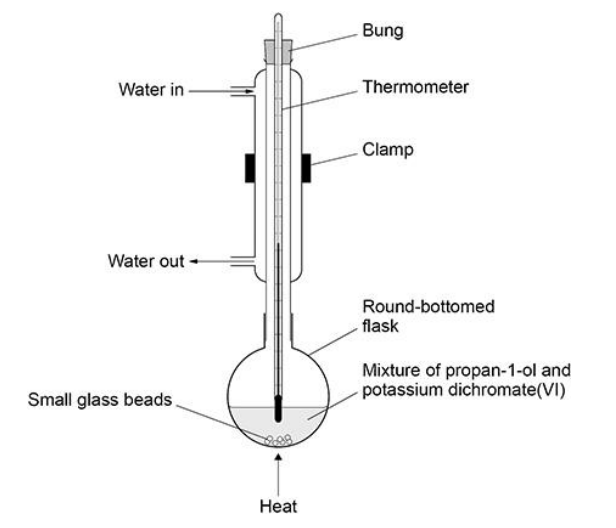
Safety:
1. Flask isn’t clamped.
2. System is sealed due to the bung
Practical:
1. Water is flowing the wrong way through the condenser.
2. The thermometer isn’t needed.Note: not just that it’s in the liquid - remember reflux doesn’t need a thermometer in the first place.
3. Sulfuric acid (or any other acid) should be added to the mixture.
Sources
2021 A-Level Paper 3 Q6.1 (2 marks)
Q:
MS:
2021 A-Level Paper 3 Q6.3 (2 marks)
Q:
MS:
Why can precise Mr values to 5 d.p. be used to distinguish between C₄H₈O and C₅H₁₂?
They have different numbers of atoms of different elements, meaning their precise Mr values are different despite having the same Mr to 1 d.p.
Note: If two compounds have the same molecular formula, you cannot distinguish between them using precise values as they 'contain the same number of atoms of each element.’
Sources
Legacy Unit 2, January 2012 Q6(a) (2 marks)
Q:
MS:
3 tests for identifying carboxylic acids:
- Add sodium carbonate/ sodium hydrogen carbonate. If a carboxylic acid is present, the solution will fizz and the gas (carbon dioxide) will turn limewater cloudy when bubble through it.Note: make sure you say the full reagent, not just 'carbonate ions'.
- Add magnesium. If a carboxylic acid is present, the solution will fizz and the gas (hydrogen) will cause a pop to be heard when exposed to a lit splint.
- Warm with ethanol and a few drops of concentrated sulphuric acid. If a carboxylic acid is present, a sweet smell (from an ester) will be produced.Note: this is the most obscure of the methods - I wouldn’t use unless necessary.
Sources
2018 A-Level Paper 2 Q3.3 (2 marks)
Q:
MS:
2 tests for differentiating between aldehydes and ketones:
- Warm with Tollens reagent (ammonia + silver nitrate). Aldehydes will form a silver mirror, but solutions containing ketones will remain colourless.
- Warm with Fehling's solution. Aldehydes will form a brick-red precipitate, but solutions containing ketones will remain blue.Note: make sure you reference the ‘warm’ part.
Sources
2019 As Paper 2 Q1.2 (3 marks)
Q:
MS:
June 2013 As Unit 2 Q2(d) (3 marks)
Q:
MS:
January 2010 As Unit 2 Q6(b) (3 marks)
Q:
MS:
Test for alkenes:
Shake with bromine water. The orange solution will turn colourless if a C=C bond was present.
Sources
2018 A-Level Paper 3 Q3.2 (2 marks)
Q:
MS:
2015 As Unit 2 Q2(b) (3 marks)
Q:
MS:
Test for identifying the different halogenoalkanes:
Warm with aqueous silver nitrate and ethanol so a silver halide can form.Note: the 'ethanol' isn’t usually required on mark schemes.
If it was a chloroalkane, a white ppt will form; cream ppt for bromoalkanes; yellow ppt for iodoalkanes.
Sources
2022 A-Level Paper 3 Q3.7 (2 marks)
Q:
MS:
Test for differentiating between primary/ secondary alcohols and tertiary alcohols:
Warm with acidified potassium dichromate.
Primary and secondary alcohols will turn the solution from orange to green, caused by a change in oxidation state of the Cr ions from +6 to +3.
The solution will remain orange for tertiary alcohols (and non-alcohols)
Sources
2019 As Paper 2 Q1.2 (3 marks)
Q:
MS:
What 2 things should you always mention when talking about using potassium dichromate?
- The fact it oxidises the alcohol.
- The fact it is acidifiedNote: the acid is needed to provide H⁺ ions for the reduction of the dichromate ions.
Sources
2020 As Paper 2 Q7.2 (2 marks)
Q:
MS:
2013 As Unit 3 EMPA Q13(a) (3 marks)
Q:
MS:
What acid should you not use to acidify potassium dichromate?
You shouldn’t use nitric acid.Note: this is because nitric acid over oxidises the alcohol, apparently.
Sources
Not from a mark scheme, but useful content to know.
If you change the structure of a molecule in any way, what’s a guaranteed thing that will happen to its infrared spectrum?
Its fingerprint region will change.Note: when asked to predict changes to an infrared spectrum, ‘fingerprint region will change’ should always be a safe mark (unless it asks for specific stuff of course).
Sources
2021 A-Level Paper 2 Q7.2 (3 marks)
Q:
MS: