Physical (Year 2)
Thermodynamics
31Bond dissociation enthalpy definition:
Enthalpy change when one mole of covalent bonds is broken in the gaseous state.
Sources
Not from a mark scheme, but useful content to know.
Enthalpy of atomisation definition:
Enthalpy change when one mole of gaseous atoms is produced from an element in its standard state.
Sources
January 2011 A-Level Unit 5 Q1(a) (4 marks)
Q:
MS:
Enthalpy of fusion definition:
Enthalpy change when one mole of a solid is turned into a liquid.
Sources
Not from a mark scheme, but useful content to know.
Enthalpy of vaporisation definition:
Enthalpy change when one mole of a liquid is turned into a gas.
Sources
Not from a mark scheme, but useful content to know.
Standard enthalpy of combustion definition:
Enthalpy change when 1 mole of a substance is completely burned in oxygen with all reactants and products in standard states under standard conditions.Note: this definition is worth 2-3 marks.
Sources
2021 As Paper 1 Q7.1 (2 marks)
Q:
MS:
2015 As Unit 2 Q7(d) (3 marks)
Q:
MS:
June 2013 As Unit 2 Q10(c)(i) (3 marks)
Q:
MS:
Standard enthalpy of formation definition:
Enthalpy change when one mole of a substance is formed from its constituent elements with all reactants and products in standard states under standard conditions.Note: this definition is worth 2-3 marks.
Sources
2020 As Paper 2 Q1.1 (2 marks)
Q:
MS:
2024 As Paper 1 Q8.1 (2 marks)
Q:
MS:
June 2011 As Unit 2 Q2(d) (3 marks)
Q:
MS:
Standard enthalpy change of neutralisation definition:
Enthalpy change when 1 mole of water is formed in a reaction between an acid and alkali under standard conditions.
Sources
Not from a mark scheme, but useful content to know.
Lattice enthalpy of formation definition:
Enthalpy change when 1 mol of a solid ionic compound is formed from its gaseous ionsNote: this definition is worth 2 marks.
Sources
2017 A-Level Paper 1 Q1.1 (2 marks)
Q:
MS:
Lattice enthalpy of dissociation definition:
Enthalpy change when one mole of a solid ionic compound is broken up into its constituent gaseous ions.Note: this definition is worth 2 marks.
Sources
2022 A-Level Paper 3 Q1.1 (2 marks)
Q:
MS:
January 2012 A-Level Unit 5 Q1(a) (3 marks)
Q:
MS:
1st electron affinity definition:
Enthalpy change when one mole of gaseous atoms gain one mole of electrons to form one mole of gaseous 1− ions.
Sources
2015 A-Level Unit 5 Q1(a) (2 marks)
Q:
MS:
June 2012 A-Level Unit 5 Q3(a) (2 marks)
Q:
MS:
2nd electron affinity definition:
Enthalpy change when one mole of gaseous 1− gain one mole of electrons to form one mole of gaseous 2− ions.
Sources
Not from a mark scheme, but useful content to know.
Enthalpy of hydration definition:
Enthalpy change when one mole of gaseous ions becomes dissolved in water.
Sources
2011 A-Level Unit 5 Q1(a)(ii) (1 marks)
Q:
MS:
Enthalpy of solution definition:
Enthalpy change when one mole of an ionic solid dissolves in a large volume of water to form an infinitely dilute solution.
Sources
Not from a mark scheme, but useful content to know.
What is the key difference between 1st and 2nd electron affinity and what causes it?
1st electron affinity is exothermic (for many non-metals) as the electron being gained is attracted to the positive nucleus, whereas 2nd electron affinity is endothermic as the negative electron being gained is repelled by the negative ion.
Sources
2024 A-Level Paper 1 Q8.4 (1 marks)
Q:
MS:
2014 A-Level Unit 5 Q1(b) (2 marks)
Q:
MS:
What’s one value you have to be careful with on Born-Haber cycle questions?
Bond dissociation enthalpy. If you’re going from ½ O₂ -> O then you have to halve the value, as O₂ -> 2O is breaking 1 mole of covalent bonds.
Sources
Not from a mark scheme, but useful content to know.
Why is theoretical lattice enthalpy of formation less exothermic than experimental?
It underestimates bond strength as a result of not accounting for covalent character, which makes the bonds holding the lattice together stronger.Note: Theoretical uses the perfect ionic model, which is inaccurate to real life. The experimental value is the ‘true’ value.
Sources
2020 A-Level Paper 1 Q1.3 (1 marks)
Q:
MS:
2024 A-Level Paper 1 Q8.1 (1 marks)
Q:
MS:
2014 A-Level Unit 5 Q1(d)(i) (2 marks)
Q:
MS:
What causes certain ionic compounds to have lots of covalent character?
The cations being small and very positive, giving them a high charge density.
The anions being large and therefore easily polarised.
Sources
Not from a mark scheme, but useful content to know.
3 properties of compounds with high covalent character:
- Less soluble in water.
- Lower melting points.
- Less conductive of electricity.
Sources
Not from a mark scheme, but useful content to know.
Why does Mg²⁺ (g) have a more exothermic enthalpy of hydration than Ca²⁺ (g)? (2 points)
- Mg²⁺ is a smaller ion/ has a greater charge to size ratio.
- This means it forms a stronger attraction to the Oδ- in water OR the lone pair on the O in water.Note: I'd go with the ‘Oδ- in water’.
Sources
2021 A-Level Paper 1 Q1.6 (2 marks)
Q:
MS:
Explain why the value for the enthalpy of hydration for the chloride ion is more negative than that for the bromide ion: (4 points)
- Water is polar.Note: this is worth mentioning in any hydration/ solution question.
- Chloride ions are smaller than bromide ions.
- Chloride ions attract the δ+ on the H of water.
- This means the force of attraction between the chloride ions and the polar water is stronger.
Sources
2023 A-Level Paper 1 Q5.3 (2 marks)
Q:
MS:
June 2013 A-Level Unit 5 Q2(a) (3 marks)
Q:
MS:
Why is the enthalpy of hydration of anions (in this case chloride ions) exothermic? (2 points)
- Water is polar/ has δ+ on its H atoms.
- The negative chloride ion attracts the δ+ in water.Note: any time you have to explain why a process is exothermic, the mark scheme seems to be about two particles attracting each other (+ why they attract each other).
Sources
2014 A-Level Unit 5 Q2(c) (2 marks)
Q:
MS:
Why do data books not contain a value for the enthalpy of solution of sodium oxide?
It reacts with water to form a solution of NaOH.Note: if a compound will only react with water, you cannot measure its enthalpy of solution.
Sources
2024 A-Level Paper 1 Q8.7 (1 marks)
Q:
MS:
2nd law of thermodynamics:
Entropy will increase over time.
Sources
Not from a mark scheme, but useful content to know.
3rd law of thermodynamics:
The entropy of a substance is zero at absolute zero and increases with temperature. This is because the higher the temperature, the faster the particles move so the greater the entropy.
Sources
Not found on any mark schemes, but useful content to know.
Why is entropy 0 at a temperature of 0 Kelvin?
Because the particles are stationary.
Sources
June 2013 A-Level Unit 5 Q3(a)(i) (2 marks)
Q:
MS:
How does increasing the temperature of a reaction with an increase in entropy affect ΔG and why? (2 points)
- It will cause ΔG to decrease/ become more negative.
- This is because ΔS is positive so increasing the temperature will make -TΔS more negative.
Sources
2018 A-Level Paper 1 Q3.3 (2 marks)
Q:
MS:
How do you use ΔH and ΔS to predict whether a reaction is feasible?
Use the equation ΔG = ΔH − TΔS and if ΔG ≤ 0 the reaction is feasible.
ΔH is the enthalpy change in kJmol-1.
T is the temperature in Kelvin.
ΔS is the entropy change in kJ K-1 mol-1.Note: remember that this means you’ll probably have to convert from J K-1 mol-1 to kJ K-1 mol-1 by dividing by 1000.
Sources
Legacy Unit 5, January 2013 Q3(a) (2 marks)
Q:
MS:
Explain why the combustion of methanol (CH2OH (g) + 3/2 O₂ (g) -> CO₂ (g) + 2H₂O (g)) is feasible at all temperatures: (3 points)
- 2.5 moles of gas react to form 3 moles of gas, meaning entropy increases and ∆S is positive.
- Combustion is exothermic so ∆H is negative.
- Therefore ∆G is always negative.
Sources
Legacy Unit 5, June 2010 Q6(d) (4 marks)
Q:
MS:
Explain why the enthalpy of lattice dissociation for sodium oxide is greater than the enthalpy of lattice dissociation for sodium chloride. (2 points)
- Oxide ions have a higher charge density than chloride ions.
- This means there is a stronger attraction between oppositely charged ions in sodium oxide.
Sources
2024 A-Level Paper 1 Q08.5 (2 marks)
Q:
MS:
Explain why the evaporation of water is spontaneous even though it is endothermic: (2 points)
- The molecules become more disordered when water changes from a liquid to a gas.
- Therefore the entropy change is positive, meaning T∆S>∆H and ∆G<0 above a certain temperature.
Sources
Legacy Unit 5, January 2013 Q3(b) (4 marks)
Q:
MS:
Explain why the standard entropy value of a gas is greater than that of a solid (e.g. CO₂ vs C):
The gas is more disordered.Note: I included this just to show that the explanation is very simple.
Sources
2021 A-Level Paper 1 Q07.1 (1 marks)
Q:
MS:
Rate Equations
8Definition of the term ‘overall rate of reaction’:
The sum of the indices to which the concentrations are raised in the rate equation.Note: or just the ‘sum of the orders of the species involved’. Don’t say ‘reactants’ though as catalysts are also involved.
Sources
2020 A-Level Paper 2 Q1.6 (1 marks)
Q:
MS:
Why are initial rates of reaction used for rate equations?
This is the point where the concentrations are known.
Sources
2016 A-Level Unit 4 Q6(b) (1 marks)
Q:
MS:
How to explain why the rate-determining step is the rate-determining step: (2 points)
- Step M is the rate determining step as step M and the steps before it contain A moles of X and B moles Y.
- This is the same proportion as found in the rate equation. .
Sources
2024 A-Level Paper 2 Q1.4 (1 marks)
Q:
MS:
June 2011 A-Level Unit 4 Q6(b) (2 marks)
Q:
MS:
January 2011 A-Level Unit 4 Q1(b) (2 marks)
Q:
MS:
How does the rate constant depend on temperature?
The higher the temperature, the higher the rate constant (k).
The rate constant also rises exponentially with temperature.
Sources
Not from a mark scheme, but useful content to know.
Why does doubling the temperature of a reaction have a much greater impact on the rate when compared to doubling the concentration of an order 1 reactant? (3 points)
- The reaction will occur when energy of collision (E) > Ea.
- Doubling temperature causes many more molecules to have this energy.Note: the word ‘many’ was required.
- Whereas doubling concentration only causes double the amount of molecules to have this energy.
Sources
Specimen A-Level Paper 2 Q1.4 (3 marks)
Q:
MS:
What must you remember about the units for activation energy in the ‘ln k = ln A – Ea / RT’ equation?
They are J mol⁻¹ in the equation. Therefore, if the question asks for the Ea in kJ mol⁻¹, you have to convert.Note: you don’t necessarily have to memorise this - just pay attention to the units of the other quantities in the question (e.g. the gas constant).
Sources
2017 A-Level Paper 2 Q3.2 (4 marks)
Q:
MS:
If asked to ‘describe the relationship between X and Y’ and they have a square/ square root relationship, what should you say?
You should either write an equation showing their proportionality, e.g. X α Y² or X² α 1/Y (use proportional symbol instead of α obvs). OR you can just say ‘When X increases by a factor of 2, Y increases by a factor of 4.’Note: you could also just try and get across the idea that they have a square/ square root relationship another way - the key thing is that you acknowledge the square aspect of the relationship and don’t just say ‘inversely proportional’ or something.
Sources
Not from a mark scheme, but useful content to know.
What must you remember to do for the units of ‘k’ in a rate equation?
You must remember to add s⁻¹ after the ‘mol dm⁻³’ part, as it is the constant for 'rate'.
Sources
2025 A-Level Paper 3 Q2.3 (2 marks)
Q:
MS:
RP 7: Measuring Rate of Reaction
17Explanation of how to determine the order of a reactant purely through knowing its concentration at certain times in the reaction: (3 points)
1. Plot concentration against time then take tangents to calculate the rates at certain times.
2. Then plot a graph of log(rate) against log(concentration)
3. The gradient of this straight line tells you the order.
Alternatively:
2. After finding the rates at certain times, plot a graph of rates against concentration.
3. A linear line through the origin tells you it is order 1, a horizontal line tells you order 0, and an exponential line tells you order 2.
Sources
2020 A-Level Paper 3 Q4.4 (3 marks)
Q:
MS:
Explanation for why a linear graph of concentration against time shows the order of the reactant in question is 0: (2 points)
- The graph has a constant gradient as [A] changes.Note: ‘constant gradient’ is needed instead of just saying ‘linear’ and it is important you mention that this occurs as [A] changes.
- This means the rate of reaction doesn’t change as the concentration of the reactant changes.
Sources
2018 A-Level Paper 3 Q1.3 (2 marks)
Q:
MS:
2021 A-Level Paper 2 Q10.4 (2 marks)
Q:
MS:
2 reasons you would put a loose cotton wool plug on the reaction between calcium carbonate and HCl, instead of leaving the top open or using a bung?
- It prevents HCl splashing out.Note: this ensures moles of the reactants aren’t lost.
- It allows the CO₂ to escape.Note: this prevents potentially dangerous pressure build-up.
Sources
2024 A-Level Paper 3 Q2.1 (2 marks)
Q:
MS:
What are the two ways to continuously monitor rate of reaction if a gas is being produced?
- Measure volume of gas produced using a gas syringe.
- Measure the mass of the container using a balance.
Note: the syringe should also have a plunger, as shown below.
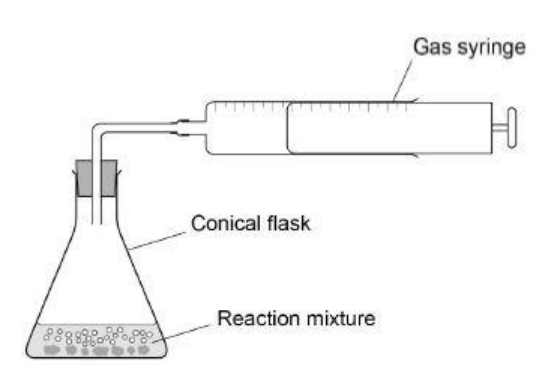
Sources
2024 A-Level Paper 3 Q2.6 (2 marks)
Q:
MS:
2014 As Unit 3 EMPA Q10(a) (2 marks)
Q:
MS:
When asked to draw the apparatus used to continuously monitor rate of reaction by measuring volume of gas produced, what 2 things must you do in your diagram?
- Your reaction vessel (conical flask) must be airtight around the bung.
- The gas must be collected in a syringe which is graduated with markings and has a plunger.
Sources
2020 A-Level Paper 2 Q1.3 (1 marks)
Q:
MS:
2013 A-Level Unit 6 ISA-Q Q9(a) (2 marks)
Q:
MS:
2 conditions that must be kept constant during a rate of reaction experiment:
Temperature and Pressure.
Sources
Not from a mark scheme, but useful content to know.
What is the purpose of adding water to make up for the volume of reactant removed? (2 points)
- It means the total volume remains the same.
- So the volume of the reactant is proportional to the concentration of the solution.
Sources
2025 A-Level Paper 3 Q2.1 (3 marks)
Q:
MS:
If a solid reactant is being used, and isn’t the independent variable, which two of its properties need to be kept constant?
- Its mass.
- Its surface area.
Sources
2014 As Unit 3 EMPA Q10(b) (1 marks)
Q:
MS:
2 things you must mention when describing how you could change an experiment, where you were initially just measuring rate of reaction with no independent variable, to test the effect of the addition of a catalyst:
Repeat the experiment with a catalyst while:
1. Keeping the same volume and concentration of the reactants.
2. Keeping the temperature the same.
Sources
2013 A-Level Unit 6 ISA-Q Q9(c) (2 marks)
Q:
MS:
What is the purpose of quenching a sample before conducting a titration to determine its concentration? (2 points)
- It stops the reaction, meaning the concentrations remain the same.
- This means the concentration of the species doesn’t change during the titration.
Sources
2025 A-Level Paper 3 Q4.2 (2 marks)
Q:
MS:
If samples of a reaction are removed at timed intervals to be analysed in some way (e.g. titrating them to determine [H⁺]), what must be done to them first?
They must first be quenched to stop the reaction.
This is done by extreme cooling or dilution.
Sources
2018 A-Level Paper 3 Q1.2 (2 marks)
Q:
MS:
In an experiment to determine the order with respect to HCl by measuring its concentration over time, why can the order with respect to NaOH be ignored in the reaction of HCl + NaOH -> NaCl + H₂O if 100 cm³ of 0.05 mol dm⁻³ HCl is added to 100 cm³ of 1 mol dm⁻³ NaOH? (3 points)
- Because the concentration of NaOH is so much higher than the concentration of HCl.
- This means the concentration of NaOH remains roughly constant/ any change in it is negligible.
- This means any changes in the concentration of NaOH has no effect on rate.Note: you could possibly say ‘the order with respect to [NaOH] is effectively 0’.
Sources
2021 A-Level Paper 2 Q10.2 (2 marks)
Q:
MS:
2018 A-Level Paper 3 Q1.1 (2 marks)
Q:
MS:
How can you determine the initial rate of reaction after collecting results from continuous monitoring? (2 points)
- Plot a graph of volume against time.Note: always mention what the two axes of the graph you are plotting are.
- Then determine the gradient at the beginning by drawing a tangent.
Sources
2013 A-Level Unit 6 ISA-Q Q9(b) (2 marks)
Q:
MS:
You’re given the times taken for a reaction to take place depending on the concentration of the reactant ‘A’. How do you use this data to draw a graph and find the order of A? (2 ways)
- You could plot the rate (1/time) against the concentrations of A then interpret the shape of the graph to find the order. Horizontal line = order 0. Positive linear line = order 1. Exponential graph = order 2.
- You could plot log (1/time) against log (concentrations of A) then calculate the gradient of the line. The gradient is the order.
Sources
2020 A-Level Paper 3 Q4.4 (3 marks)
Q:
MS:
2012 A-Level Unit 6 EMPA Q2(a) (4 marks)
Q:
MS:
2012 A-Level Unit 6 EMPA Q2(b) (2 marks)
Q:
MS:
How to determine the order of a reactant ‘A’, where ‘D’ turns the solution dark blue once all of ‘X’ has reacted with ‘D’ for the equation A + B -> C + D: (10 points)
- Measure known volumes of the reagents A and B into separate containers.
- Measure a known amount of X (using a measuring cylinder).
- Add A and X to a container, then add B last to begin the reaction.Note: you must mention adding one of the reactants - but not X - last to begin the reaction.
- Start a timer at the point of adding and mixing B.
- Record the time it takes for the solution to turn blue.
- Repeat the reaction with different concentrations of A.Note: describe adding different ratios of A and distilled water to achieve this.
- The same volumes (and concentrations) of B and X and the same temperature of reaction liquid - controlled using a water bath.
- Find the rate using the formula 1/ Time taken.
- Plot a graph of log(1 / time) against log (concentration of A).Note: mention what goes on which axis.
- Gradient of the log plot gives the order.
Sources
2018 A-Level Paper 3 Q1.8 (6 marks)
Q:
MS:
What does the graph of rate against concentration look like for an order 1 reactant?
It is a straight line through the origin.Note: mentioning ‘through the origin’ is key.
Sources
2022 A-Level Paper 3 Q4.5 (2 marks)
Q:
MS:
2024 A-Level Paper 3 Q2.5 (1 marks)
Q:
MS:
2020 A-Level Paper 3 Q4.4 (3 marks)
Q:
MS:
Why is a large excess of a solid reactant used when investigating the order of hydrochloric acid in the reaction? (2 points)
- Using a large excess means the surface area and mass of the solid reactant remains constant throughout the reaction.
- This means only the changing concentration of the hydrochloric acid affects rate.
Sources
2024 A-Level Paper 3 Q02.2 (1 marks)
Q:
MS:
Electrode Potentials + RP 8
35When asked to describe the set-up of a cell (to find the standard electrode potential for a species), what should you do?
Draw a diagram if possible. Make sure to label the electrodes and solutions (with concentrations), show and label that the salt bridge connects the solutions, and show and label the two electrodes being connected by a wire with a ‘high resistance’ voltmeter in it.Note: I’d also add that you should indicate what reactants make the solutions, e.g. FeCl₂ for a solution of Fe²⁺ ions.Note 2: I’d also include a temp of 298K and explain how to make the salt bridge.
Sources
January 2013 A-Level Unit 5 Q7(a) (5 marks)
Q:
MS:
4 conditions needed in the Standard Hydrogen Electrode:
- H₂ gas at 100kPa.
- HCl at 1 mol dm⁻³.
- Pt electrode.
- 298K.
Sources
2020 A-Level Paper 3 Q6.1 (3 marks)
Q:
MS:
What feature of the voltmeter in a cell allows it to measure cell EMF?
Its high resistance.Note: this is because it stops the reaction from occurring and keeps them still at equilibrium due to its very high resistance, which prevents electrons flowing through the external circuit. Therefore, to allow the cell reaction to go to completion (after you have finished measuring the EMF), you would remove the voltmeter as this allows electrons to flow through the circuit.
Sources
2025 A-Level Paper 3 Q3.2 (1 marks)
Q:
MS:
2019 A-Level Paper 3 Q3.5 (2 marks)
Q:
MS:
What is the purpose of the salt bridge? (2 points)
- It allows ions to flow between the solutions.
- To complete the circuit/ maintain charge balance.
Sources
Specimen A-Level Paper 1 Q3.1 (2 marks)
Q:
MS:
2023 A-Level Paper 1 Q2.1 (2 marks)
Q:
MS:
How does the salt bridge achieve its purpose?
By containing mobile ions, meaning ions can move through it and complete the circuit.
Sources
2018 A-Level Paper 1 Q6.1 (1 marks)
Q:
MS:
June 2013 A-Level Unit 5 Q5(a) (1 marks)
Q:
MS:
What must any separator/ barrier in a cell allow?
It must allow ions to pass through it.Note: this is so the charges can remain balanced and the circuit can be complete.
Sources
2022 A-Level Paper 1 Q8.2 (1 marks)
Q:
MS:
June 2012 A-Level Unit 5 Q5(c)(iii) (1 marks)
Q:
MS:
Why are Cl- ions unsuitable for salt bridges in cells that contain Ag⁺?
They react to form a solid AgCl precipitate.Note: they would be fine with Fe²⁺ ions (even though Fe²⁺ ions are more reactive) as the ions would remain soluble.Note 2: mark schemes do normally allow you to just say they ‘react’ with Ag⁺ ions, but it’s important you understand the precipitate concept as saying they 'react with Fe²⁺ ions' is penalised. Also always remember to actually say which ions react/ form precipitates with which to gain the marks.
Sources
2015 A-Level Unit 5 Q6(e)(ii) (1 marks)
Q:
MS:
2 ways you’d prepare metal electrodes for a cell and the explanation for each:
- Rub them with sandpaper to remove the layer of metal oxide that forms on their outside as it prevents the flow of electrons.
- Degrease them using cotton wool and propanone as grease would prevent the flow of electrons.Note: I haven’t seen this one on a mark scheme, so I’d stick with the first.
Sources
2013 A-Level Unit 6 EMPA Q17(a) (1 marks)
Q:
MS:
What are the actual substances inside of a Fe²⁺/ Fe³⁺ electrode?
FeCl₂ and FeCl₃.Note: make sure that in any question where you’re asked to identify the substance inside of an electrode you give the full compounds (e.g. HCl for the SHE) not just the ions.
Sources
2019 A-Level Paper 3 Q3.4 (4 marks)
Q:
MS:
What can cause the EMF of a cell to be different from expected?
Non-standard conditions.Note: one of the concentrations being wrong could be a possible alternative answer, but I’d always go with non-standard conditions.
Sources
2021 A-Level Paper 1 Q9.3 (1 marks)
Q:
MS:
2019 A-Level Paper 3 Q3.8 (2 marks)
Q:
MS:
Definition of the term ‘electrochemical series’:
A list of the electrode potentials (E°) of half cells/ equations in numerical order.
Sources
2021 A-Level Paper 1 Q8.1 (1 marks)
Q:
MS:
How to use the E° of half equations to explain why a reaction would occur between the reactant of a reduction reaction with a high E° and the product of a reduction reaction with a low E°: (1 point)
‘The E° of the reactant of the reaction with the high E° is greater than the E° of the reactant in the reaction with a low E°’.Note: Making this comparison explains why the reaction would then occur between the reactant of the high E° reaction and the product of the low E° reaction, as it shows the product of the reaction with the lower E° is a better reducing agent than the product of the reaction with the high E°.Note 2: Alternatively, you could do a calculation for the EMF of a hypothetical cell formed from the two reactions and show that since it is positive the reaction would be spontaneous. This is the best approach in my opinion.
Sources
2020 A-Level Paper 3 Q6.4 (3 marks)
Q:
MS:
How to explain why a metal (e.g. Cu) with a positive electrode potential won’t react with H⁺ ions: (3 ways)
- You can say the EMF for the cell that contains the reaction between Cu and H⁺ would be negative.
- You can say the fact Cu²⁺/ Cu has a positive electrode potential (e.g. +0.34) shows Cu is a less powerful reducing agent than H₂.Note: I think this is good terminology to use - a weaker reducing agent will not be able to react with the oxidised form of the other species.
- You can say that since the E° of H⁺ (or the SHE) < the E° of Cu²⁺(or the copper electrode), H⁺ cannot oxidise Cu to Cu²⁺.Note: basically compare the electrode potentials, use that to make a statement about the reducing/ oxidising power of the species the reaction is meant to occur between, and also talk about the EMF of the cell that would form between them and how it would be negative.
Sources
2020 A-Level Paper 3 Q6.4 (3 marks)
Q:
MS:
What is the effect on the E° of an equation when you double all of its molar ratios?
There is no effect. The E° of an equation is always the same, even if you have to double it to combine it with another equation, for example.
Sources
Not from a mark scheme, but useful content to know.
Why may two cobalt(III) complex ions have different electrode potentials?
They have different ligands.
Sources
2021 A-Level Paper 1 Q8.6 (1 marks)
Q:
MS:
When forming Fe²⁺ as a product of oxidation, what must you always remember can happen?
You must remember that Fe³⁺ can then form from further oxidation. This means that if you are reducing a substance with iron, the final product will most likely be Fe³⁺. This means you may have to combine 3 half equations to get the full equation for the redox reaction.
Sources
2021 A-Level Paper 1 Q8.4 (2 marks)
Q:
MS:
When is H₂O included in a conventional cell representation and what should you remember about state boundaries when it is involved?
H₂O is included when it is an actual reactant or product in a reaction.Note: I have seen it left out when it’s a reactant, but it's always there when it’s a product of a reaction. Remember that it should go in the same state boundary as aqueous products/ reactants.Note: they do usually allow you to separate them on mark schemes.
Sources
2020 A-Level Paper 1 Q11.4 (2 marks)
Q:
MS:
If ROOR doesn’t clearly apply to a reaction in a conventional cell representation question (e.g. you’re forming H₂O from O₂ so the reactants and products have the same oxidation state), how should you order the species?
You order them in the order they appear in the overall reaction, so the reactants on the left-hand side and the products on the right-hand side. This means that for the negative electrode side (the left-hand side, also the oxidation side), the products are closest to the salt bridge and the reactants are furthest away. For the positive electrode side (the reduction side), the reactants are closest to the salt bridge and the products are farthest away.Note: this logic can be used for any conventional cell representation question, it’s just that using ROOR is easier in most cases.
Sources
2020 A-Level Paper 1 Q11.4 (2 marks)
Q:
MS:
In a conventional cell representation, where should you place H+ in relation to the other reactant/ product it is reacted with/ formed alongside?
H+ should always be placed further away from the salt bridge than the other reactant/ product.
Example: H⁺ (aq) │CO₂ (g) ││O₂ (g) │H⁺ (aq)
Here H⁺ and CO₂ were both formed in the oxidation reaction, and CO₂ was placed closest to the salt bridge.
When O₂ and H+ were both reactants in the reduction reaction, O₂ was placed closest to the salt bridge.Note: this is in spite of H⁺ being the more oxidised species, so make sure you remember this. I do not know the reasoning behind this rule.
Sources
2020 A-Level Paper 1 Q11.4 (2 marks)
Q:
MS:
How do the reactions in an alkaline hydrogen fuel cell produce an electric current? (2 points)
- The hydrogen produces electrons, then the oxygen accepts these electrons.
- This causes electrons to flow from the negative, hydrogen electrode to the positive, oxygen electrode.
Sources
2025 A-Level Paper 1 Q6.3 (2 marks)
Q:
MS:
2014 A-Level Unit 5 Q6(a)(ii) (2 marks)
Q:
MS:
Alkaline Hydrogen Oxygen Fuel Cell overall reaction:
H₂ + ½ O₂ — H₂O.
Sources
2016 A-Level Unit 5 Q5(a)(i) (3 marks)
Q:
MS:
January 2010 A-Level Unit 5 Q3(f) (1 marks)
Q:
MS:
Alkaline Hydrogen Oxygen Fuel Cell reaction at the anode:
H₂ + 2OH⁻ —> 2H₂O +2e-.
Sources
2025 A-Level Paper 1 Q6.1 (2 marks)
Q:
MS:
Alkaline Hydrogen Oxygen Fuel Cell reaction at the cathode:
½ O₂ + H₂O +2e- —> 2OH⁻.
Sources
2025 A-Level Paper 1 Q6.1 (2 marks)
Q:
MS:
Why are the EMF values of the acidic and alkaline hydrogen-oxygen fuel cells the same?
They have the same overall reaction.
Sources
2022 A-Level Paper 1 Q8.5 (1 marks)
Q:
MS:
2025 A-Level Paper 1 Q6.7 (1 marks)
Q:
MS:
January 2010 A-Level Unit 5 Q3(f) (1 marks)
Q:
MS:
Why do fuel cells not need to be recharged?
The fuel (hydrogen) is supplied continuously.
Sources
2023 A-Level Paper 1 Q8.4 (1 marks)
Q:
MS:
2014 A-Level Unit 5 Q6(b) (1 marks)
Q:
MS:
January 2010 A-Level Unit 5 Q3(g) (1 marks)
Q:
MS:
What must be done to maintain the EMF of a fuel cell?
The concentrations of the reactants must be kept constant by constantly adding reactants.Note: don’t say something like ‘the temperature must be kept the same’ when it’s in the context of specifically fuel cells.
Sources
2020 A-Level Paper 1 Q11.5 (1 marks)
Q:
MS:
What is the advantage of using hydrogen in a fuel cell instead of using it as fuel in an internal combustion engine?
A fuel cell converts more of the energy released in combustion into kinetic energy, as the internal combustion energy wastes more energy as heat.Note: always use this as your reason for why using hydrogen in fuel cells is better than using it in internal combustion engines, don’t mention waste products or anything like that.
Sources
Specimen A-Level Paper 1 Q3.5 (1 marks)
Q:
MS:
2014 A-Level Unit 5 Q6(c) (1 marks)
Q:
MS:
What are 2 hazards associated with hydrogen-oxygen fuel cells?
- Hydrogen being flammable and explosive.
- H⁺ and OH⁻ being corrosive.
Sources
2014 A-Level Unit 5 Q6(d) (1 marks)
Q:
MS:
Reaction that occurs at the positive electrode in a lithium cobalt oxide electrode:
Li⁺ + CoO₂ + e⁻ → Li⁺[CoO₂]⁻.
Sources
2024 A-Level Paper 1 Q9.7 (1 marks)
Q:
MS:
2021 A-Level Paper 1 Q9.5 (1 marks)
Q:
MS:
Reaction that occurs at the negative electrode in a lithium cobalt oxide electrode:
Li → Li⁺ + e⁻.
Sources
2021 A-Level Paper 1 Q9.6 (1 marks)
Q:
MS:
Why can some cells be recharged while others cannot?
Rechargeable cells can be recharged because their electrode reactions can be reversed by applying a reverse potential.
Sources
2024 A-Level Paper 1 Q09.8 (1 marks)
Q:
MS:
What is the recharging equation for (all) rechargeable cells? (generally)
It is the reverse of its discharging equation (its overall equation, which is reversible).Note: this is key knowledge - one question asked for the ‘overall equation that occurs when the cell is recharging’ and you had to work out the overall equation then reverse it to get the right answer.
Sources
June 2012 A-Level Unit 5 Q5(d)(i) (3 marks)
Q:
MS:
Why may the recharging of a lithium cell lead to release of carbon dioxide into the atmosphere?
The electricity needed often comes from the combustion of fuels.
Sources
June 2013 A-Level Unit 5 Q5(e)(iii) (1 marks)
Q:
MS:
2 properties of platinum that make it suitable as an electrode:
- It is a conductor of electricity.
- It is inert.
Sources
Legacy Unit 5, January 2011 Q5(a)(iii) (2 marks)
Q:
MS:
What is the effect of increasing the surface area of an electrode on the EMF?
There will be no effect, as surface area doesn’t affect electrode potential.Note: remember the conditions described for the SHE are the only things that affect EMF.
Sources
2023 A-Level Paper 1 Q02.2 (1 marks)
Q:
MS:
Acids and Bases
14Strong acid definition:
An acid that completely dissociates to form H⁺ ions.
Sources
2018 A-Level Paper 1 Q05.1 (1 marks)
Q:
MS:
Weak acid definition:
Acid that partially dissociates when added to water.Note: do not say ‘it doesn’t fully dissociate’, as this could mean it doesn’t dissociate at all.
Sources
2024 A-Level Paper 3 Q4.1 (1 marks)
Q:
MS:
2020 A-Level Paper 1 Q4.1 (1 marks)
Q:
MS:
2014 A-Level Unit 4 Q2(a) (1 marks)
Q:
MS:
2014 A-Level Unit 4 Q5(d) (2 marks)
Q:
MS:
Why is chloroethanoic acid a stronger acid than ethanoic acid? (2 points)
- The Cl is an electron withdrawing group so attracts electrons and draws them away from the O-H bond.
- This makes the O-H bond weaker, making it easier for an H⁺ to dissociate.
Sources
2023 A-Level Paper 2 Q1.3 (3 marks)
Q:
MS:
2016 A-Level Unit 4 Q1(e) (2 marks)
Q:
MS:
Why is [H₂O] ignored in Kw?
It is almost constant as it is very large in comparison to [H⁺] and [OH⁻].Note: saying it is ‘1’ was ignored.
Sources
2021 A-Level Paper 1 Q6.1 (1 marks)
Q:
MS:
What is an acidic buffer solution composed of?
It is composed of a weak acid and its conjugate salt, or a weak acid and a strong base.
For example, propanoic acid and sodium propanoate or sodium hydroxide.
Note: They have high concentrations of [HA] (from the weak acid) and [A⁻] (from the salt) relative to [H⁺]. Note 2: They naturally form in weak acid, strong base titrations.
2 ways acidic buffer solutions resist increases in pH when OH⁻ ions are added:
Way 1: When the OH⁻ ions react with the H⁺ ions, the equilibrium for the dissociation of [HA] moves to the right to replace the H⁺ ions and (almost) maintain [H⁺].
Way 2: When the OH⁻ ions react with the HA (to form A⁻ + H₂O), the ratio of [HA] to [A⁻] remains almost constant since their concentrations are so high, meaning [H⁺] doesn’t decrease much.Note: Way 2 is the one that is used in buffer calculations, but I’d use both explanations in a theory question since both happen at the same time and explanation 1 is a bit easier to use.
Sources
2024 A-Level Paper 3 Q4.5 (2 marks)
Q:
MS:
2019 A-Level Paper 1 Q9.5 (1 marks)
Q:
MS:
2022 A-Level Paper 1 Q4.4 (3 marks)
Q:
MS:
How do acidic buffer solutions resist decreases in pH when H⁺ ions are added?
The added H⁺ ions react with A⁻ to form HA. Since the [A⁻] and [HA] are very high, the ratio of [A⁻] to [HA] remains roughly constant, meaning pH doesn’t decrease much.
Sources
Not from a mark scheme, but useful content.
How to make an acidic buffer solution:
Add an excess of a weak acid to a strong base (e.g. NaOH), so the acid is partially neutralised and a mixture of the HA and A⁻ forms.
Sources
2022 A-Level Paper 1 Q4.4 (3 marks)
Q:
MS:
What is an alkaline buffer solution composed of?
A weak base and the conjugate salt of that base.Note: the common example is NH₃ and NH₄Cl.Note 2: there is a high concentration of both NH₃ and NH₄⁺, although this isn’t as relevant as it is with acidic buffers.
Sources
2012 A-Level Unit 4 Q3(d) (1 marks)
Q:
MS:
How do alkaline buffers resist increases in pH when OH⁻ ions are added?
The OH⁻ ions react with NH₄⁺ to form NH₃ + H₂O, meaning [OH⁻] does not increase much because the OH⁻ ions are used up.
Sources
Not from a mark scheme, but useful content to know.
How do alkaline buffers resist decreases in pH when H⁺ ions are added?
The H⁺ ions react with NH₃ to form NH₄⁺, meaning [H⁺] does not increase much because the H⁺ ions are used up.
Sources
Not from a mark scheme, but useful content to know.
Brønsted–Lowry acid and base definitions:
Acid: proton (H⁺) donor Base: proton (H⁺) acceptor.Note: fun fact - water is both a Brønsted–Lowry acid and base, as it can donate a proton to form OH⁻ ions or accept a proton to form H₃O⁺ ions.
Sources
Legacy Unit 4, June 2012 Q3(a) (1 marks)
Q:
MS:
2018 A-Level Paper 1 Q05.3 (1 marks)
Q:
MS:
Why does the value of Kw increase as temperature increases? (2 points)
- The dissociation of water is an endothermic process (in the forward direction)
- This means the equilibrium shifts to the right-hand side when temperature increases to oppose the temperature increase. This means the yield of H⁺ and OH⁻ increases, increasing Kw because Kw = [H⁺][OH⁻]
Sources
2021 A-Level Paper 1 Q06.2 (2 marks)
Q:
MS:
Why is pure water still neutral when its pH is below 7 (e.g. 6.92 at 30 °C)?
Because [H⁺] = [OH⁻], which is the definition of ‘neutral’.Note: neutral isn’t defined as pH = 7, it’s defined as [H⁺] = [OH⁻].
Sources
2018 A-Level Paper 1 Q05.3 (1 marks)
Q:
MS:
RP 9: pH Curves
15How to explain why a given indicator isn’t suitable for a titration: (2 points)
- Its pH range for colour change doesn’t lie within the steep/vertical change in pH in the reaction.Note: use the terminology ‘steep’.
- This means the colour change occurs before/ after the equivalence point/ end point of the titration.
Sources
2024 A-Level Paper 3 Q4.6 (2 marks)
Q:
MS:
Explanation for why universal indicator is not a suitable indicator for a titration:
It has no distinct colour change and turns a range of different colours during a titration.
Sources
2024 A-Level Paper 3 Q4.6 (2 marks)
Q:
MS:
Step-by-step process for producing a pH curve: (6 points)
- Measure the pH of the acid.
- Add alkali in known small portions (1cm3)
- Stir mixture.
- Measure pH after each addition.
- Repeat until alkali is in excess.Note: ideally state a volume, calculated using moles given in question.
- Add in smaller increments near endpoint (0.1 cm³)
Sources
2013 A-Level Unit 6 ISA-P Q10(b) (5 marks)
Q:
MS:
What is the equivalence point on a pH curve?
The point where [H⁺] = [OH⁻]. It can be identified by the steep/ near vertical increase in pH. It is also therefore the point where all of the acid has reacted.
Sources
Not from a mark scheme, but useful content to know.
What is true of the pKa at half equivalency?
The pKa = pH.
So the Ka of the weak acid can be calculated by doing 10-pH.
It is also the point at which half the acid has reacted, which is why pH = pKa, as [A⁻] = [HA] so Ka = [H⁺].
Sources
2024 A-Level Paper 3 Q4.3 (3 marks)
Q:
MS:
2017 A-Level Paper 3 Q4.5 (1 marks)
Q:
MS:
How do you use a pH curve to choose a suitable indicator for a titration?
You must ensure the indicator’s colour change falls within the range of the steep section of the curve.
Sources
2024 A-Level Paper 3 Q4.6 (2 marks)
Q:
MS:
What are indicators and how do they work?
They are weak acids, where HA is the dominant species at low pH and A⁻ is the dominant species at high pH, and HA and A⁻ are different colours.
Sources
Not from a mark scheme, but useful content to know.
Colour change of methyl orange and phenolphthalein + what approximate pH range they occur in:
Methyl orange:
Red at low pH and yellow at high pH.
Changes at approx. 3-4 pH.
Phenolphthalein:
Colourless at low pH and pink at high pH.
Changes at approx. 8-10 pH.
Sources
June 2012 A-Level Unit 4 Q4(f)(ii) (1 marks)
Q:
MS:
Why is a burette better than a pipette for progressively adding the alkali to the acid?
Because it can deliver variable volumes.
Sources
Specimen A-Level Paper 1 Q6.1 (2 marks)
Q:
MS:
Why does a gradual change in pH at the end point of a neutralisation mean it would be difficult to judge with an indicator?
The indicator would change colour over a range of volumes of alkali added.
Sources
Specimen A-Level Paper 1 Q6.2 (2 marks)
Q:
MS:
Why is the volume of NaOH added in between each pH measurement smaller as the end point of the titration is approached?
This is because there is a large change in pH for a small addition of OH⁻ near and at the end point, meaning small increments need to be added to avoid missing the end point.
Sources
2021 A-Level Paper 1 Q6.6 (1 marks)
Q:
MS:
How to ensure a pH probe gives accurate readings: (4 points)
- Use buffer solutions of known pHs.
- Rinse the probe with distilled water between measurements.
- Measure the pH of more than one buffer solutions.
- Plot a graph of pH of buffer against pH on probe (calibration curve) or adjust the probe.
Sources
Not from a mark scheme, but useful content to know.
Why is it important to calibrate pH probes?
They don’t give accurate readings after storage.
Sources
2013 A-Level Unit 6 ISA-P Q10(a) (1 marks)
Q:
MS:
How to improve the accuracy of the pH curve experiment by improving the set-up, aside from using a different pH probe or calibrating the pH probe:
Maintain a constant temperature.Note: I’d describe a method for this, e.g. using an electric water bath or taking readings of the temperature at 30 second intervals.
Sources
2011 A-Level Unit 6 EMPA Q13(b) (1 marks)
Q:
MS:
What would cause an anomalous data point in the pH curve experiment?
Ineffective stirring of the mixture.Note: this would cause the OH⁻ ions to not spread out evenly through the solution.
Sources
2025 A-Level Paper 3 Q2.1 (3 marks)
Q:
MS: