Physical (Year 1)
Atomic Structure
22How do ions get accelerated, detected and have their abundance measured in TOF Mass spectrometry? (3 points)
- They are accelerated by an electric field.
- They are detected by attracting and gaining an electron when they hit the negatively charged plate at the end of the chamber, which generates a current.
- Their abundance is determined by the fact that it is relative to the size of the current produced.Note: the idea that the size of the current is proportional to the abundance is key.
Sources
2016 As Paper 1 Q6.1 (3 marks)
Q:
MS:
2018 As Paper 1 Q8.2 (2 marks)
Q:
MS:
2025 As Paper 1 Q3.4 (3 marks)
Q:
MS:
Electron impact ionisation description: (2 points)
- A high energy electron is fired at the sample from an electron gun.Note: It is vital you say ‘high energy electron’.
- This knocks off one outer shell electron from each atom, forming 1+ ions.Note: it is used for elements and low Mr compounds and the mass remains the same.
Sources
2023 As Paper 1 Q7.2 (1 marks)
Q:
MS:
January 2012 As Unit 1 Q7(b) (5 marks)
Q:
MS:
June 2012 As Unit 1 Q1(b)(i) (2 marks)
Q:
MS:
Electrospray ionisation description: (4 points)
- The sample is first dissolved in a volatile, polar solvent.
- It is then injected through a fine hypodermic needle as a fine spray into a vacuum in the ionisation chamber.
- A very high voltage is applied to the end of the needle where the spray emerges.
- The particles gain a proton (H+) and become ions. The solvent then evaporates, leaving a fine mist of 1+ ions.Notes: this is used for high Mr compounds and the mass goes up by one due to the addition of the H⁺.
Sources
2019 As Paper 1 Q2.1 (3 marks)
Q:
MS:
2019 A-Level Paper 1 Q2.1 (4 marks)
Q:
MS:
What state are substances in when they are ionised with electron impact ionisation?
They are gaseous.Note: the ions formed are gaseous, too.Note 2: this means the equation for electron impact ionisation is: X(g) → X⁺(g) + e⁻.
Sources
Not from a mark scheme, but useful content to know.
Why would a large molecule (e.g. a protein) be unable to be ionised using electron impact ionisation?
If the molecule does not break up or fragment.Note: No other alternative answer was given. I assume this answer comes with the assumption that it’s just obvious electron impact has to be used with small, low Mr molecules, meaning that if the molecule can't fragment into a small molecule it obviously can't be ionised using electron impact.
Sources
2023 A-Level Paper 1 Q9.5 (1 marks)
Q:
MS:
How are ions separated in TOF?
They are separated by their differing time of flight, which is shorter for lighter ions.
Sources
Not from a mark scheme, but useful content to know.
3 uses of TOF:
- Finding relative atomic mass.
- Finding relative molecular mass.
- Finding relative isotopic abundances.
Sources
Not from a mark scheme, but useful content to know.
Relative atomic mass definition: (2 points)
- The average mass of an atom of an element.
- Divided by 1/12th of the mass of an atom of 12C.
Sources
2024 A-Level Paper 1 Q1.2 (3 marks)
Q:
MS:
2025 As Paper 1 Q3.3 (2 marks)
Q:
MS:
2022 A-Level Paper 1 Q2.1 (2 marks)
Q:
MS:
2020 A-Level Paper 1 Q2.1 (2 marks)
Q:
MS:
2020 As Paper 1 Q3.1 (2 marks)
Q:
MS:
June 2013 As Unit 1 Q1(a) (2 marks)
Q:
MS:
2016 As Unit 1 Q1(a) (2 marks)
Q:
MS:
Relative molecular mass definition: (2 points)
- The sum of the average masses of atoms of each element in the molecular formula of a molecule.
- Divided by 1/12 of the mass of an atom of 12C.
Sources
2018 As Paper 1 Q6.1 (5 marks)
Q:
MS:
When writing the species of the ion that was detected in TOF, should you write the Mr of the molecule or the Ar of the element?
The Ar of the element. E.g. the species is ³¹P₄⁺, not ¹²⁴P₄⁺.
Sources
2022 A-Level Paper 1 Q5.4 (2 marks)
Q:
MS:
Why do different isotopes of the same element have the same chemical properties?
They have the same electron configuration as each other.
Sources
2022 A-Level Paper 1 Q2.3 (1 marks)
Q:
MS:
2018 A-Level Paper 1 Q4.6 (4 marks)
Q:
MS:
June 2011 As Unit 1 Q1(a)(ii) (1 marks)
Q:
MS:
January 2013 As Unit 1 Q1(d)(iii) (1 marks)
Q:
MS:
Why is the ionisation of every element endothermic?
Because energy is needed to overcome the attraction between the positive nucleus and negative electron being removed.
Sources
January 2013 As Unit 1 Q2(d) (1 marks)
Q:
MS:
Why does first ionisation decrease going down groups? (2 points)
- The elements gain more shells and get larger.
- This means there is a weaker attraction of the ion/ nucleus to the lost, outer electron.Note: I’d also always mention the increase in shielding (the core electrons repelling the outer electrons) as being another reason for the decrease in ionisation energy. It appears on some mark schemes as an alternative thing you could mention, but isn’t usually required for full marks.
Sources
Specimen As Paper 1 Q1.5 (3 marks)
Q:
MS:
2022 As Paper 1 Q1.1 (2 marks)
Q:
MS:
2016 As Unit 2 Q1(a) (2 marks)
Q:
MS:
Why do the noble gases have the highest 1st ionisation energy of their periods? (2 points)
- They have the largest number of protons of all the elements in a period.
- They have the same amount of shielding and energy levels as the rest of the elements in their period.
Sources
2015 As Unit 1 Q1(b) (3 marks)
Q:
MS:
Why does oxygen have a lower 1st ionisation energy than nitrogen (and sulphur lower than phosphorus)? (3 points)
- The electron in oxygen is being removed from a doubly-occupied p orbital.
- It therefore experiences repulsion from the other electron in the orbital, as the pair of electrons repel each other.
- This means less energy is required to remove the electron from the p orbital in sulfur compared to phosphorus.
Sources
2016 As Paper 1 Q2.3 (4 marks)
Q:
MS:
2020 As Paper 1 Q1.1 (3 marks)
Q:
MS:
2016 As Unit 1 Q5(b) (3 marks)
Q:
MS:
Why is the second ionisation energy of an element always greater than the first? (2 reasons)
- The electron is being removed from a positive 1+ ion, meaning it experiences a stronger force of attraction than if it were being removed from an atom.
- The electron being removed is closer to the nucleus.Note: this is true even if the electron is being removed from the same subshell, as the ion will be smaller than the atom.
Sources
2023 A-Level Paper 1 Q5.6 (1 marks)
Q:
MS:
January 2010 As Unit 1 Q1(b)(iii) (1 marks)
Q:
MS:
2014 As Unit 1 Q1(e) (1 marks)
Q:
MS:
Why is the second ionisation energy of a group 1 element greater than the second ionisation of a group 2 element? (2 points)
- The group 2 ion loses an electron from a higher energy orbital, meaning it is further from the nucleus.Note: name the orbital it is removed from for both elements
- There is more shielding in the group 2 ion.Note: name which orbital/ subshell shields the group 2 but not the group 1.
Sources
2018 A-Level Paper 1 Q4.2 (2 marks)
Q:
MS:
What should you never talk about when talking about the properties of ions (for example 2nd ionisation energy)?
Atomic Radius.Note: this is a chemical error, so always refer to ions being smaller/ larger and the electron removed being closer/ further from the nucleus.
Sources
2023 A-Level Paper 1 Q5.6 (1 marks)
Q:
MS:
3 features of the modern model of the atom:
- Contains protons and neutrons in a nucleus at the centre of the atom.
- Contains electrons in energy levels around the nucleus.
- Most of it is empty spaceNote: these three points should be enough for any ‘compare X model to the modern day model’ question.
Sources
2024 A-Level Paper 1 Q01.1 (3 marks)
Q:
MS:
Explanation for why the third ionisation energy of a Group 2 element much higher than the second: (3 points)
- The electron is removed from a lower energy orbital.Note: name the orbital it was removed from for the 2nd and compare this to the 3rd.
- The electron being removed experiences less shielding and is closer to the nucleus.
- This means there is a stronger attraction between the nucleus and the outer electron being removed.
Sources
2024 As Paper 1 Q02.1 (3 marks)
Q:
MS:
First ionisation energy definition: (2 points)
- Enthalpy needed to remove one mole of electrons from one mole of atoms.
- In the gaseous state.
Sources
Legacy Unit 1, January 2010 Q1(b)(i) (2 marks)
Q:
MS:
What would cause the relative atomic mass of a sample to be different from the relative atom mass given in the Period Table?
Different abundances of isotopes.Note: this note is just to show that the explanation is as simple as that.
Sources
Legacy Unit 1, June 2015 Q2(b)(ii) (1 marks)
Q:
MS:
Amount of Substance
4In a 2 mark calculation question, how should you demonstrate a reactant is in excess?
You should calculate the moles of each substance, then use the molar ratios to clearly state how much of the limiting reactant would be needed to react with the reactant in excess, thus showing there isn’t enough of the limiting reactant to react with all of the excess reactant.Note: the key is that you say ‘X moles of A are needed to react with the Y moles of B’.
Sources
2016 As Paper 2 Q8.1 (3 marks)
Q:
MS:
2 important things to remember when calculating atom economy:
- Molar ratios (big numbers) are used.
- Mr is used.
Sources
Not from a mark scheme, but useful content to know.
If a question asks you to give an answer to ‘an appropriate number of significant figures’, what should you do?
You should give it to the number of significant figures found in the value with the LOWEST number of significant figures in the question.
Even if there’s just 1 value to 2sf in the question, give it to 2sf.
This applies the other way round too - if in the question they always give it to 3sf, and your answer is 0.05, you should give the answer of 0.0500 (3sf).
Sources
Not strictly from a mark scheme, but useful knowledge.
Empirical formula definition:
The simplest whole number ratio of atoms of each element in a compound.Note: always use ‘compound’ for definitions. Same goes with structural isomers etc.
Sources
2016 As Unit 1 Q3(b)(i) (1 marks)
Q:
MS:
RP 1: Make up a Volumetric Solution and Carry out a Simple Acid-base Titration
225 steps in preparing a standard solution:
- Weigh out a known mass of the solid using weighing by difference.Note: or you could wash the solid from the weighing container into the beaker. I'd describe the process of weighing by difference if you go with that.
- Add distilled water and stir until the solid has dissolved.
- Transfer this to a volumetric flask, rinsing the beaker and glass rod into the flask using distilled water.
- Add distilled water until the bottom of the meniscus reaches the graduation mark on the volumetric flask.
- Shake the flask (or invert 10 times) to homogenise the solution.
Sources
2023 As Paper 1 Q3.1 (3 marks)
Q:
MS:
2023 A-Level Paper 1 Q6.2 (3 marks)
Q:
MS:
2019 As Paper 2 Q7.2 (6 marks)
Q:
MS:
2019 A-Level Paper 3 Q2.3 (4 marks)
Q:
MS:
5 ways to improve technique when preparing a standard solution:
- Wash the beaker into the volumetric flask with distilled water.
- Wash the glass stirring rod into the volumetric flask.
- Use weighing by difference (describe if it’s a long mark question)
- Ensure the bottom of the (liquid) meniscus is on the graduation mark.
- Mix / shake the final solution in the flask (to homogenise the solution).
Sources
2023 As Paper 1 Q3.1 (3 marks)
Q:
MS:
How should you answer any question that asks, ‘Why should you do X while conducting a titration’?
You should say that NOT doing X will result in too high/ low of a titre value because… (reason).Note: usually these questions will be one markers and often you won’t get the mark for the first part, but there are some cases where you do get the mark just for saying that, so always do it just in case.
Sources
Not from a mark scheme, but useful content to know.
How should you wash the pipette and burette before using them?
You should first wash them with distilled water to remove any of the solutions that were previously inside of them, then with the solution they will contain during the reaction so the solution doesn’t get diluted by the distilled water that remains after it was used to wash them.
Sources
Not from a mark scheme, but useful content to know.
What is the effect of only washing the burette/ volumetric pipette with distilled water before adding the solution? (2 points)
- It would increase the titre value.
- Because the solution would get diluted.
Sources
2021 As Paper 1 Q8.2 (2 marks)
Q:
MS:
3 sources of error with the actual process of filling the burette:
- Not opening the tap before the titre to fill the jet.
- There being an air bubble in the jet or other part of the burette.
- Forgetting to remove the funnel from the top of the burette before beginning the titration.
Sources
2019 As Paper 1 Q6.3 (1 marks)
Q:
MS:
2021 A-Level Paper 3 Q1.7 (2 marks)
Q:
MS:
2023 A-Level Paper 1 Q6.4 (1 marks)
Q:
MS:
2020 As Paper 1 Q2.2 (1 marks)
Q:
MS:
Why is it important to fill the space below the tap in the burette before beginning the titration?
Not filling it will produce too large of a titre value because an incorrect initial volume will be recorded and the space will fill during the titration.Note: the level in the burette will fall as the space below the tap is filled before any liquid is delivered.
Sources
Specimen As Paper 2 Q7.1 (2 marks)
Q:
MS:
2019 As Paper 1 Q6.3 (1 marks)
Q:
MS:
Why does the funnel have to be removed after it has been used for filling the burette?
A droplet from the funnel could enter the burette, adding volume to the burette and decreasing the value of the final titre.
Sources
2020 As Paper 1 Q2.2 (1 marks)
Q:
MS:
2023 A-Level Paper 1 Q6.4 (1 marks)
Q:
MS:
2021 A-Level Paper 3 Q1.7 (2 marks)
Q:
MS:
How should you empty the pipette when using it to transfer solution from the volumetric flask to the conical flask and why?
You should empty it under gravity so a small amount of liquid is left in the tip, as they are calibrated this way so the water at the top of the meniscus is cancelled out.
Sources
Not from a mark scheme, but useful content to know.
How much indicator should be added to the conical flask and why?
- Only a few drops.
- Only a small amount should be added as the indicators are weak acids, meaning more alkali would be required to neutralise the solution if too much is added.
Sources
2011 As Unit 3 EMPA Q8(b) (1 marks)
Q:
MS:
Why is it better to conduct the titration into a conical flask than into a beaker?
There is less chance of the liquid splashing out of the container when swirling.
Sources
2020 As Paper 1 Q2.3 (1 marks)
Q:
MS:
Why can/ should you rinse the conical flask and tip of the burette with distilled water during the titration?
You should do it to wash any splashed solution back into the reaction mixture, ensuring all of the acid/ alkali reacts.
It does not negatively affect the titration because the same number of moles of reagents are reacting as water is not a reagent.
Sources
2017 As Paper 2 Q5.2 (1 marks)
Q:
MS:
2014 A-Level Unit 6 EMPA Q12(b) (1 marks)
Q:
MS:
When should you add the solution from the burette until?
Until there is a permanent colour change.Note: don’t just say ‘until it changes colour’.
Sources
Not from a mark scheme, but useful content to know.
Why does repeating a titration make the value of the average titre more reliable?
A single titration could be flawed or anomalous, and doing multiple titrations would allow you to identify this and discard these results.Note: the mark scheme also allowed you to say ‘to obtain concordant results’
Sources
2011 As Unit 3 EMPA Q8(e) (1 marks)
Q:
MS:
2 causes of inconsistent results that have nothing to do with technique:
- Drop sizes varying.Note: no more explanation was given on mark scheme - I assume it means that there will be inconsistencies in the size of the last drop before the colour change.
- The percentage error in the equipment being large enough to cause inconsistencies in results. This would occur if the volume of either solution used is too small.
Sources
Specimen As Paper 2 Q7.2 (1 marks)
Q:
MS:
What are the two types of uncertainty (not absolute and percentage) and how do they differ?
There is uncertainty of readings and uncertainty of measurements. Readings are when you only have to make one judgement to get your value (e.g. a thermometer) and the uncertainty is + or - HALF the smallest graduation on the instrument (e.g. for a thermometer that measures to the nearest degree, the uncertainty would be + or - 0.5 degrees).
Measurements are when you have to make two judgments to get your value, both at the starting and end point (e.g. a ruler or burette). This causes there to be 2 of the + or - half the graduation uncertainties, so they have to be added together to make the total uncertainty of the equipment + or - one graduation (e.g. for a ruler that measures to the nearest mm, the uncertainty would be + or - 1mm)
Sources
Not from a mark scheme, but useful content to know.
The 3 causes of uncertainty when using a burette:
- Reading the burette at the start of the reaction.
- Reading the burette at the end of the reaction.
- Judging the end point to within one drop.
Note: this means the total uncertainty is three times the uncertainty of a single reading.
Sources
2018 As Paper 2 Q2.4 (1 marks)
Q:
MS:
2020 A-Level Paper 1 Q8.2 (1 marks)
Q:
MS:
How do you calculate total uncertainty when adding and multiplying readings?
If you are adding, add the absolute uncertainties (e.g. Initial volume in burette = 3.40 +- 0.05cm, Final volume in burette = 28.50 +- 0.05 cm, Titre = 25.10 +- 0.1 cm)
If you are multiplying two readings together, add the percentage uncertainties of each reading to get a total percentage uncertainty.
Sources
2023 A-Level Paper 1 Q6.6 (1 marks)
Q:
MS:
2025 A-Level Paper 2 Q8.2 (3 marks)
Q:
MS:
How to decrease percentage uncertainty without changing the equipment:
Increase the volume of the solution being measured. You can do this by using a more concentrated non-titre solution, or a more dilute titre solution.
Sources
2025 As Paper 1 Q5.3 (2 marks)
Q:
MS:
2016 As Paper 1 Q3.3 (2 marks)
Q:
MS:
2020 As Paper 1 Q4.4 (1 marks)
Q:
MS:
If the volume of a solution is too small, causing a large amount of percentage error, what steps should be taken to reduce percentage error? (3 points)
You should use a larger volume by:
- Dissolving the current solution in a solvent (water in most cases, but an organic solvent in some cases).
- Then transferring this solution to a volumetric flask and making it up to 250cm3 with more solvent.
- Then titrating 25cm3 samples from the flask.
Sources
Specimen As Paper 2 Q7.3 (4 marks)
Q:
MS:
What hazard does an acid pose and what safety precaution should be taken for this hazard?
The hazard is that it is corrosive, and gloves and eye protection should be worn as a safety precaution.
Sources
Legacy Unit 6 EMPA, June 2011 Q11(b) (2 marks)
Q:
MS:
What hazard does hydrogen pose and what safety precaution should be taken for this hazard?
The hazard is that it is flammable, and naked flames and sparks should be avoided as a safety precaution.
Sources
Legacy Unit 6 EMPA, June 2011 Q11(b) (2 marks)
Q:
MS:
Structure and Bonding
37Why is a lot of energy needed to melt an ionic compound? (3 points)
- There are strong electrostatic forces of attraction.
- Between oppositely charged (positive and negative) ions.
- They form a giant ionic lattice, meaning there are many of these electrostatic attractions/ ionic bonds to overcome. Always talk about the ‘giant ionic lattice’ and how this causes there to be ‘many’ ionic bonds to overcome.
Sources
2019 As Paper 1 Q1.2 (2 marks)
Q:
MS:
2021 As Paper 1 Q2.3 (3 marks)
Q:
MS:
January 2013 As Unit 1 Q3(b) (3 marks)
Q:
MS:
2015 A-Level Unit 5 Q5(a)(ii) (2 marks)
Q:
MS:
Explain why, when heated to the same temperature, Sr metal forms a vapour while Al₂O₃ remains a solid: (2 points)
- Al₂O₃ forms an ionic lattice so is held together by strong ionic attractions.
- Sr has a metallic structure with relatively weaker bonding.Note: It seems that in these questions where you’re comparing boiling points of ionic vs. metallic structures, you should just say the metal’s metallic bonding is weaker than the ionic compound’s ionic bonding. You should also then describe the structure and bonding of each substance to make sure all possible marking points are covered.
Sources
Not from a mark scheme I can find, but useful content to know.
How can you demonstrate that a given compound is ionic?
Melt it and show that it conducts electricity.
Sources
June 2013 A-Level Unit 5 Q4(a) (3 marks)
Q:
MS:
Explain the origin of the interaction represented by the dotted lines: (4 points)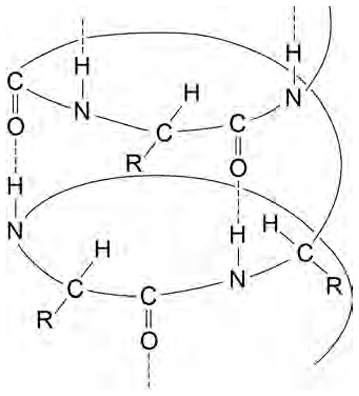
- Nitrogen and oxygen are very electronegative.Note: clearly you should mention the electronegativity of every atom involved, even if it isn’t bonded to an H.
- Therefore, C=O and N-H are very polar.Note: again mention all of the bonds being polar and name the bonds with chemical symbols.
- Which results in the formation of a hydrogen bond between the O on C=O and H on N-H.Note: if describing a specific hydrogen bond, always mention that it is a hydrogen bond and say what it forms between.
- In which the δ+H is strongly attracted to the lone pair on the O.Note: of course I’d also mention the H nucleus being deshielded, and this causing it to have the delta positive. However, it seems you should always say the delta positive on the H is what’s attracted to the lone pair, not the deshielded nucleus.
Sources
Specimen A-Level Paper 2 Q5.2 (4 marks)
Q:
MS:
Describe the structure and bonding of a metal: (2 points)
- They form a giant lattice of positive metal ions.
- Where there are strong electrostatic attractions between the ions and the sea of delocalised electronsNote: remember to always pluralise ‘attractions’
Sources
2023 As Paper 1 Q2.1 (2 marks)
Q:
MS:
2021 As Paper 1 Q2.2 (2 marks)
Q:
MS:
Why is a metal (e.g. Mg) liquid over a much greater temperature range than a simple molecular substance (e.g. Br₂)?
The forces of attraction in a molten metal are still strong, whereas the van der Waals forces between simple molecules are much weaker and easily overcome as a liquid.Note: the mark scheme didn’t explain this very well - check the source to see what you need to say.
Sources
2016 As Paper 1 Q04.1 (5 marks)
Q:
MS:
Why can metals be pulled into thin wires?
The layers of atoms can slide over one another.Note: I don’t know why the answer referred to ‘atoms’ instead of ‘ions’.
Sources
2025 A-Level Paper 1 Q7.2 (1 marks)
Q:
MS:
Why are metals that have been moulded into different shapes still as strong as unmoulded metals?
Because their bond strengths are still the same.
Sources
June 2012 As Unit 1 Q4(c)(ii) (1 marks)
Q:
MS:
Why do macromolecules have a high melting point? (2 points)
- Because they have a giant molecular structure.
- And a lot of energy is required to break the many covalent bonds in the structure.
Sources
2021 A-Level Paper 1 Q3.3 (4 marks)
Q:
MS:
Why do metals and molten/ aqueous ionic compounds conduct electricity?
- They contain delocalised electrons/ mobile ions that are free to move and are charged.
- These are able to flow through the structure.Note: probably don’t say ‘carry charge’, just say the particles ‘are charged’
Sources
2015 As Unit 1 Q3(b) (1 marks)
Q:
MS:
June 2012 As Unit 1 Q4(a)(ii) (2 marks)
Q:
MS:
Electronegativity definition:
The power of an atom to attract a pair of electrons in a covalent bond.
Sources
2017 As Paper 1 Q5.1 (1 marks)
Q:
MS:
2014 As Unit 1 Q4(c)(i) (2 marks)
Q:
MS:
January 2013 As Unit 1 Q3(a)(i) (2 marks)
Q:
MS:
What makes a bond covalent rather than ionic?
There being a small electronegativity difference between the elements.Note: this was from a question where we were given the electronegativities of the elements mentioned, so may not always apply. Also note that the mark scheme allows you to explain that it is because there are 2 non-metals, although I wouldn’t always rely on this being valid. The most important thing is that you don’t mention charge, as they do not become charged as they don’t form ions.
Sources
January 2013 As Unit 1 Q3(c) (1 marks)
Q:
MS:
Dative covalent bond description:
A pair of electrons are donated from one atom to another, then shared in a covalent bond.
Sources
2019 As Paper 1 Q1.3 (2 marks)
Q:
MS:
2016 As Paper 1 Q7.2 (2 marks)
Q:
MS:
June 2011 As Unit 1 Q3(d) (2 marks)
Q:
MS:
January 2010 As Unit 1 Q3(e) (2 marks)
Q:
MS:
How should you describe why a bond is polar (e.g. a C-Cl bond)? (2 marks)
- Chlorine has a higher electronegativity than carbon/ they have different electronegativities.
- This means the electron density is unsymmetrical/ chlorine becomes delta (δ) negative and the carbon becomes δ positive.Note: I’d always mention the delta negative and positives.
Sources
2024 As Paper 1 Q3.2 (2 marks)
Q:
MS:
What are the two things that cause dipoles?
- Differences in electronegativities.Note: this only causes a polar molecule if the molecule is asymmetrical.
- Lone pairs.
Sources
Not from a mark scheme, but useful content to know.
Why could a molecule with polar bonds not be a polar molecule? (2 points)
- It’s symmetrical.
- This means the dipoles cancel out.Note: always say this, don’t talk about polar bonds cancelling out.
Sources
2022 As Paper 1 Q4.4 (2 marks)
Q:
MS:
2024 As Paper 1 Q3.3 (2 marks)
Q:
MS:
2023 As Paper 2 Q6.2 (1 marks)
Q:
MS:
Explanation of how Van der Waals forces arise: (3 points)
- Random electron movement in the first molecule creates a temporary dipole.
- This induces a dipole in a neighbouring molecule.
- The slight positive (δ+) dipole in one molecule attracts the slight negative (δ-) molecule in the adjacent molecule, forming a temporary attraction.
Sources
2024 As Paper 1 Q3.4 (3 marks)
Q:
MS:
2021 As Paper 1 Q5.1 (3 marks)
Q:
MS:
2018 As Paper 1 Q9.3 (3 marks)
Q:
MS:
2016 As Unit 1 Q2(a) (3 marks)
Q:
MS:
Explanation of why Noble Gases have weak VdW forces between atoms: (2 points)
- They are single atoms, meaning the electrons are closer to the nucleus and they have fewer electrons.
- This means they cannot be polarised easily as the electron cloud cannot be easily distorted.Note: I believe this explanation can also be applied to small molecules.
Sources
Not from a mark scheme, but useful content to know.
Why do straight chain molecules have higher boiling points than branched chain molecules? (2 points)
- Straight chain molecules have more surface contact with each other and pack closer together.
- They therefore have stronger van der Waals’ forces between molecules.
Sources
2018 As Paper 2 Q4.2 (2 marks)
Q:
MS:
January 2013 As Unit 1 Q4(g)(ii) (2 marks)
Q:
MS:
Explanation of how permanent dipole-dipole forces arise in HCl molecules: (2 points)
- Difference in electronegativities (Cl more electronegative than H) causes partial negative (on chlorine) and positive (on hydrogen) dipoles to form in each molecule.
- The ∂+ on the H of one molecule attracts the ∂- on the Cl of a neighbouring molecule.
Sources
2017 As Paper 1 Q5.2 (2 marks)
Q:
MS:
Explanation of how non-polar molecules can have higher boiling points than polar molecules: (2 points)
- The Van der Waals forces in the non-polar molecules can be stronger than the permanent dipole-dipole forces in the polar molecules.
- If the non-polar molecules have many more electrons.
Sources
2023 As Paper 2 Q6.3 (2 marks)
Q:
MS:
How should you describe hydrogen bonding when given a specific example (e.g. between ethanol molecules)? (2 points)
- It is the attraction between the lone pair on the O of one molecule.
- And the delta positive H on another molecule.Note: obviously talk about the 'deshielded nucleus' and 'differences in electronegativity' too, but always remember that the H’s attraction is to the lone pair of the NOF element.
Sources
2023 As Paper 2 Q6.4 (2 marks)
Q:
MS:
4 things to include in a diagram of hydrogen bonding:
- Lone pairs on the NOF atoms involved in the hydrogen bond.
- Partial charges (O δ−, H δ+) on the atoms involved in the hydrogen bond.
- A dotted line between the lone pair on the NOF atom and the correct H.
- The O–H⋅⋅⋅⋅⋅O being linear.Note: it is vital you draw it this way.
Sources
2025 As Paper 2 Q02.3 (3 marks)
Q:
MS:
2 ways to explain why a molecule doesn’t have hydrogen bonding:
- The atom the hydrogen is bonding to is not as electronegative as nitrogen, oxygen or fluorine.
- The difference in electronegativity between the two atoms is not large enough.
Sources
June 2012 As Unit 1 Q3(d) (1 marks)
Q:
MS:
2015 As Unit 1 Q5(c) (2 marks)
Q:
MS:
On a 6 mark question about shapes of molecules, what should always be mentioned? (7 things)
- How many electrons the central atom has in its outer shell.
- How many electrons are given by the surrounding elements, and how this adds up to having 8 electrons in the outer shell in total.
- How many bonding and lone pairs there are.
- The fact that bonding pairs repel equally and spread as far apart as possible. Mention this on every shapes question, even small 2 markers.
- The fact that lone pairs repel more than bonding pairs (if there are lone pairs). The new vocab is ‘lone-pair bonding-pair repulsion is stronger than bonding-pair bonding-pair repulsion.’
- The shape of the molecule.
- The bond angle of the molecule AND the bond angle it is ‘reduced’ from due to the lone pairs. E.g. Angle is reduced from 109.5 to 107.
Sources
2024 As Paper 1 Q5 (6 marks)
Q:
MS:
How should you describe why molecules that contain only bonding pairs have the shape they do (e.g. CCl₄ has a tetrahedral shape)?
Mention that bonding pairs repel equally and spread apart as far as possible, to minimise repulsion.
Sources
Specimen As Paper 1 Q3.2 (2 marks)
Q:
MS:
2020 As Paper 1 Q6 (5 marks)
Q:
MS:
June 2013 As Unit 1 Q5(f)(ii) (1 marks)
Q:
MS:
January 2013 As Unit 1 Q6(b) (2 marks)
Q:
MS:
If a molecule contains 2 (or more) lone pairs, what wording should you use to describe why it has the shape it has?
You should say ‘lone-pair lone-pair repulsion is greater than bonding-pair bonding-pair repulsion’Note: one mark scheme had this as the only option (aside from lone pairs repel to be as far apart as possible) - it didn’t accept ‘lone pairs repel more strongly than bonding pairs’.Note: Lone-pair lone-pair repulsion > lone-pair bond-pair repulsion > bond-pair bond-pair repulsion. Use this wording in answers.
Sources
2022 A-Level Paper 1 Q6.6 (3 marks)
Q:
MS:
Why may you not be able to predict the shape of a molecule/ ion with a transition metal as the central atom/ ion?
If it has too many electrons in its d sub-shell, you may not be able to use normal electron repulsion theory to predict the shape.Note: just bear this in mind in case a question like ‘Why are you not able to predict the shape of [CoCl₄]²⁻?’ comes up.
Sources
Specimen A-Level Paper 1 Q1.3 (1 marks)
Q:
MS:
Shape and bond angle of a molecule with 3 bonding pairs and 1 lone pair:
(Trigonal) pyramidal, 107 degrees.
Sources
Not from a mark scheme, but useful content to know.
Shape and bond angle of a molecule with 2 bonding pairs and 2 lone pairs:
Bent (V-Shape), 104.5 degrees.
Sources
Not from a mark scheme, but useful content to know.
Shape and bond angle of a molecule with 5 bonding pairs and no lone pairs:
Trigonal bipyramidal, 90 and 120 degrees.
Sources
Not from a mark scheme, but useful content to know.
Shape and bond angle of a molecule with 4 bonding pairs and 1 lone pair:
See-saw. 89 and 119 degrees (roughly)
Sources
Not from a mark scheme, but useful content to know.
Shape and bond angle of a molecule with 3 bonding pairs and 2 lone pairs:
T-shape. 87.5 degrees (roughly).Note: you may be able to get away with 'trigonal planar' but it is incorrect.
Sources
Not from a mark scheme, but useful content to know.
Shape and bond angle of a molecule with 2 bonding pairs and 3 lone pairs:
Linear, 180 degrees.
Sources
Not from a mark scheme, but useful content to know.
Shape and bond angle of a molecule with 6 bonding pairs and no lone pairs:
Octahedral, 90 degrees.
Sources
Not from a mark scheme, but useful content to know.
Shape and bond angle of a molecule with 5 bonding pairs and 1 lone pair:
Square pyramidal. 87.5 degrees (roughly)
Sources
Not from a mark scheme, but useful content to know.
Shape and bond angle of a molecule with 4 bonding pairs and 2 lone pairs:
Square planar. 90 degrees.
Sources
Not from a mark scheme, but useful content to know.
Energetics
6Enthalpy change definition:
Heat energy change at constant pressure.
Sources
2020 As Paper 1 Q4.1 (1 marks)
Q:
MS:
2021 As Paper 2 Q8.1 (1 marks)
Q:
MS:
2025 As Paper 2 Q7.1 (1 marks)
Q:
MS:
2021 A-Level Paper 1 Q1.1 (1 marks)
Q:
MS:
January 2010 As Unit 2 Q2(a) (1 marks)
Q:
MS:
June 2011 As Unit 2 Q2(b) (1 marks)
Q:
MS:
Hess’ law definition:
The enthalpy change for a reaction is independent of the route taken.
Sources
June 2011 As Unit 2 Q2(c) (1 marks)
Q:
MS:
January 2010 As Unit 2 Q2(b) (1 marks)
Q:
MS:
Mean bond enthalpy definition: (2 points)
- It is the enthalpy required to break 1 mol of bonds.
- Averaged over a range of compounds.
Sources
2015 A-Level Unit 5 Q2(a) (2 marks)
Q:
MS:
2014 As Unit 2 Q9(c)(i) (2 marks)
Q:
MS:
2 reasons standard enthalpy of combustion calculated using mean bond enthalpies will not be accurate:
- Mean bond enthalpies are calculated using enthalpies from a wide range of compounds.
- Calculations using mean bond enthalpies don’t take into account the enthalpy changes that occur when substances change state, meaning they don’t account for the vaporisation of the fuel or the condensing of water.Note: this is the weaker of the two - I’d stick with the first.
Sources
Specimen A-Level Paper 1 Q4.2 (1 marks)
Q:
MS:
2017 As Paper 2 Q4.3 (1 marks)
Q:
MS:
June 2011 A-Level Unit 5 Q3(a)(ii) (1 marks)
Q:
MS:
June 2010 As Unit 2 Q8(c) (4 marks)
Q:
MS:
Why is the O=O bond enthalpy not a mean value?
O₂ is the only substance containing an O=O bond, so there is no range of compounds to average over.
Sources
2021 As Paper 2 Q08.3 (1 marks)
Q:
MS:
Why is the enthalpy change of a thermal decomposition difficult to determine experimentally?
Because the substance has to be heated, so it’s very difficult to measure the temperature change caused by the reaction itself.
Sources
2024 As Paper 1 Q08.3 (1 marks)
Q:
MS:
RP 2: Measurement of an Enthalpy Change (Calorimetry)
212 assumptions you have to make about the solutions involved in calorimetry questions:
- The density of the solutions are 1.00 g cm-3.
- The specific heat capacity of the solutions are 4.18 J g⁻¹ K⁻¹Note: basically you’re acting like the solutions are water, even when they’ll have solids dissolved in themNote 2: this hasn’t been tested before - usually they’re just assumptions the question will tell you to make.
Sources
2018 As Paper 2 Q3.1 (4 marks)
Q:
MS:
What must you always remember to do to your answer in enthalpy change calculation questions?
Make it negative. If it’s an exothermic reaction (temp increased), your enthalpy change (delta H) should be negative.
Sources
2018 A-Level Paper 2 Q3.4 (3 marks)
Q:
MS:
January 2013 As Unit 2 Q4(d)(i) (3 marks)
Q:
MS:
3 ways to reduce heat loss in a calorimetry experiment:
- Use a wind shield to insulate the entire experiment.Note: This is the ‘best way’ as it was the only answer option on one mark scheme.
- Reduce the distance between the flame and the beaker.
- Add a lid.
Sources
2021 A-Level Paper 2 Q3.4 (1 marks)
Q:
MS:
2014 As Unit 3 EMPA Q8(e) (1 marks)
Q:
MS:
What is the disadvantage of using glass in a calorimetry experiment?
Glass is a poorer conductor than copper.Note: copper is the normal material used. Remember that in calorimetry you are burning the material to heat a container of water, so you want to maximise conduction, not minimise heat loss.
Sources
2021 A-Level Paper 2 Q3.2 (2 marks)
Q:
MS:
Why is using a tripod and gauze to hold the copper container worse than using a clamp in a calorimetry experiment?
A tripod and gauze would reduce heat transfer to the container as some of the heat would be transferred to the tripod and gauze.
Sources
2021 A-Level Paper 2 Q3.2 (2 marks)
Q:
MS:
How to find the enthalpy change of the reaction when you add MgCl₂ to water: (13 points)
Stage 1:
- Measure water out with a named apparatus (e.g. measuring cylinder)
- Use a suitable mass of water (in the range of 10 - 200g).
- Add the water to an insulated container/ polystyrene cup.Note: it can be easy to forget to do this for calorimetry questions as usually you have to use a copper beaker, but remember that if heat is being released by the reactant IN the water, you need to insulate the reaction.
- Add a known mass of MgCl₂.
- Using weighing by differenceNote: remember that any time you are adding a known but unspecified mass of something you need to mention using weighing by difference. Adding it ‘with washings’ wouldn’t work in this scenario as the MgCl₂ would react with the distilled water. Stage 2:
- Record the initial temperature every 30 seconds for 2 minutesNote: the mark scheme specified a ‘min of 2 measurements’.
- Record the temperature every 30 seconds for a minimum of 10 minutes after adding the MgCl₂ or until a trend is seen.Note: I’d also add ‘stir the solution before each reading to disperse the heat throughout the solution, ensuring the temperature is the same throughout the solution. Of course also mention the whole ‘don’t record the temperature when you add the reactant’ thing in these questions, too.
- Plot temperature against time.Note: you could've received full marks for this section by simply drawing the graph and showcasing all of this stuff in the graph. Stage 3:
- Extrapolate the lines to when the solid was added.
- Find the temperature change at the point of addition by taking the initial temperature away from the temperature found at the point of addition on the extrapolated line.
- Use the formula q = mc∆T to find the energy released by the reaction.
- Find the moles of the reactant using Moles = Mass/Mr.
- The enthalpy change is -q/ molesNote: make sure you show you understand you have to make q negative since the reaction is exothermic.
Sources
June 2017 A-Level Paper 3, Q1.3 (6 marks)
Q:
MS:
How to find the temperature change of a reaction using extrapolation: (6 points)
- Measure and record the initial temperature of the solution for a few minutes before addition.
- Add the reactant but do NOT record the temperature at the time of addition.Note: you don’t have to usually specify this, but do just in case.
- Measure and record the temperature after the addition at regular intervals (e.g. each minute) for 8+ minutes.
- Plot a graph of temperature against time.Note: it's important you specify what the graph actually shows, not just ‘a graph of the results’.
- Extrapolate to the point of addition.
- Determine ΔT at the point of addition by taking initial T away from final T.
Sources
Specimen A-Level Paper 1 Q9.1 (4 marks)
Q:
MS:
2018 A-Level Paper 3 Q4.1 (5 marks)
Q:
MS:
2012 As Unit 3 EMPA Q4(a) (1 marks)
Q:
MS:
In an experiment to determine enthalpy change, what two variables do you need to measure?
- Temperature (initial and final, so you can calculate the change to use in the calculation for q)
- Mass of the reactant that enthalpy change is being calculated for (initial and final, so you can find the moles used in the reaction)
Sources
Not from a mark scheme, but useful content to know.
When measuring the temperature of water, what should you do before each temperature reading and why?
Stir to ensure all of the solution is at the same temperature, as stirring disperses the heat equally.
Sources
Not from a mark scheme, but useful content to know.
2 reasons enthalpy of combustion obtained from experimental data may be lower than what is found in the data book:
- Heat loss to the surroundings.
- Incomplete combustionNote: remember that these two are the go-tos, but some fuel being lost by evaporation is a third option.
Sources
2021 A-Level Paper 2 Q3.3 (2 marks)
Q:
MS:
2023 A-Level Paper 2 Q8.3 (2 marks)
Q:
MS:
2014 As Unit 2 Q9(b) (5 marks)
Q:
MS:
4 reasons why the absolute value of the enthalpy of combustion may be less experimentally than from calculations involving enthalpies of formations:
- Heat loss to the surroundings.Note: you should say 'heat loss' here, not just 'heat exchange'.
- Incomplete combustion.
- Evaporation of fuel.
- Experiment not done under standard conditions.
Sources
2021 A-Level Paper 2 Q3.3 (2 marks)
Q:
MS:
2021 As Paper 1 Q7.3 (1 marks)
Q:
MS:
2016 As Paper 2 Q2.2 (1 marks)
Q:
MS:
2023 A-Level Paper 2 Q8.3 (2 marks)
Q:
MS:
2019 As Paper 2 Q3.2 (1 marks)
Q:
MS:
2015 As Unit 2 Q7(f) (2 marks)
Q:
MS:
2014 As Unit 2 Q9(b) (5 marks)
Q:
MS:
4 ways to reduce heat loss in a calorimetry practical where the sample is burned to heat water:
- Reduce the distance between the flame and the container of water.
- Put a sleeve around the flame to protect it from drafts.
- Add a lid to the top of the container.Note: any insulation must be at the top only - we want conduction at the bottom.
- Use a copper calorimeter instead of a beaker.
Sources
2014 As Unit 3 EMPA Q8(e) (1 marks)
Q:
MS:
3 ways to reduce heat loss to the surroundings in a neutralisation reaction where the liquids are currently reacting in a glass beaker:
- Replace the glass beaker with a polystyrene cup.Note: don’t just say use a polystyrene cup - say what you are using it instead of.
- Insulate the glass beaker.Note: probably don’t use this one.
- Use a lid.
Sources
2018 A-Level Paper 3 Q4.3 (1 marks)
Q:
MS:
In a calorimetry experiment, how can the volume of water being heated be changed to cause a reduction in heat loss to the surroundings? + 3 reasons why this works:
Increasing the volume of water being heated will reduce heat loss to the surroundings for these 3 reasons:
1. There will be a smaller increase in temperature above room temperature, meaning a smaller temperature gradient between the water and the surroundings, causing less heat loss.
2. There is increased contact between the calorimeter and water, meaning more of the heating of the calorimeter is going towards the heating of the water.
3. There is less (relative) heat loss by evaporation from the surface of the water.Note: Evaporation is important due to the heat loss it causes, not the change in mass of water it causes.
Sources
Not from a mark scheme, but useful content to know.
What is the effect of incomplete combustion on the enthalpy of combustion?
It makes it less negative/ exothermic.
Sources
2021 As Paper 1 Q7.3 (1 marks)
Q:
MS:
3 reasons the experimental value for enthalpy of combustion of an alcohol obtained using calorimetry could be different to the value from a Data Book, aside from heat transfer to the atmosphere or incomplete combustion:
- Heating up the copper container/ thermometer of the calorimeter.Note: this is heat transfer to the surroundings, but not the ‘atmosphere’.
- Evaporation of the alcohol.Note: this will affect the change in mass of the alcohol, changing the calculated moles of alcohol that were combusted.
- The experiment was not done under standard conditions.
Sources
2016 As Paper 2 Q2.2 (1 marks)
Q:
MS:
How to reduce percentage uncertainty in an enthalpy change experiment without changing the thermometer:
Increase the magnitude of the temperature change by increasing the concentration of the acid/ alkali.Note: this works as temperature change is the denominator for the percentage uncertainty.
Sources
2020 As Paper 1 Q4.4 (1 marks)
Q:
MS:
2 reasons a thermometer with a high degree of uncertainty may be appropriate for an enthalpy change experiment:
- If the temperature change is much bigger than the uncertainty this will mean that the percentage uncertainty is still fairly low.
- Heat loss is more significant of an issue than uncertainty caused by equipment.
Sources
2016 As Paper 2 Q2.4 (1 marks)
Q:
MS:
When comparing an experimental value with an accurate, official value, how do you calculate the percentage error in the experimental value?
You do (Experimental - Accurate)/ Accurate.Note: this is because the percentage error of the experimental value measures how far the experimental value is from the accurate value.
Sources
2014 As Unit 3 EMPA Q8(d) (1 marks)
Q:
MS:
Why would the enthalpy of neutralisation for a reaction between sulfuric acid and a base be more exothermic than the enthalpy of neutralisation for a reaction between ethanedioic acid and a base? (2 points)
- Since ethanedioic acid is a weak acid (unlike sulfuric), energy will be needed to break its bonds during the reaction to cause it to fully dissociate and react.
- Therefore less energy will be released in total as some will be taken in for the endothermic process of dissociation of the weak acid.
Sources
2018 A-Level Paper 3 Q4.6 (2 marks)
Q:
MS:
Why can you not use calorimetry to measure the enthalpy change for a hydration reaction?
Some of the reactant will dissolve in the water, meaning you cannot accurately measure its final mass.
Sources
2017 A-Level Paper 3 Q1.1 (1 marks)
Q:
MS:
Kinetics + RP 3
9Explain why a small increase in temperature can lead to a large increase in the rate of reaction between hydrogen and chlorine: (3 points)
- The molecules have greater kinetic energy.
- Many more molecules have energy greater than activation energy.Note: ‘many’ was its own mark.
- This leads to more frequent successful collisions.
Sources
2022 As Paper 2 Q1.6 (2 marks)
Q:
MS:
January 2012 As Unit 2 Q3(e) (1 marks)
Q:
MS:
2025 As Paper 2 Q02.2 (3 marks
Q:
MS:
Why does a Maxwell-Boltzmann curve start at the origin?
Because there are no molecules with 0 energy.
Sources
2021 As Paper 2 Q1.2 (1 marks)
Q:
MS:
2014 As Unit 2 Q2(b) (1 marks)
Q:
MS:
What causes some molecules in a sample to have a very low energy?
Unsuccessful collisions that cause molecules to slow down or lose energy.
Sources
Not from a mark scheme, but useful content to know.
What effect does doubling the concentration of a reaction have on its rate? (2 points)
- It doubles it, because there are twice as many particles per unit volume.
- This means the frequency of successful collisions (with E ≥ Ea) doubles.
Sources
January 2013 As Unit 2 Q1(a)(iii) (2 marks)
Q:
MS:
Why does increasing pressure cause an increase in rate of reaction? (2 points)
- Increased pressure means there are more particles in a given volume.
- This causes more frequent successful collisions above the activation energy.
Sources
2014 As Unit 2 Q1(c)(ii) (3 marks)
Q:
MS:
June 2010 As Unit 2 Q1(b)(ii) (3 marks)
Q:
MS:
Definition of a catalyst: (2 points)
- A substance that increases the rate of reaction.
- And remains chemically unchanged at the end of the reaction.
Sources
June 2012 As Unit 2 Q3(d)(i) (1 marks)
Q:
MS:
How does a catalyst increase rate of reaction? (2 points)
- They provide an alternative pathway.
- With a lower activation energy.
Sources
January 2013 As Unit 2 Q2(b)(i) (3 marks)
Q:
MS:
What happens to the number of molecules with the most probable energy when the temperature is decreased?
It increases.Note: this is because the peak of the Maxwell-Boltzmann curve moves to the left and gets taller as temperature decreases, as the molecules are spread over a narrower range of energies.
Sources
Legacy Unit 2, June 2011 Q1(c)(ii) (1 marks)
Q:
MS:
2 ways to increase the accuracy of the disappearing cross experiment using equipment:
- Use a water bath to maintain a constant temperature so the results aren’t affected by the temperature being different in different experiments.
- Use a colorimeter to monitor the colour change to eliminate human error in judging the colour change.
Sources
Not from a mark scheme, but useful content to know.
Equilibria + The Equilibrium Constant
122 features of a reaction in dynamic equilibrium:
- The forward and reverse reactions proceed at equal rates.
- The concentrations of reactants and products remain constant.Note: 'the system being closed' doesn’t appear on mark schemes.
Sources
2022 A-Level Paper 1 Q1.1 (2 marks)
Q:
MS:
2014 As Unit 2 Q1(b) (1 marks)
Q:
MS:
June 2011 A-Level Unit 4 Q3(a) (2 marks)
Q:
MS:
Why does the position of equilibria change when temperature is increased? (2 points)
- The equilibrium shifts in the endothermic direction.Note: also say whether it goes to the right or left.
- To decrease the temperature, or to oppose the increase in temperature.Note: don’t talk about ‘minimising’ or just a ‘change’ in temperature.
Sources
2024 As Paper 2 Q7.8 (3 marks)
Q:
MS:
2025 As Paper 1 Q7.2 (3 marks)
Q:
MS:
2018 A-Level Paper 1 Q2.4 (3 marks)
Q:
MS:
2022 As Paper 1 Q7.1 (2 marks)
Q:
MS:
2023 As Paper 1 Q8.3 (3 marks)
Q:
MS:
Why does an increase in temperature cause Kc to shift? (3 points)
- The position of equilibria shifts in the endothermic direction.Note: state whether this is to the left or right.
- This decreases the temperature.
- This will decrease/ increase the yield of the products/ reactants, causing Kc to increase/ decrease.
Sources
2024 As Paper 2 Q7.8 (3 marks)
Q:
MS:
2025 As Paper 1 Q7.2 (3 marks)
Q:
MS:
2018 A-Level Paper 1 Q2.4 (3 marks)
Q:
MS:
2023 As Paper 1 Q8.3 (3 marks)
Q:
MS:
Why does increasing pressure have no effect on the position of equilibria in a reaction where there are an equal number of moles on each side of the reaction? (2 points)
- There is an equal number of moles of gas on each side of the reaction.
- This means increasing the pressure has an equal effect on the forwards and backwards reactions.
Sources
2014 As Unit 2 Q1(c)(i) (2 marks)
Q:
MS:
Explanation of why a catalyst has no effect on position of equilibrium: (2 points)
- The catalyst increases the rate of reaction of the forwards and backwards reactions.
- Equally.
Sources
2022 As Paper 1 Q7.3 (1 marks)
Q:
MS:
2020 A-Level Paper 1 Q6.5 (2 marks)
Q:
MS:
2018 As Paper 2 Q8.1 (2 marks)
Q:
MS:
If a question asks you to give an expression for Kc, what must you include?
You must write the chemical symbols in square brackets with their molar ratios as powers.
Sources
2022 A-Level Paper 2 Q2.2 (1 marks)
Q:
MS:
2024 As Paper 2 Q7.6 (1 marks)
Q:
MS:
2016 As Paper 2 Q1.1 (2 marks)
Q:
MS:
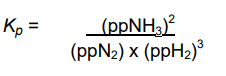
How to write an expression for Kp:
Note: remember the ‘pp’ and do not use square brackets.
Sources
Not from a mark scheme, but useful content to know.
What happens to Kp when you multiply a reaction by 2? (e.g. turn all of the molar ratios from 2 to 4 and ½ to 1)
It gets squared because you’re doubling the power on all of the partial pressures.
Sources
Not from a mark scheme, but useful content to know.
2 reasons a lower temperature and pressure makes an industrial process cheaper and more energy efficient:
- It creates lower electrical pumping costs.
- It allows the use of lower pressure, less expensive equipment.
Sources
January 2012 As Unit 2 Q2(d)(ii) (1 marks)
Q:
MS:
State Le Chatelier's principle:
If a factor is changed which affects an equilibrium, the position of equilibrium will shift to oppose the change.Note: ‘minimise’ is unacceptable wording.
Sources
Legacy Unit 2, January 2010 Q1(c)(i) (1 marks)
Q:
MS:
Explain the effect of adding water to an aqueous equilibrium mixture: (2 points)
- The equilibrium will shift to the side with the most (aqueous) moles.
- To oppose the decrease in concentration of all reactants and products.
Sources
2024 A-Level Paper 2 Q02.3 (2 marks)
Q:
MS:
Why does Kc/Kp sometimes have no units?
The moles of products equals moles of reactants so the units cancel.Note: apply this specifically to ‘gaseous’ reactants and products for Kp.
Sources
2024 A-Level Paper 1 Q04.2 (1 marks)
Q:
MS:
Redox
4Definition of an oxidising agent and reducing agent:
Oxidising agent - An electron acceptor
Reducing agent - An electron donor.
Sources
2021 As Paper 1 Q3.1 (1 marks)
Q:
MS:
2024 As Paper 1 Q9.1 (1 marks)
Q:
MS:
2022 As Paper 1 Q6.1 (1 marks)
Q:
MS:
2025 As Paper 1 Q1.3 (2 marks)
Q:
MS:
2016 As Unit 2 Q6(b)(i) (1 marks)
Q:
MS:
January 2012 As Unit 2 Q5(f)(i) (1 marks)
Q:
MS:
How should you explain why a specific substance is a reducing/ oxidising agent? (2 points)
- Mention the change in its oxidation state.
- State that this means electrons are lost/ gained.
Sources
2020 As Paper 1 Q5.2 (2 marks)
Q:
MS:
How do you combine half equations into an overall equation? (2 steps)
- Balance the electrons on each side by multiplying one/both of the equations so the electrons cancel out when you combine the equations.Note: your overall equation should have no electrons in it.
- Cancel out H⁺s and H₂Os that appear on both sides, so you only have them on one side.
Sources
2021 As Paper 1 Q3.2 (3 marks)
Q:
MS:
2023 As Paper 1 Q6.3 (3 marks)
Q:
MS:
Why would Br₂ not oxidise the Cl⁻ ions in NaCl? (2 points)
- Bromine is not a strong enough oxidising agent to displace chloride ions.
- This is because it is a weaker oxidising agent than Cl₂.Note: Never talk about halide ions having oxidising ability.
Sources
2024 As Paper 1 Q1.2 (2 marks)
Q:
MS: