Organic (Year 2)
Year 2 Mechanisms
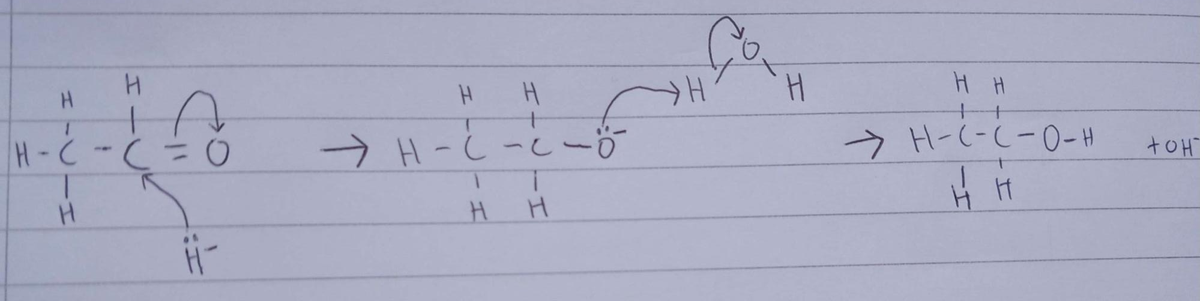
5Explanation of, mechanism, conditions and useful facts for the nucleophilic addition reactions of NaBH₄ to aldehydes and ketones:
These are reduction reactions that reverse the oxidation of alcohols to aldehydes and ketones.
The overall reaction is: Aldehyde/ Ketone + 2[H] -> Alcohol
The NaBH₄ provides the H⁻ nucleophile, while the solution of water provides the H⁺. Therefore, the conditions are aqueous.
Sources
Specimen A-Level Paper 2 Q11.1 (1 marks)
Q:
MS:
2019 A-Level Paper 2 Q13.1 (5 marks)
Q:
MS:
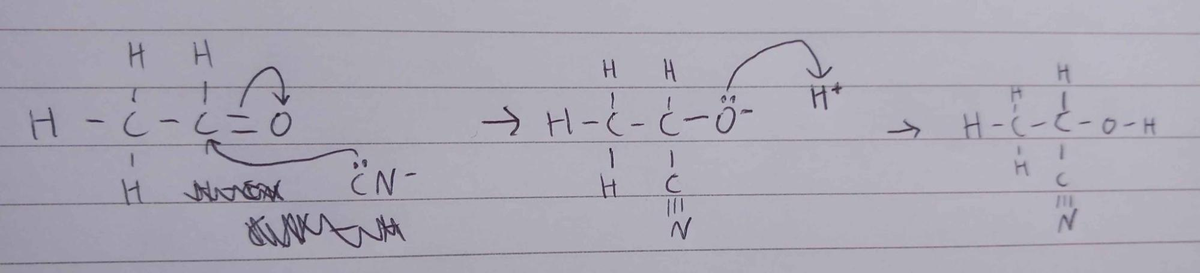
Explanation of, mechanism, conditions and useful facts for the nucleophilic addition reactions of CN⁻ to aldehydes and ketones:
This is the mechanism that forms optical isomers (and often a racemic mixture).
The overall reaction is: Aldehyde/ ketone + CN⁻ + H⁺ -> Hydroxynitrile
The conditions are Potassium cyanide followed by dilute sulfuric acid. It is important you say the ‘followed by’ as the acid needs to provide the H⁺ for the O⁻.
Sources
2022 A-Level Paper 2 Q1.8 (5 marks)
Q:
MS:
2021 A-Level Paper 3 Q3.3 (4 marks)
Q:
MS:
2017 A-Level Paper 2 Q4.1 (1 marks)
Q:
MS:
Explanation of, mechanism, conditions and useful facts for electrophilic substitution reactions with benzene and nitrate ions:
The reactant that forms the nitrate ion is concentrated HNO₃, and it forms this with the catalyst concentrated H₂SO₄. The conditions are 50 degrees C.
Stage 1 is the formation of the nitronium electrophile:
HNO₃ + H₂SO₄ -> H₂NO₃⁺ + HSO₄⁻
H₂NO₃⁺ -> NO₂⁺ + H₂O
Stage 2 is the electrophilic substitution:
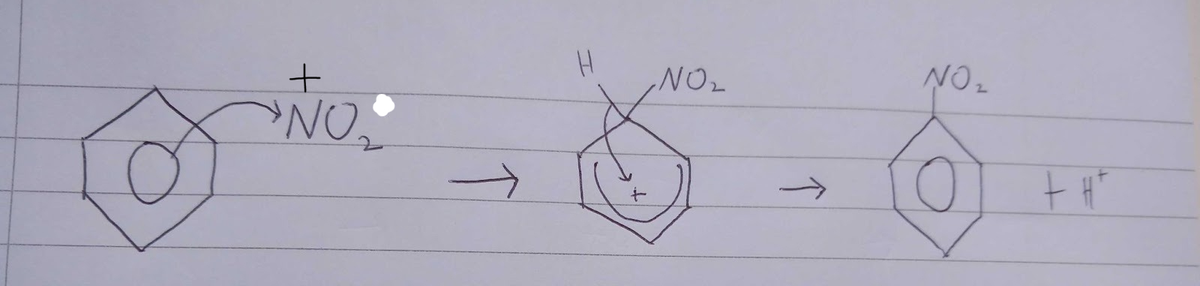
Make sure the + is on the N of the NO₂⁺
Stage 3 is the reformation of the catalyst:
H⁺ + HSO₄⁻ -> H₂SO₄
Bonus note: It’s important to keep the temperature at 50 degrees C, as if it increases above this the chance of forming a dinitro benzene increases.
Sources
2024 A-Level Paper 2 Q10.2 (2 marks)
Q:
MS:
Explanation of, mechanism, conditions and useful facts for the Friedel Crafts acylation of benzene:
Acyl chlorides (and acid anhydrides) form phenyl ketones and aldehydes.
Conditions are AlCl₃ catalyst and 50 degrees heat for the actual substitution.
Stage 1 formation of the electrophile:

Stage 2 electrophilic substitution:
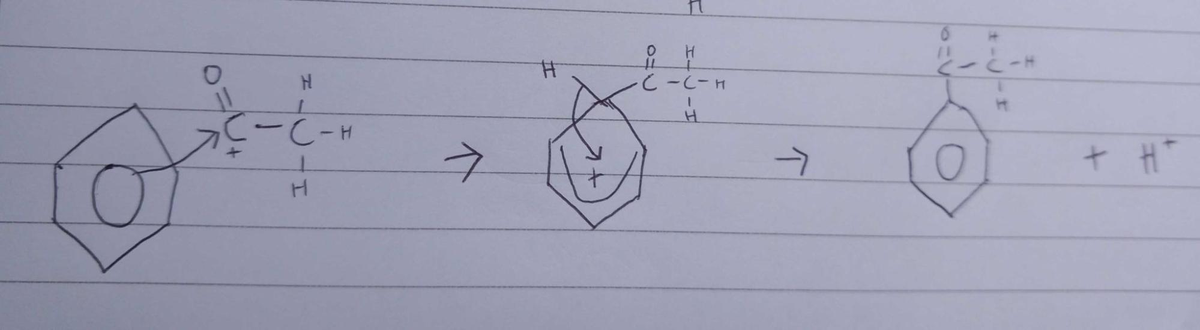
Stage 3 reformation of the catalyst: H⁺ + AlCl₄⁻ -> AlCl₃ + HCl.
Sources
2022 A-Level Paper 2 Q8.2 (2 marks)
Q:
MS:
2018 A-Level Paper 2 Q7.1 (4 marks)
Q:
MS:
Explanation of, mechanism, conditions and useful facts for all nucleophilic addition-elimination reactions with acid chlorides/ anhydrides:
It’s the same with all of the 4 molecules (H₂O, Alcohols, NH₃, Amines), the products are just different.
Water:
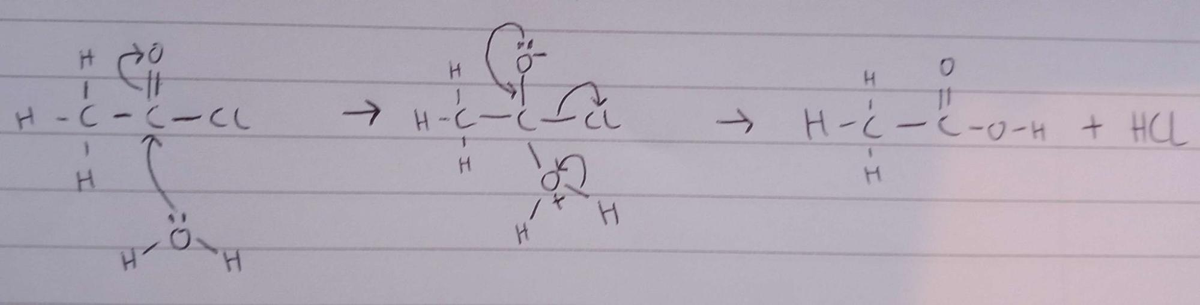
Product with water = Carboxylic acid
Product with alcohol = Ester
Product with NH₃ = Amide (e.g. ethanamide)
Product with amine = N-substituted amide (e.g. N-methyl ethanamide)
Acid chlorides always form HCl as a side product, which then reacts with ammonia and the amines to form an ammonium salt. Acid anhydrides form a carboxylic acid.
Sources
2017 A-Level Paper 2 Q6.4 (6 marks)
Q:
MS:
Optical Isomerism + Aldehydes and Ketones
8What is the relationship between two stereoisomers?
They are non-superimposable mirror images of each other.
Sources
2016 A-Level Unit 4 Q2(b)(ii) (1 marks)
Q:
MS:
What is a racemic mixture?
A mixture that contains an equal proportion of both enantiomers/ optical isomers.
Sources
2016 A-Level Unit 4 Q2(b)(i) (1 marks)
Q:
MS:
Explain why a product formed from the nucleophilic addition of cyanide ions to X aldehyde doesn’t affect plane polarised light: (7 points)
- The nucleophilic attack.
- On the planar carbonyl group.
- Has an equal chance of occurring on either side (the top or bottom).
- This means the two enantiomers formed exist in two chiral forms.
- Where there are equal amounts of each enantiomer/ a racemic mixture.
- Since the enantiomers rotate the plane of polarised light equally in opposite directions,.
- The effects will cancel out as the mixture is racemic.
Sources
Specimen A-Level Paper 2 Q11.2 (6 marks)
Q:
MS:
2017 A-Level Paper 2 Q4.3 (3 marks)
Q:
MS:
2024 A-Level Paper 2 Q8.4 (3 marks)
Q:
MS:
2019 A-Level Paper 3 Q4.2 (5 marks)
Q:
MS:
January 2013 A-Level Unit 4 Q7(c)(ii) (3 marks)
Q:
MS:
How to distinguish between two separate samples of the two enantiomers of an optical isomer: (2 points)
- Use plane polarised light.
- The two samples will rotate it in opposite directions.
Sources
2017 A-Level Paper 2 Q4.2 (2 marks)
Q:
MS:
2021 A-Level Paper 2 Q6.2 (2 marks)
Q:
MS:
Is a racemic mixture optically active?
No, it is optically inactive. This means it can’t be used to tell whether enantiomers have been formed.
Sources
January 2010 A-Level Unit 4 Q4(b) (3 marks)
Q:
MS:
What is an ‘asymmetric carbon atom’?
A chiral carbon, so a carbon atom with 4 different groups attached to it.Note: If a question asks you to circle them, circle the chiral carbons.
Sources
Specimen A-Level Paper 2 Q6.1 (1 marks)
Q:
MS:
2020 A-Level Paper 3 Q26 (1 marks)
Q:
MS:
January 2013 A-Level Unit 4 Q4(a)(i) (1 marks)
Q:
MS:
January 2011 A-Level Unit 4 Q5(f)(ii) (1 marks)
Q:
MS:
Ignoring safety, what is one reason why KCN is used over HCN to form hydroxynitriles?
HCN is a weak acid, meaning the concentration of CN⁻ ions it forms is too low.
Sources
2021 A-Level Paper 3 Q3.2 (2 marks)
Q:
MS:
2014 A-Level Unit 4 Q5(d) (2 marks)
Q:
MS:
How does the rate of nucleophilic addition of HCN to a ketone compare with that to an aldehyde, and why? (2 points)
- The rate is slower with a ketone.
- As the C of the C=O is less positive in propanone due to the electroinductive effect of the alkyl groups that surround the C, which push electron density onto it.
Sources
Legacy Unit 4, January 2011 Q6(b)(iii) (2 marks)
Q:
MS:
Carboxylic acids and their derivatives
12What occurs in the acid hydrolysis of esters?
Water is added in the presence of an acid catalyst to produce a carboxylic acid and alcohol.
Sources
Not from a mark scheme, but useful content to know.
What occurs in the alkaline hydrolysis of esters?
NaOH is added to form a carboxylate salt and alcohol.
Sources
2022 A-Level Paper 2 Q7.2 (1 marks)
Q:
MS:
One key difference between acid and alkaline hydrolysis of esters:
In acid, the reaction is reversible.
In alkaline, the reaction is irreversible.
Sources
Not from a mark scheme, but useful content to know.
2 advantages of using an acid chloride instead of a carboxylic acid in the laboratory preparation of an ester:
- The reaction is irreversible, making the yield higher and the product pure.Note: the product being pure means the product doesn’t have to be separated by fractional distillation.
- No acid catalyst is needed.
Sources
Not found explicitly on a mark scheme, but useful content to know for application questions.
Why is ethanol a suitable solvent for the reaction between coconut oil and KOH?
It allows both the oil and KOH to dissolve as it is a mutual solvent to both.Note: you could also add it makes the reactants ‘miscible’.Note: there was no explanation for WHY it actually is a mutual solvent, so I guess you just need to know that it's a mutual solvent to both (lipids = soluble in ethanol, insoluble in water; KOH = soluble in both ethanol and water).
Sources
2021 A-Level Paper 2 Q1.4 (3 marks)
Q:
MS:
How is biodiesel formed?
Methanol is added to vegetable oils in the presence of a strong acid catalyst.Note: a strong alkaline catalyst (NaOH) can also be used and this is preferred in industry.Note 2: the mixture is also warmed.Note 3: remember the reaction is also reversible.
Sources
Not from a mark scheme, but useful content to know.
What are the two ways carboxylic acids can be reduced to form alcohols?
- Reduction with NaBH₄ (nucleophilic addition)Note: the overall equations uses 4 [H] to represent the hydrogens used and the condition is 'aqueous'.
- Reduction with H₂ gas and Nickel catalyst.
Sources
Not from a mark scheme, but useful content to know.
What mechanism is carboxylic acid + alcohol esterification?
It is nucleophilic addition-elimination.Note: you don’t have to draw this mechanism, but you should know that carboxylic acid + alcohol, like acid chloride + alcohol, is nucleophilic addition-elimination.
Sources
Not from a mark scheme, but useful content to know.
3 reasons acid anhydrides are preferred over acid chlorides for most reactions:
- Acid chlorides produce more violent, dangerous reactions.
- Acid chlorides produce fumes of HCl, a strong acid and toxic gas, whereas acid anhydrides produce carboxylic acids.
- Acid chlorides are vulnerable to hydrolysis, but acid anhydrides are not.
Sources
2019 A-Level Paper 2 Q8.4 (1 marks)
Q:
MS:
2024 A-Level Paper 3 Q1.2 (1 marks)
Q:
MS:
June 2012 A-Level Unit 4 Q4(c)(iii) (2 marks)
Q:
MS:
2 observations when an acyl chloride reacts with an alcohol:
- Steamy fumes from the HCl gas are formed.Note: use this one in exam questions.
- A sweet smell from the ester formed.
Sources
2018 A-Level Paper 2 Q7.3 (3 marks)
Q:
MS:
Why do fats form stronger intermolecular forces with long chain esters than water does? (3 points)
- Fatty acids contain long alkyl chains.
- This causes them to form strong Van der Waals’ with long chain esters.
- As long chain esters also contain long alkyl chains and are non-polar.Note: long chain esters are non-polar in spite of their carbonyl groups due to their long alkyl chains, meaning they don’t form hydrogen bonds with water.
Sources
2025 A-Level Paper 2 Q3.6 (3 marks)
Q:
MS:
What is formed when the ester link in a triglyceride reacts with NaOH, and what is it used for?
- A carboxylate salt (CH₂COONa) forms.
- It is used as a soap/ anionic surfactant.
Sources
2025 A-Level Paper 3 Q06.3 (2 marks)
Q:
MS:
Aromatic Chemistry
7How to describe the bonding and shape/ structure of a benzene ring: (4 points)
- Each carbon forms 3 covalent bonds.
- The spare electrons are delocalised and overlap to form a Pi cloud.
- It has a planar shape and forms a hexagon.
- It has 6 C-C bonds of equal length, where their lengths are in between that of a standard C-C and C=C bond.
Sources
2024 A-Level Paper 2 Q10.1 (5 marks)
Q:
MS:
3 pieces of evidence against the Kekule model:
- Benzene doesn’t undergo electrophilic addition reactions, but undergoes electrophilic substitution ones instead.
- It has 6 C-C bonds of equal length 0.140nm, instead of 3 C=C bonds of 0.134nm and 3 C-C bonds of 0.154nm.
- The enthalpy of hydrogenation of benzene is −208 kJ mol⁻¹ , making it 152 kJ mol⁻¹ less exothermic and more stable than the expected −360 kJ mol⁻¹ of Kekule's model.
Sources
2024 A-Level Paper 2 Q10.1 (5 marks)
Q:
MS:
June 2011 A-Level Unit 4 Q8(a) (4 marks)
Q:
MS:
Why is cyclohexa-1,3-diene’s enthalpy of hydrogenation not exactly double cyclohexene’s enthalpy of hydrogenation? (3 points)
- It is slightly lower than double as the two double bonds are close together (only separated by one single bond).
- This means some delocalisation of the electrons occurs.
- Making the molecule more stable.
Sources
2018 A-Level Paper 2 Q6.2 (3 marks)
Q:
MS:
How can benzene be reduced into cyclohexane?
H₂ + Nickel catalyst.
Sources
Not from a mark scheme, but useful content to know.
Equation for the reaction of concentrated nitric acid with concentrated sulfuric acid to form the species that reacts to form nitrobenzene in the nitration of benzene:
H₂SO₄ + HNO₃ → NO₂+ + HSO₄⁻ + H₂ONote: the preferred answer on the mark scheme was: HNO₃ + 2H₂SO₄ → NO₂ + + H₃O⁺ + 2HSO₄− However, they explicitly accepted the top equation I gave so I’d use that one as it combines the two equations seen in the ‘Mechanisms’ section for the nitration of benzene.
Sources
2017 A-Level Paper 2 Q8.1 (1 marks)
Q:
MS:
How is nitrobenzene converted to phenylamine? (equation + explanation)
Nitrobenzene + 6[H] -> Phenylamine + 2H₂O
This is the equation as it isn’t a normal H₂ + Nickel catalyst reaction. Instead, the nitrobenzene is heated with Sn and concentrated HCl, creating a phenyl ammonium ion, which is then neutralised with NaOH.
Note: H₂ + Nickel catalyst can be used for this conversion, too, but on exams they usually talk about the Sn/HCl method.
Sources
2018 A-Level Paper 2 Q10.6 (2 marks)
Q:
MS:
January 2013 A-Level Unit 4 Q7(a) (5 marks)
Q:
MS:
Why is ammonia unlikely to react with benzene? (2 points)
- Ammonia is a nucleophile.
- The delocalised π electrons in benzene repel nucleophiles.
Sources
Legacy Unit 4, June 2014 Q4(b)(i) (2 marks)
Q:
MS:
Amines
9Why is an amine is a better base than ammonia: (2 points)
- The lone pair on the N is more available to accept an H⁺ on an amine.
- This is because of alkyl electron pushing/ the positive inductive effect from the alkyl groups.
Sources
2019 A-Level Paper 2 Q1.4 (2 marks)
Q:
MS:
Why is phenylamine less basic than normal amines? (2 points)
- In phenylamines, the lone pair on the N is delocalised into the Pi cloud of electrons.
- Making it less available to accept an H⁺.
Sources
June 2011 A-Level Unit 4 Q8(d) (3 marks)
Q:
MS:
What happens when an amine is added to water?
It reacts with the water to form an alkyl ammonium ion + OH⁻, forming a basic solution.Note: the reaction is reversible and it is important to note that an alkyl ammonium hydroxide salt doesn’t form.
Sources
Not from a mark scheme, but useful content to know.
Why does phenylamine form a solution when added to water, despite being insoluble?
Due to the reaction described in the note above (amine + water -> alkyl ammonium ion + OH⁻).
A phenylammonium ion forms, which dissolves in water.
Sources
2018 A-Level Paper 2 Q10.6 (2 marks)
Q:
MS:
Why is it better to prepare primary amines from nitriles rather than halogenoalkanes? (2 points)
- Halogenoalkanes undergo further reactions, producing a mixture of products and lower atom economy.Note: the mark scheme said ignore lower yield as this is not necessarily the case.
- Nitriles don’t undergo further reaction, meaning they produce a single product and have a higher atom economy.Note: in the mark scheme, you had to make a statement about both the halogenoalkanes and nitriles for both marks.
Sources
2018 A-Level Paper 2 Q10.3 (2 marks)
Q:
MS:
What are the two main ways to turn a nitrile into an amine?
- H₂ gas with a nickel catalyst.
- LiAlH₄ in ether.
Sources
Not from a mark scheme, but useful content to know.
If you wanted to turn an alkane into an amine, what would the first step be?
First, you have to make a halogenoalkane, as this is needed for both the cyanide and ammonia method.
To do this you need to react the alkane with Cl₂ in the presence of UV light.
Sources
January 2010 A-Level Unit 4 Q9(b) (6 marks)
Q:
MS:
What are quaternary ammonium salts used for?
Hair conditioners and fabric softeners.Note: this is because they act as cationic surfactants.
Sources
2020 A-Level Paper 2 Q5.3 (2 marks)
Q:
MS:
What is the use of amines?
The manufacture of cationic surfactants (fabric softeners, hair conditioners).Note: of course only the quaternary alkyl ammonium salts are cationic surfactants, but the use of any amine can be to manufacture these quaternary alkyl ammonium salts.
Sources
2024 A-Level Paper 2 Q10.5 (1 marks)
Q:
MS:
2015 A-Level Unit 4 Q5(b)(iii) (1 marks)
Q:
MS:
Polymers
11Explanation for why polyesters (and other condensation polymers) are biodegradable but polyalkenes are not: (2 points)
- Polyesters contain the C=O and C-O-C polar bonds, whereas polyalkenes only contain C-C non-polar bonds in their chain.
- Polyesters can therefore be attacked by nucleophiles and hydrolysed, while polyalkenes cannot.
Sources
2021 A-Level Paper 3 Q1.2 (2 marks)
Q:
MS:
2017 A-Level Paper 2 Q10.7 (3 marks)
Q:
MS:
Specimen A-Level Paper 2 Q7.3 (3 marks)
Q:
MS:
Explanation for why addition polymers are not biodegradable:
The C-C bonds in their chain are non-polar and cannot be attacked by nucleophiles, meaning they cannot be hydrolysed.Note: PVC, for example, contains polar C-Cl bonds, but since these aren’t in the chain it is still non-biodegradable.
Sources
2025 A-Level Paper 2 Q3.2 (1 marks)
Q:
MS:
How can condensation polymers be hydrolysed?
By heating them with concentrated hydrochloric acid or a concentrated base (usually a hydroxide so alkali).Note: this is in contrast to additional polymers which can only be broken down through burning them.
Sources
2021 A-Level Paper 3 Q34 (1 marks)
Q:
MS:
2022 A-Level Paper 3 Q28 (1 marks)
Q:
MS:
Why would it be beneficial for polymers to be biodegradable?
It would prevent them building up in land fill as they would be able to be broken down by natural processes.
Sources
2021 As Paper 2 Q5.3 (1 marks)
Q:
MS:
Do polyesters and polyamides form hydrogen bonds between their chains? Why/ not?
Polyesters don’t, but polyamides do.
Polyamides form hydrogen bonds between the hydrogen on their NH groups and the lone pair on the oxygen on their C=O groups.Note: This is why it’s important to know the examples of polyesters and polyamides I mentioned above - I’ve seen a question where they asked ‘which of these 4 polymers (Terylene, Kevlar, PVC, and poly(something) ) contains hydrogen bonding between its chains?’ and you had to know Kevlar was a polyamide so therefore had hydrogen bonding.
Sources
2021 A-Level Paper 3 Q24 (1 marks)
Q:
MS:
2019 A-Level Paper 3 Q28 (1 marks)
Q:
MS:
2024 A-Level Paper 3 Q32 (1 marks)
Q:
MS:
June 2011 A-Level Unit 4 Q4(a)(ii) (3 marks)
Q:
MS:
2014 A-Level Unit 4 Q4(a) (1 marks)
Q:
MS:
Example of a polyester:
Terylene.Note: this can come in useful in multiple choice questions.
Sources
January 2012 A-Level Unit 4 Q8(b)(i) (2 marks)
Q:
MS:
2 examples of polyamides:
- Nylon 6,6.
- Kevlar.
Sources
Not from a mark scheme, but useful content to know.
What is PVC? What are its properties and uses?
It is poly(chloroethene).
It is an addition polymer made out of chloroethene monomers.
It is hard and brittle so is used to make drain pipes.
Sources
Not from a mark scheme, but useful content to know.
What does adding a plasticiser to PVC do?
It makes it more flexible as it gets between the polymer chains and pushes them apart, weakening the IMFs between the chains, allowing them to slide over each other more easily.
Sources
2020 As Paper 2 Q6.3 (2 marks)
Q:
MS:
2025 A-Level Paper 2 Q3.3 (1 marks)
Q:
MS:
2 reasons a biodegradable polymer may take longer to break down in landfill compared to perfect decomposition conditions:
- In landfill there may not be enough air or UV for a fast rate of decay.
- In landfill there may not be enough water to hydrolyse the polyester.
Sources
Legacy Unit 4, June 2013 Q5(d)(v) (1 marks)
Q:
MS:
3 advantages and 2 disadvantages of recycling a polymer rather than disposing of it:
Advantages:
- Saves raw materials.
- Recycling is cheaper than making something from scratch.
- Reduces CO₂ emissions by not being incinerated.
Disadvantages:
- The collecting, sorting and processing is difficult and costly.
- The recycled material is easily contaminated.
Sources
Legacy Unit 4, June 2010 Q7(e) (4 marks)
Q:
MS:
Amino Acids, Proteins and DNA
132 ways to hydrolyse polypeptides: (reagent + conditions)
1. Hydrochloric acid + heat
2. Protease in warm conditions (not heat).
Sources
2023 A-Level Paper 3 Q3.3 (2 marks)
Q:
MS:
What is the overall charge on a zwitterion?
An amino acid must have an overall net neutral charge to be a zwitterion, so if it has a COO⁻ or NH₃⁺ in its R group that causes it to have a negative or positive charge, it is not a zwitterion.
Sources
2021 A-Level Paper 3 Q35 (1 marks)
Q:
MS:
2024 A-Level Paper 3 Q33 (1 marks)
Q:
MS:
Why are enzymes only able to catalyse the hydrolysis of enantiomer of a compound? (2 points)
- The enzyme has an active site.
- Only one enantiomer has the correct stereochemistry to bond to this active site as the enzyme is stereospecific. This means only one enantiomer has a complementary shape.
Sources
2020 A-Level Paper 2 Q2.4 (2 marks)
Q:
MS:
Why can a stereospecific active site only bind to one enantiomeric form of a substrate/ drug?
Only one enantiomer will be able to form the correct hydrogen/ ionic bonds (interactions) with the active site that allow it to bond and be catalysed, as the functional groups need to be oriented correctly according to the lock-key model.
Sources
Not from a mark scheme, but useful content to know.
Circle the groups in the molecules below that bond together to form a single nucleotide for all 4 bases: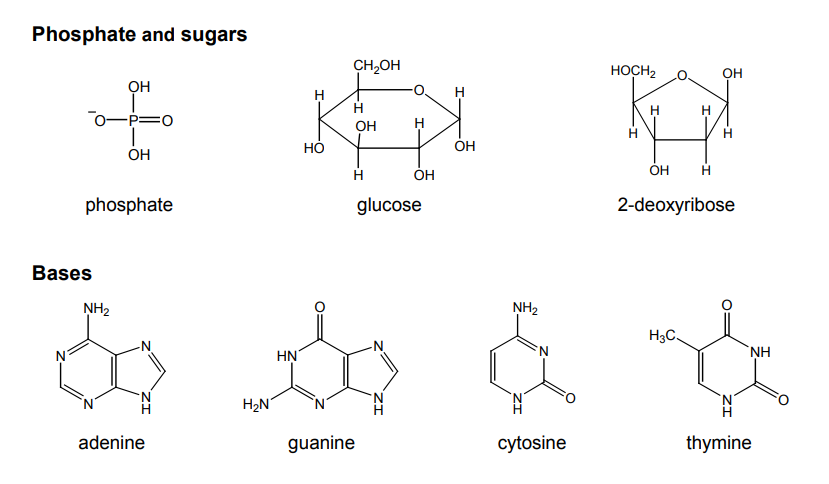
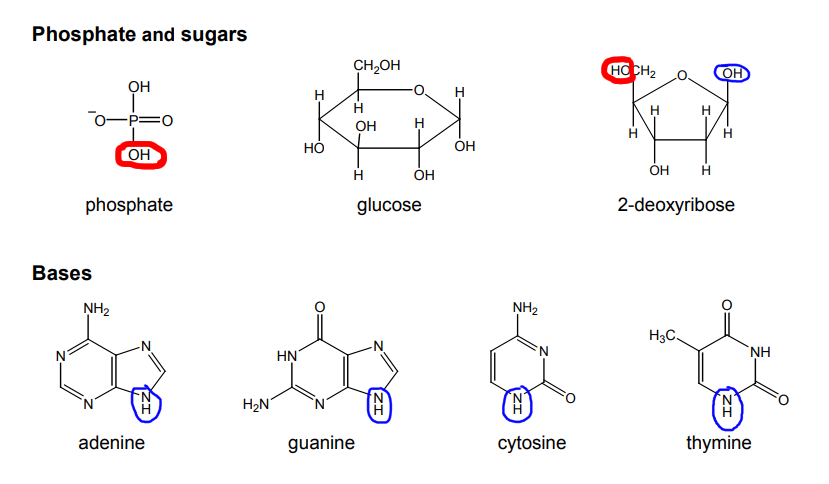
Note: this means it is probably best to flip guanine and adenine when drawing nucleotides, or just leave enough room for them to sprawl over to the left.
Sources
Not from a mark scheme, but useful content to know.
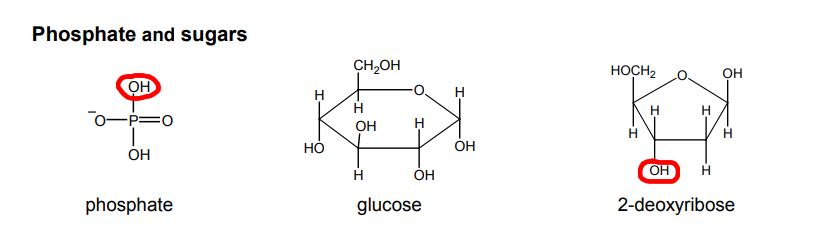
Circle the groups in the molecules below that bond together to form the sugar-phosphate backbone:
Sources
Not from a mark scheme, but useful content to know.
Visualise how guanine forms hydrogen bonds with cytosine:
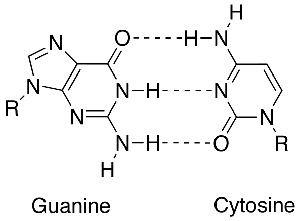
Note: from the data sheet, they are both inverted. The ‘R’ is the rest of the nucleotide of course.
Sources
Not from a mark scheme, but useful content to know.
Visualise how adenine forms hydrogen bonds with thymine:
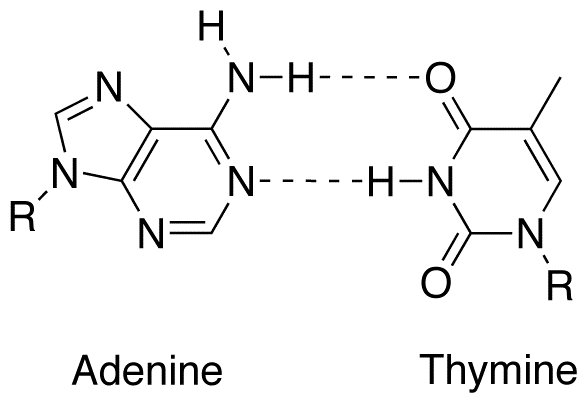
Note: from the data sheet, they are both inverted. Remember the top C=O forms the hydrogen bond on thymine.
Sources
Not from a mark scheme, but useful content to know.
If you are asked to name the sugar molecule found in DNA, what should you say?
2-deoxyribose.Note: always include the '2' as it is found on the data sheet.
Sources
Specimen A-Level Paper 2 Q8.1 (1 marks)
Q:
MS:
How does cisplatin disrupt DNA replication?
A nitrogen atom on guanine forms co-ordinate bonds with Pt. When two N atoms from separate strands form this dative covalent bond, this distorts the shape of the DNA molecule and prevents it from replicating.Note: this occurs after the Cl ligands have already been substituted for H₂O ligands, so the H₂O ligands are replaced by the N’s on guanine.
Sources
Specimen A-Level Paper 2 Q8.3 (1 marks)
Q:
MS:
2014 A-Level Unit 5 Q7(c)(ii) (1 marks)
Q:
MS:
2 ways cisplatin can be used to minimise damage to healthy cells:
- Use it in very small amounts.
- Target the application to the tumour.
Sources
Specimen A-Level Paper 2 Q8.4 (1 marks)
Q:
MS:
2014 A-Level Unit 5 Q7(c)(iii) (1 marks)
Q:
MS:
Name the two types of protein secondary structure shown: 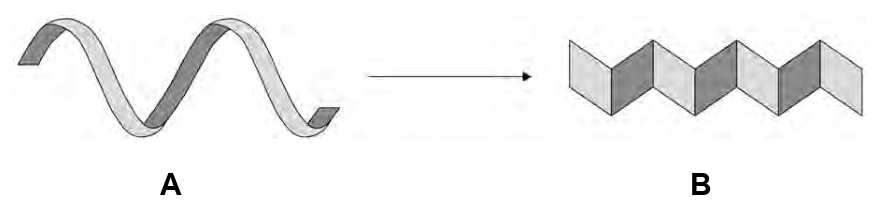
A - alpha helix.
B - beta pleated sheet.
Sources
2025 A-Level Paper 2 Q06.3 (2 marks)
Q:
MS:
Why are amino acids solid at room temperature when they exist as zwitterions? (2 points)
- Because ionic bonds form between the NH₃+ on one amino acid and the COO⁻ on another.
- These strong electrostatic forces require a lot of energy to overcome.
Sources
Legacy Unit 4, June 2012 Q5(d)(ii) (2 marks)
Q:
MS:
Legacy Unit 4, January 2011 Q6(b)(iii) (2 marks)
Q:
MS:
Organic Synthesis
55 things that make a synthesis process more sustainable:
- The use of renewable resources.
- The use of catalysts, which can be re-used.
- A high atom economy.
- The process having few stages.
- Low pressures and temperatures being required.
Sources
2025 A-Level Paper 2 Q4.6 (2 marks)
Q:
MS:
3 reasons chemists design process with a high atom economy:
- It saves resources.
- It leads to less waste.
- It leads to less pollution.
Sources
2021 A-Level Paper 2 Q8.4 (2 marks)
Q:
MS:
2025 As Paper 1 Q1.2 (1 marks)
Q:
MS:
2 reasons chemists design production methods with fewer steps:
- Less energy is used (in production)
- A better yield is obtained (partly due to reduced practical losses)
Sources
2021 A-Level Paper 2 Q8.4 (2 marks)
Q:
MS:
2 steps to obtain an alcohol from an ester:
- First, add aqueous, warm NaOH. This forms an alcohol and a sodium carboxylate salt.
- Then, separate the alcohol using (fractional) distillation.
Sources
2016 A-Level Unit 4 Q8(a) (3 marks)
Q:
MS:
2 ways a ketone can be reduced into an alcohol:
- Using aqueous NaBH₄ in a nucleophilic addition reaction.Note: this should be your go-to way.
- Using H₂ with a Ni catalyst in an addition/ hydrogenation reaction.Note: this is a backup only but may be worth knowing.
Sources
2018 A-Level Paper 2 Q7.2 (3 marks)
Q:
MS:
2020 A-Level Paper 2 Q6.2 (3 marks)
Q:
MS:
RP 10: Preparation of an Organic Liquid
10How to produce a pure organic liquid: (6 points)
- React reagents to make the product, usually by heating under reflux.
- Separate the product using simple distillation.
- Purify the product by adding a substance that will react with the contaminants (e.g. a carbonate for an acid), then using a separating funnel to separate the aqueous solution from the organic liquid.
- Dry by swirling with a drying reagent (e.g. anhydrous calcium chloride) to remove any water still remaining.
- Filter off the organic liquid.
- Check the purity by distilling it. If the liquid is pure the boiling point will be sharp, instead of boiling over a range of temperatures.
Sources
2023 A-Level Paper 3 Q1.1 (1 marks)
Q:
MS:
2023 A-Level Paper 3 Q1.6 (1 marks)
Q:
MS:
Why can organic liquids and aqueous solutions be separated in separating funnels?
They are immiscible, so the denser liquid will sink to the bottom and can be drained off first.
Sources
2019 A-Level Paper 2 Q2.2 (1 marks)
Q:
MS:
2023 A-Level Paper 3 Q1.5 (2 marks)
Q:
MS:
How could you wash a product contaminated with acid?
Add sodium carbonate to neutralise the acid, then separate in a separating funnel.
Sources
2023 A-Level Paper 3 Q1.4 (2 marks)
Q:
MS:
2018 A-Level Paper 3 Q3.3 (1 marks)
Q:
MS:
Why is it important to open the tap of the separating funnel periodically?
To avoid the pressure build-up caused by the releasing of gas (CO₂), preventing the stopper blowing out.
Sources
2018 A-Level Paper 3 Q3.4 (1 marks)
Q:
MS:
January 2011 As Unit 1 Q3(c) (1 marks)
Q:
MS:
2 reasons anhydrous calcium chloride (and any drying agent mentioned) is a suitable drying agent:
- It absorbs water.
- It doesn’t react with or dissolve in the product.Note: always name the product.
Sources
2018 A-Level Paper 3 Q3.5 (1 marks)
Q:
MS:
2023 A-Level Paper 3 Q1.6 (1 marks)
Q:
MS:
What are the two ways to release pressure from a separating funnel?
- Removing the stopper.
- Tipping the funnel upside-down then opening the tap.
Sources
2024 A-Level Paper 2 Q4.3 (3 marks)
Q:
MS:
What is the standard method for removing an unwanted solid from a solution and what are the two variations of this method?
The method is filtration.
There is gravity filtration where the solution is poured through V-shaped filter paper into a funnel into a beaker.
There is vacuum filtration where the solution is poured through a Buchner funnel into a side arm flask that has a side arm to a vacuum source.Note: notice the Buchner funnel has its filter paper laid horizontally.
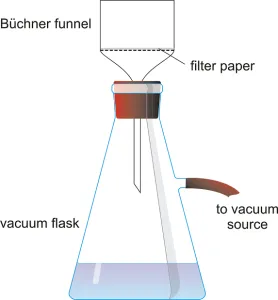
Sources
2018 A-Level Paper 3 Q3.6 (2 marks)
Q:
MS:
2024 A-Level Paper 3 Q1.6 (2 marks)
Q:
MS:
2014 As Unit 3 EMPA Q10(c)(i) (2 marks)
Q:
MS:
What is filtration under reduced pressure and what is the set up for it?
It is vacuum filtration where the pressure is reduced in the container the product is being filtered into, drawing the liquid through the filter paper.
The equipment needed is a Buchner funnel containing filter paper with a side arm flask connected to a vacuum pump.
Note that a Buchner funnel has a flat bottom. Don’t draw a funnel with a triangular bottom as this is a Hirsch funnel.
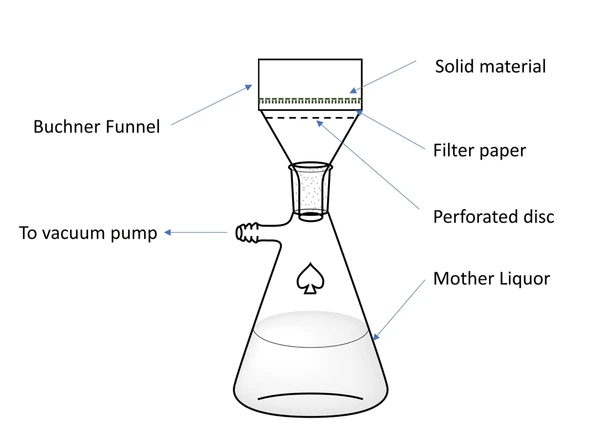
Sources
2018 A-Level Paper 3 Q3.6 (2 marks)
Q:
MS:
2014 As Unit 3 EMPA Q10(c)(i) (2 marks)
Q:
MS:
3 theoretical and 2 practical reasons the percentage yield of the organic liquid could be less than 100%:
Theoretical:
1. Side reactions occur, so by-products are made instead of the expected products.
2. The reagents used may be impure.
3. The reaction is incomplete.
Practical:
1. Some of the product is lost in the purification steps, such as in transfer between apparatus.
2. Some product is lost in distillation.
Sources
2013 A-Level Unit 6 ISA-Q Q7(e) (1 marks)
Q:
MS:
Why could the percentage yield of the organic liquid be greater than 100%?
The product wasn’t fully dried, so the mass of water is being measured too.
Sources
2017 A-Level Paper 3 Q3.9 (3 marks)
Q:
MS:
RP 10: Preparation of an Organic Solid
13Describe how a crystalline solid can be separated from a liquid then purified using recrystallisation: (6 points)
- Filter it to separate it from the liquid.
- Dissolve it in the minimum volume possible to make a saturated solution.
- Of a hot solvent.Note: ‘warm’ is not allowed.
- Then use hot filtration to remove any insoluble impurities while keeping the desired product (and soluble impurities) dissolved.Note: this is an important step that is often forgotten. It is necessary if your mixture still has undissolved impurities after forming the saturated solution of the product.
- Cool it to leave it to crystallise then filter under reduced pressure.
- Wash with cold, distilled water and dry with filter paper.
Sources
2021 A-Level Paper 3 Q3.1 (5 marks)
Q:
MS:
2017 A-Level Paper 3 Q3.8 (6 marks)
Q:
MS:
2024 A-Level Paper 3 Q1.8 (6 marks)
Q:
MS:
2025 A-Level Paper 2 Q4.3 (5 marks)
Q:
MS:
When heating the mixture of ethanol and crude aspirin to produce a saturated solution that will cause recrystallization when cooled, what are 2 precautions that must be taken?
- Heat using a water bath as ethanol is flammable.
- Heat to a temperature below the boiling point of ethanol so no ethanol boils away.Note: this is particularly important as it could mean that not all of the aspirin dissolves (reducing yield) or it may cause some impurities to recrystallize as there isn’t enough solvent left to keep them dissolved.
Sources
June 2020 A-Level Paper 2, Q4.7 (2 marks)
Q:
MS:
For crystallisation, why is the minimum amount of hot solvent used?
To ensure the hot solution is saturated so crystals form upon cooling.
Sources
Specimen A-Level Paper 2 Q9.2 (4 marks)
Q:
MS:
For crystallisation, why is the flask left to cool to room temperature before filtering off the crystals?
Because the solubility decreases as temperature decreases, meaning more crystals form as it cools, allowing a higher yield of the solid to be obtained.
Sources
Specimen A-Level Paper 2 Q9.2 (4 marks)
Q:
MS:
For crystallisation, why are the crystals compressed in the Buchner funnel with a clean cork?
To allow air to pass through the sample, not just around it.
This creates better drying, but doesn’t squeeze water out of the crystals.
Sources
Specimen A-Level Paper 2 Q9.2 (4 marks)
Q:
MS:
Why is a small amount of cold ethanol poured through the Buchner funnel (on top of the aspirin) after the aspirin has been filtered under reduced pressure? Specifically, why is it important that it is only a 'small amount' and 'cold'?
The purpose is to wash away any soluble impurities/ any ethanolic solution on the product.
It is important that only a small amount of cold ethanol is added to avoid aspirin getting dissolved in the ethanol.
Sources
2020 A-Level Paper 2 Q4.8 (1 marks)
Q:
MS:
3 things you have to include in a Buchner funnel diagram:
- A bung.Note: the funnel must enter the side arm through a bung.
- A ‘Vacuum pump’ label.
- A ‘filter paper’ label for the horizontal filter paper.
Sources
2018 A-Level Paper 3 Q3.6 (2 marks)
Q:
MS:
2024 A-Level Paper 3 Q1.6 (2 marks)
Q:
MS:
What is the most likely source of impurities in crystallisation reactions and how can it be minimised?
Water.
It can be minimised by pressing the sample between dry filter papers.
Sources
Not from a mark scheme, but useful content to know.
How to find the melting point of a substance and what this tells you about its purity: (3 points)
- Put the substance in a capillary tube and put this capillary tube in a melting point apparatus.
- Heat slowly/ gradually to establish a melting point range.Note: the ‘slowly/ gradually’ is key wording.
- A lower melting point than expected or a broad range of melting points indicates an impure substance.
Sources
2018 A-Level Paper 3 Q2.5 (3 marks)
Q:
MS:
2024 A-Level Paper 3 Q1.9 (3 marks)
Q:
MS:
2012 A-Level Unit 6 EMPA Q12(a) (2 marks)
Q:
MS:
Why could a pure sample of aspirin not measure as having the same melting point as the one in a data booklet?
The temperature on the thermometer could be different to the actual temperature of the sample, as the thermometer measures the temperature next to the capillary tube, not inside of it.
Sources
2012 A-Level Unit 6 EMPA Q12(b) (1 marks)
Q:
MS:
2 visual differences between crude and pure aspirin:
- Pure aspirin has large, needle-like crystals.
- Pure aspirin will be lighter in colour/ whiter.
Sources
2020 A-Level Paper 2 Q4.9 (1 marks)
Q:
MS:
3 reasons for a non-100% yield in the production of aspirin:
- Product being lost in the transfer between equipment.
- The sample still being wet when weighed (would make it greater than 100%)
- Some of the sample being lost during recrystallization.
Sources
2013 A-Level Unit 6 ISA-Q Q7(e) (1 marks)
Q:
MS:
What’s a hazard of using concentrated phosphoric acid?
It’s corrosive.Note: you could’ve also said skin burn or permanent eye damage, but not just ‘irritant’.
Sources
June 2020 A-Level Paper 2, Q4.3 (1 mark)
Q:
MS:
NMR Spectroscopy
5Why are CCl₄, and CDCl3 good solvents for ¹H NMR, and when should each one be used?
They are good solvents for ¹H NMR because they are inert and they don’t contain any ¹H atoms, meaning they don’t produce a signal. CCl₄ is non-polar so is a suitable solvent for non-polar molecules. CDCl3 is polar so is a suitable solvent for polar molecules.
Sources
2020 A-Level Paper 2 Q7.1 (6 marks)
Q:
MS:
January 2011 A-Level Unit 4 Q5(c)(ii) (1 marks)
Q:
MS:
4 reasons TMS (Si(CH₃)₄) a good reference point for ¹H NMR:
- It gives one, strong signal as it has 12 equivalent Hs in a single environment.
- Its signal is upfield and far away from other typical H signals as the low electronegativity of Si shifts it right.
- It is easy to remove as it is volatile.
- It is inert.
Sources
2015 A-Level Unit 4 Q10(d) (3 marks)
Q:
MS:
How to explain why a given peak in a ¹H spectrum is a singlet:
The adjacent C has no non-equivalent H attached.Note: this means that no splitting takes place.
Sources
2024 A-Level Paper 2 Q6.4 (2 marks)
Q:
MS:
What are the splitting patterns of the two environments for the molecule below? (¹H NMR)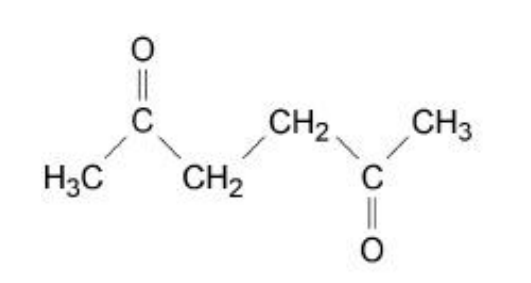
They are both singlets.
Note: at first I didn’t realise you only count the hydrogens on carbons adjacent to the whole environment, and don’t count the hydrogens within a given environment.
Sources
From the question that screenshot is from - I can't currently find it.
What molecule with the molecular formula C3H7ClO has the 1H data shown below? Then, a 4 point explanation of why:
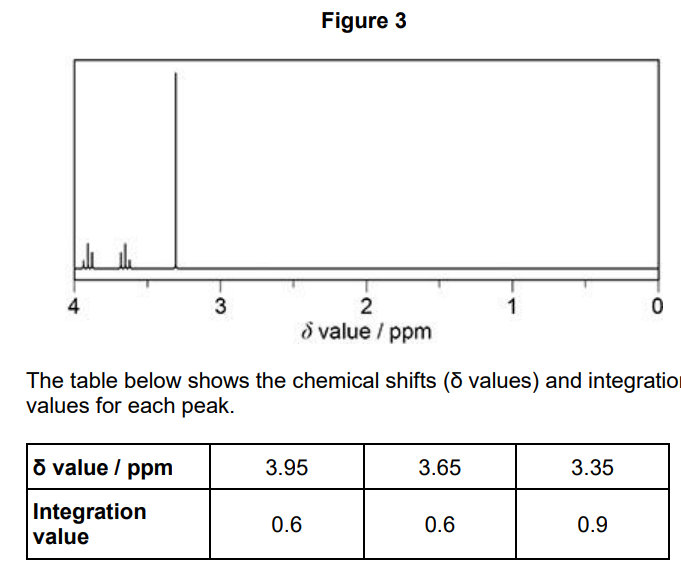
Answer:
CH₃-O-CH₂CH₂Cl
Explanation:
1. There is an integration ratio of 2:2:3.
2. The peak at 3.95 is caused by ClCH₂ and it is triplet as it is next to a CH₂.
3. The peak at 3.65 is caused by O-CH₂ and it is triplet as it is next to a CH₂(Cl)
4. The peak at 3.35 is caused by O-CH₃ and it is a singlet as there is no adjacent HNote: basically give the integration ratio, then explain what caused each peak and explain the splitting patterns.
Sources
2021 A-Level Paper 2 Q7.3 (5 marks)
Q:
MS:
Chromatography + RP 12
12Description of the three types of chromatography:
- Thin-layer chromatography: a plate is coated with a solid and a solvent moves up the plate.
- Column chromatography: a column is packed with a solid and a solvent moves down the column.
- Gas chromatography: a column is packed with a solid or with a solid coated by a liquid, and an inert gas is passed through the column under pressure at high temperature.
Sources
Not from a mark scheme, but useful content to know.
How to locate the positions of the amino acids on the TLC plate and determine their Rf values: (4 points)
- Spray the plate with a developing agent like ninhydrin or use a UV lamp to reveal their positions.Note: UV light seems to be the safe bet for all mark schemes.
- Measure the distance from the initial starting line to the middle of the spots.
- Measure the distance from the initial starting line to the solvent front line.
- Rf value = Distance in 2) / Distance in 3)
Sources
Specimen A-Level Paper 3 Q3.2 (4 marks)
Q:
MS:
In general terms, what determines the distance a spot moves in TLC?
The balance between its solubility in the mobile phase and the retention by the stationary phase.Note: the words ‘solubility’ and ‘retention’ are preferred. You can also say ‘relative affinity for the mobile and stationary phase’.Note 2: this is also the explanation for why different compounds separate in chromatography - ‘they have differences in the balance between solubility in the mobile phase and retention by the stationary phase.’
Sources
2017 A-Level Paper 2 Q8.4 (1 marks)
Q:
MS:
2023 A-Level Paper 3 Q3.5 (1 marks)
Q:
MS:
Explain why different amino acids have different Rf values: (2 points)
- Amino acids have different polarities.
- This causes them to have different solubilities in the mobile phase and different retentions to the stationary phase.
Sources
Specimen A-Level Paper 3 Q3.3 (2 marks)
Q:
MS:
2021 A-Level Paper 3 Q2.3 (1 marks)
Q:
MS:
January 2011 A-Level Unit 4 Q4(f) (3 marks)
Q:
MS:
2 ways amino acids are made visible after a chromatography experiment is finished:
- UV lamp.
- Ninhydrin.Note: ninhydrin only works for compounds with amine groups.Note 2: they are needed to make amino acids visible as the amino acids are ‘colourless’.Note 3: You could’ve also said a ‘developing agent’ or ‘iodine’ but I’d stick with a UV lamp (and remember ninhydrin for amino acids).
Sources
2021 A-Level Paper 3 Q2.2 (1 marks)
Q:
MS:
2023 A-Level Paper 3 Q3.6 (2 marks)
Q:
MS:
2019 A-Level Paper 2 Q9.2 (1 marks)
Q:
MS:
Why should the solvent not be added to a level above the starting line in TLC?
If it is added to a depth above the starting line, the sample will dissolve directly into the solvent, meaning it won’t be able to move up the plate with the solvent.Note: ‘dissolve’ seems to be the key word.
Sources
2017 A-Level Paper 2 Q8.5 (1 marks)
Q:
MS:
Specimen A-Level Paper 3 Q3.1 (4 marks)
Q:
MS:
Why is a lid needed for TLC?
To prevent the solvent vapour escaping, which allows the atmosphere in the beaker to remain saturated with the solvent vapour.
Sources
2023 A-Level Paper 3 Q3.4 (3 marks)
Q:
MS:
What must you remember to do when setting up an amino acid chromatography experiment?
You must wear plastic gloves when handling the TLC plate to prevent contamination from the hands to the plate.
Sources
Specimen A-Level Paper 3 Q3.1 (4 marks)
Q:
MS:
Explanation of why 2 molecules can be separated by gas chromatography: (2 points)
- They’ll have different balances between solubility in the mobile, gas phase and retention by the stationary phase.
- This means they’ll have different retention times so will appear at different times.
Sources
Not from a mark scheme, but useful content to know.
What typically happens to the components of a sample after they are separated by gas chromatography?
Mass spectrometry is used to analyse them.
Sources
Not from a mark scheme, but useful content to know.
Explanation of why 2 structural isomers can’t be separated by mass spectrometry: (2 points)
- They’ll have the same m/z values.
- Because they have the same molecular formula/ Mr.
Sources
2016 As Paper 2 Q4.1 (2 marks)
Q:
MS:
What happens to a polar compound's Rf value if you make the TLC solvent more polar, and why? (2 points)
- It will increase.
- Because the compound will be more attracted to and more soluble in the solvent, meaning it will travel further.
Sources
2017 A-Level Paper 2 Q08.7 (2 marks)
Q:
MS: