Responding to Changes in the Environment
Stimuli and Response
152 benefits of taxes:
- It allows the animals to disperse and create new colonies.
- It allows animals to avoid competition.
Sources
2021 A-Level Paper 3 Q3.1 (2 marks)
Q:
MS:
6 control variables for an experiment comparing growth of stems in different concentration solutions of a plant growth hormone:
- Same volume of solution.
- Leave them for the same time
- Same temperature.
- Same species of plant.
- Same age of plant.
- Same thickness of stem.
Sources
2024 A-Level Paper 2 Q8.4 (5 marks)
Q:
MS:
2021 A-Level Paper 2 Q3.2 (5 marks)
Q:
MS:
3 advantages of reflexes:
- They are rapid.
- They protect against damage to body tissues.
- They don’t have to be learnt.
Sources
Not from a mark scheme, but useful content to know.
4 things that could cause an anomalous result where the distance is impossibly short in the ruler-drop practical:
- The student guessing when the ruler will be dropped and beginning to close their fingers before it was actually dropped.
- The ruler not falling vertically.
- The ruler getting stuck to the person’s skin.
- The person dropping the ruler holding it too high.
Sources
2022 A-Level Paper 3 Q2.3 (1 marks)
Q:
MS:
5 reasons an estimate for nerve speed impulse speed based on the ruler-drop practical would be slower than the true speed of nerve impulses:
- Time for synaptic transmission.
- Time for muscle contraction.
- Time for the sodium ion channels to open (at the Parcinian corpuscle)
- The student may have been distracted.
- Time taken for coordination and comprehension in the brain.
Sources
2022 A-Level Paper 3 Q2.5 (3 marks)
Q:
MS:
How is a generator potential stimulated in the Parcinian Corpuscle? (4 points)
- Pressure deforms the membrane.
- The stretch-mediated sodium ion channels are also deformed, causing them to open.
- Sodium ions then diffuse in.
- Depolarising the cell, causing a generator potential.
Sources
2023 A-Level Paper 3 Q1.1 (3 marks)
Q:
MS:
Label P, Q, and R: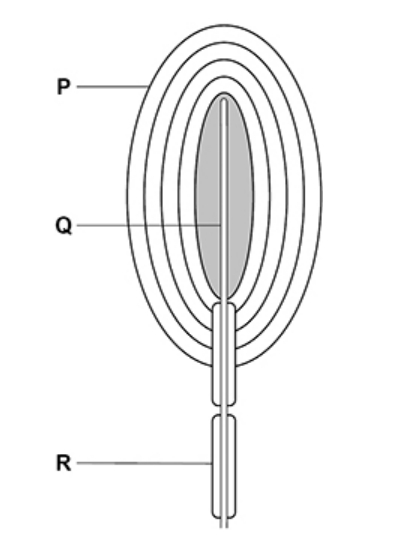
- P = Lamella(e) / Capsule. Technically it is the capsule, as the capsule is the outer layer then the inner layers are the lamellae.
- Q = Axon/ sensory neurone.
- R = Schwann cell / Myelin (sheath)
Sources
2022 A-Level Paper 3 Q2.1 (2 marks)
Q:
MS:
What is the ‘all-or-nothing’ principle?
An action potential is only produced when a threshold is reached.Note: this could be demonstrated by an action potential only being produced at a high pressure.
Sources
2023 A-Level Paper 3 Q1.2 (2 marks)
Q:
MS:
Why do rod cells allow us to see better in low light intensities than cone cells? (2 points)
- Several rod cells connect to each bipolar cell (convergence)
- This means there is an additive effect when light strikes several rod cells (summation)Note: ‘Summation’ and ‘Convergence’ were key words that would get you the mark automatically.
Sources
2020 A-Level Paper 2 Q1.4 (3 marks)
Q:
MS:
Mark scheme explanation of why cone cells allow us to distinguish objects that are close together (2 marks):
- Each cone cell connects to a single bipolar cell/ neurone (no convergence)
- This means they brain receives information from each cone cell individually.
Sources
2020 A-Level Paper 2 Q1.2 (3 marks)
Q:
MS:
2018 A-Level Paper 2 Q10.1 (3 marks)
Q:
MS:
Explain how the fovea (with its high density of cone cells) allows an animal to see objects in detail: (3 points)
- It creates high visual acuity.
- As each cone cell connects to one bipolar cell.
- Which allows the cone cells to send separate impulses to the brain.
Sources
2020 A-Level Paper 2 Q1.2 (3 marks)
Q:
MS:
How is an orange (mixture of red and green) colour registered and detected by the brain? (3 points)
- The cone cells in the retina.
- Absorb different wavelengths of light and have different pigments.
- Orange is registered when more impulses are sent to the brain by red and green-detecting cone cells.
Sources
2023 A-Level Paper 2 Q5.1 (3 marks)
Q:
MS:
Description of how the heart contracts, starting from the SAN: (5 points)
- The SAN sends a wave of excitation/ electrical activity across the atria, causing atrial contraction. I’d say ‘wave of electrical activity’ - it seems to be preferred.
- Non-conducting tissue prevents the wave reaching the ventricles, preventing the immediate contraction of the ventricles.
- The AVN delays the impulse while blood leaves the atria so the ventricles can fill.
- The AVN then relays the impulse and sends a wave of electrical activity down the Bundle of His which then travels to the Purkyne fibres.
- This causes ventricles to contract from the base up.
Sources
2024 A-Level Paper 2 Q6.1 (5 marks)
Q:
MS:
June 2013 As Unit 1 Q8(a) (5 marks)
Q:
MS:
June 2012 As Unit 1 Q8(a) (5 marks)
Q:
MS:
How does an increase in muscle activity cause an increase in heart rate? (6 marks)
- Increase in CO₂ is detected by chemoreceptors in the aorta/ carotid artery.Note: An increase in blood pressure could also be detected by baroreceptors.
- This sends more impulses to the cardioregulatory centre in the medulla.
- This causes more impulses to be sent along the sympathetic nerves.
- To the SAN.
- This causes more release of noradrenaline.
- This causes an increased frequency of impulses from the SAN to the AVN.Note: always mention point 6 with the AVN on these types of questions.Note: For a decrease in heart rate, talk about less impulses being sent to the medulla, more impulses being sent along parasympathetic nerves, causing the release of more acetylcholine.
Sources
2023 A-Level Paper 2 Q10.5 (4 marks)
Q:
MS:
2012 A-Level Unit 5 Q4(a) (3 marks)
Q:
MS:
Explain how a shoot grows towards light using IAA: (3 points)
- The tip produces IAA.
- The IAA diffuses into the shoot and accumulates on the shaded side.
- More elongation of cells occurs on the shaded side of the shoot.
Sources
2021 A-Level Paper 2 Q03.1 (3 marks)
Q:
MS:
RP 10 – Taxes and Kineses
3In the taxes/ kineses practical (humidity), why do you give the woodlice 15 minutes in the petri dish before recording their movement? (2 points)
- To give them time to establish the humidity by absorbing the water.
- This means their behaviour is typical of the humidity and isn’t affected by handling.
Sources
June 2011 A-Level Unit 6 EMPA Q16 (2 marks)
Q:
MS:
In a taxes/ kineses practical question, you are asked why not all of the points lie on the curve. What are three reasons you could give?
- It is a line of best fit.Note: presumably you were just shown the line - useful to know this was a marking point though.
- There is variation in the woodlice (e.g. age)
- There is variation in environmental conditions (e.g. temperature)
Sources
I couldn't find the mark scheme this was based on.
4 ways (with explanations) the choice chamber practical can be made more representative:
- Mimicking the animals habitat so they exhibit their normal behaviour as a result of being in their natural environment.
- Using a large sample size which makes the sample more representative
- Placing the animals in the centre each time so there is the same distance to each segment.
- Using a delay before recording the results so the animals can acclimatise and have enough time to respond.
Sources
2025 A-Level Paper 2 Q7.1 (3 marks)
Q:
MS:
Nervous Coordination
12How is a resting potential maintained? (3 points)
- The membrane is more permeable to potassium ions and less permeable to sodium ions.
- This means more potassium ions diffuse out than sodium ions diffuse ion.
- Sodium ions are actively transported out of the neurone, and potassium ions are actively transported in.Note: 3 sodium ions out for every 2 potassium ions in, through the sodium-potassium pump.
Sources
2021 A-Level Paper 2 Q2.1 (3 marks)
Q:
MS:
Why do myelinated axons conduct impulses faster than non-myelinated axons? (4 points)
- Myelin causes provides electrical insulation.
- In myelinated axons, depolarisation and action potentials only occur at the nodes at Ranvier, whereas in non-myelinated axons depolarisation occurs along the whole length of the axon.
- This means the impulse jumps from node to node (saltatory conduction)
- This means the action potential doesn’t have to travel along the full length of the axon.
Sources
2021 A-Level Paper 2 Q2.2 (3 marks)
Q:
MS:
2014 A-Level Unit 5 Q3(a) (3 marks)
Q:
MS:
Why do axons with larger diameters conduct impulses more quickly?
The ions experience less resistance as they flow through them.
Sources
Not from a mark scheme, but useful content to know.
Why does a lower temperature lead to slower nerve impulses?
There is slower diffusion of Na⁺ and K⁺ ions.
Sources
2014 A-Level Unit 6 ISA-P Q16(a) (2 marks)
Q:
MS:
3 benefits of the refractory period:
- It means action potentials can only travel in one direction, as it prevents the local currents from diffusing backwards.
- It means that each impulse remains distinct from the next.
- It prevents the frequency of action potentials being too high, which could cause damage to effectors by overstimulating them.
Sources
2013 A-Level Unit 5 Q4(b) (2 marks)
Q:
MS:
6 reasons synapses are important:
- Convergence - Signals from different parts of the nervous system link to the same neurone to create the same response.
- Divergence - One impulse is transmitted to multiple parts of the nervous system.
- Filtering out - Low-level stimuli are filtered out as threshold potentials won't be reached in the post-synaptic neurone if there isn't a high enough frequency of impulses.
- Summation - Important but low frequency impulses aren't lost.
- Acclimitization - The synapse eventually temporarily runs out of vesicles of the neurotransmitter, making it fatigued and unable to keep sending impulses. This prevents damage to effectors.
- Ensures impulses can only travel in one direction as there are only vesicles on the pre-synaptic neurone.
Sources
2022 A-Level Paper 2 Q7.1 (2 marks)
Q:
MS:
Most of these points are not from mark schemes, but are useful to know.
What are A, B, C, and D?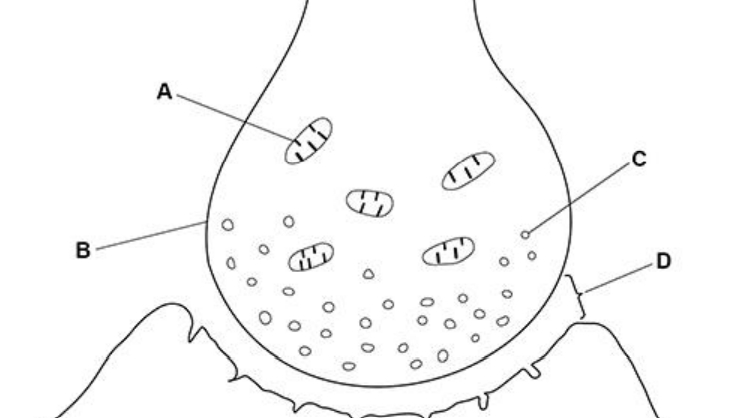
- A = Mitochondrion.
- B = Presynaptic membrane.
- C = Neurotransmitter vesicles.
- D = Synaptic cleft.
Sources
I can't find the past paper this is from.
Why does the inhibition of acetylcholine esterase lead to muscular issues? (4 points)
- Less acetylcholine will be broken down in the cleft, meaning more is present.
- This means more acetylcholine will bind to receptors on the postsynaptic membrane, opening sodium channels.
- This means more Na⁺ ions will diffuse into the postsynaptic knob, creating an action potential.
- This causes the muscle to remain contracted.
Sources
June 2012 A-Level Unit 5 Q1(d) (3 marks)
Q:
MS:
Explanation of temporal summation:
Several repeated impulses in a short time period increase membrane potential enough for threshold to be met.
Sources
2022 A-Level Paper 2 Q7.2 (2 marks)
Q:
MS:
How do inhibitory neurotransmitters prevent synaptic transmission? (2 points)
- They make the post-synaptic membrane more negative, where its voltage is below resting potential (hyperpolarisation)
- This means more sodium ions are required to enter to reach threshold potential and cause an action potential, so they are prevented from doing so.
Sources
2024 A-Level Paper 2 Q1.3 (2 marks)
Q:
MS:
How does a drug that blocks calcium channels at the synapses of sensory neurones prevent the transmission of pain impulses to the brain? (5 marks)
- No calcium ions enter the presynaptic knob via calcium ion channels since they are blocked.Note: you couldn’t have said presynaptic membrane.
- No synaptic vesicles move to and fuse with the presynaptic membrane, meaning no neurotransmitter is released into the synaptic cleft.
- No neurotransmitter diffuses across the synaptic cleft.
- No neurotransmitter binds to the receptors on the postsynaptic membrane.
- No sodium ions enter the postsynaptic knob so no impulses are sent to the brain.
Sources
2023 A-Level Paper 2 Q2.1 (5 marks)
Q:
MS:
2 reasons a polypeptide drug would be injected into a patient’s cerebrospinal fluid instead of taken as a pill:
- It allows the drug to rapidly reach the spinal cord.
- It prevents the polypeptide from being broken down by acid or enzymes in the stomach.
Sources
2023 A-Level Paper 2 Q2.2 (2 marks)
Q:
MS:
Skeletal Muscles
14How do muscles act? (in general)
They act in antagonistic pairs against an incompressible skeleton.Note: It may also be useful to know that muscles can only 'pull' on skeletons, which is why they have to act in pairs.
Sources
Not from a mark scheme, but useful content to know.
4 features of muscle cells:
- They are elongated and contain many nuclei.
- They contain contractile proteins that form myofibrils.
- The sarcolemma contains folds in its outer surface called T-tubules.
- The sarcoplasm contains many mitochondria for ATP production for muscle contraction.
Sources
Not from a mark scheme, but useful content to know.
Role of calcium ions in muscle contraction: (4 points)
- Calcium ions diffuse into myofibrils from the sarcoplasmic reticulum.
- The binding of them to their binding sites causes the movement of tropomyosin.
- This causes the myosin binding sites on actin to become exposed.
- This means myosin heads are able to attach to the actin and form actinomyosin bridges.
Sources
Specimen A-Level Paper 2 Q2.1 (5 marks)
Q:
MS:
Describe the sequence of events from acetylcholine being released into the synaptic cleft at a neuromuscular junction to Ca²⁺ ions being released into the myofibril (4 marks):
- Acetylcholine diffuses across the synaptic cleft.
- It attaches to receptors on the sarcolemma.Note: You could’ve said the postsynaptic membrane, but this wasn’t ideal.
- Sodium ions enter leading to depolarisation.
- Calcium ions exit the sarcoplasmic reticulum.
Sources
2024 A-Level Paper 2 Q1.2 (4 marks)
Q:
MS:
Explain the role of ATP in muscle contraction before the actual contraction:
It provides energy for the active transport of Ca²⁺ ions into the sarcoplasmic reticulum, allowing a high concentration of them to build up in preparation for when the sarcolemma is depolarised and the Ca²⁺ ions need to diffuse out of the sarcoplasmic reticulum.
Sources
2023 A-Level Paper 2 Q10.1 (2 marks)
Q:
MS:
What is the role of ATP in myofibril contraction? (2 points)
- The attachment of ATP to myosin causes the myosin heads to detach from the actin, breaking the actinomyosin bridges.
- Its hydrolysis provides energy to bend the myosin head, pulling the actin molecules.Note: technically the hydrolysis of ATP provides the energy for the restraightening of the myosin head, but the idea of the bending (caused by ATP hydrolysis) causing the actin to move is found in two mark schemes, so I’d always describe it how I did here.
Sources
2023 A-Level Paper 2 Q10.1 (2 marks)
Q:
MS:
Specimen A-Level Paper 2 Q2.1 (5 marks)
Q:
MS:
2016 A-Level Unit 5 Q4(a) (2 marks)
Q:
MS:
2013 A-Level Unit 5 Q2(a)(ii) (2 marks)
Q:
MS:
Where are slow twitch and fast twitch muscle fibres generally found in the body?
Fast twitch are found in the biceps, triceps and eyelid muscles of humans as these muscles need to be able to contract quickly.
Slow twitch are found in the leg and back muscles of humans as these muscles don’t need to contract as quickly and they are required for more sustained activities, meaning they can’t fatigue quickly.
Sources
Not from a mark scheme, but useful content to know.
When are fast-twitch and slow-twitch muscle fibres used?
Fast fibres are used for short-term exercise.
Slow fibres are used for long-term exercise.Note: these two statements can be a mark each on long questions.
Sources
2023 A-Level Paper 2 Q10.3 (5 marks)
Q:
MS:
2024 A-Level Paper 2 Q2.3 (4 marks)
Q:
MS:
4 differences between fast and slow twitch muscle fibres:
Fast twitch:
- Contain less capillaries and receive less blood flow as they require less oxygen as they don’t respire aerobically as much.
- Contain less myoglobin as they don’t require as much oxygen.
- Contain less mitochondria as they don’t respire aerobically as much.
- Fatigue more quickly due to lactic acid build upNote: the converse applies for slow twitch.
Sources
2013 A-Level Unit 5 Q2(b)(ii) (2 marks)
Q:
MS:
2010 A-Level Unit 5 Q7(a)(i) (2 marks)
Q:
MS:
Why may creatine supplements be useful for exercise? (2 points)
- Creatine forms phosphocreatine.
- Phosphocreatine reacts with ADP to form ATP.
Sources
2023 A-Level Paper 2 Q10.3 (5 marks)
Q:
MS:
2014 A-Level Unit 5 Q6(a) (2 marks)
Q:
MS:
Why may eating a lot of carbohydrates be useful for exercise? (2 points)
- The carbohydrate/ glucose is stored as glycogen in glycogenesis.
- The glycogen can then be hydrolysed into glucose during exercise in glycogenolysis.Note: I’d always include the technical words like ‘glycogenesis’ and ‘glycogenolysis’ in answers.
Sources
2023 A-Level Paper 2 Q10.3 (5 marks)
Q:
MS:
Explanation of why GLUT4 proteins (glucose transporters) are useful for exercise: (2 points)
- They allow glucose to enter the cells.
- Via facilitated diffusion.Note: always mention this whenever you mention channel/ carrier proteins.
Sources
2023 A-Level Paper 2 Q10.4 (3 marks)
Q:
MS:
Why would fatty acids entering the mitochondria be useful during exercise? (2 points)
- They can be used in the Krebs cycle.
- Respiration provides ATP.Note: always name the stage of respiration when describing the role of fatty acids in respiration - it’s important you show that you understand they are used specificallly on the Krebs cycle.
Sources
2023 A-Level Paper 2 Q10.4 (3 marks)
Q:
MS:
Describe and explain the banding pattern of a sarcomere: (3 points)
- The I band is light as it contains only actin.
- The H zone contains only myosin.
- The A band is dark as it contains both actin and myosin.
Sources
2020 A-Level Paper 2 Q04.1 (3 marks)
Q:
MS:
Homeostasis
22Principles of negative feedback:
When a change is detected, a change in the body will occur that acts in the opposite direction of this change, causing levels to be returned to the norm/ original.
Sources
2025 A-Level Paper 2 Q2.4 (2 marks)
Q:
MS:
Why is having two separate mechanisms for negative feedback beneficial? (2 points)
- It allows negative feedback systems to reverse changes in either direction.
- This gives them greater control for returning levels back to their original levels, keeping the internal environment in a narrower range.
Sources
2025 A-Level Paper 2 Q2.4 (2 marks)
Q:
MS:
The actual source for this isn't from a mark scheme, but is useful content to know.
Description of how insulin works: (5 points)
- It binds to specific receptors on target muscle and liver cells.
- This causes these vesicles of glucose transporters in these cells to fuse with their cell membranes, causing more glucose transporter proteins to be uptaken into the cell membranes.
- Increasing the permeability of the muscle and liver cells to glucose.
- This allows more glucose to enter the cells via facilitated diffusion through the carrier proteins.
- Where it is then converted into and stored as glycogen (glycogenesis) after insulin activates enzymes that cause this to occur.
Sources
2019 A-Level Paper 2 Q5.3 (2 marks)
Q:
MS:
2014 A-Level Unit 5 Q4(a) (2 marks)
Q:
MS:
Description of how adrenaline causes blood glucose levels to increase: (4 points)
- It will bind to receptors on target cells.
- This causes adenylate cyclase is activated, producing cAMP from ATP.
- This will activate protein kinases.
- These enzymes (and other enzymes) will stimulate glycogenolysis and gluconeogenesis.
Sources
2012 A-Level Unit 5 Q6(a) (2 marks)
Q:
MS:
2019 A-Level Paper 2 Q5.4 (3 marks)
Q:
MS:
What occurs in gluconeogenesis?
Glycerol or amino acids (non-carbohydrate substrates) are converted into glucose.
Sources
2019 A-Level Paper 2 Q5.1 (2 marks)
Q:
MS:
Why does a diabetic person’s blood glucose rise more after consuming glucose when compared to a non-diabetic person’s glucose? (3 points)
- The diabetic person either has a lack of insulin or reduced sensitivity of cells to insulin.
- Causing reduced uptake of glucose from the blood into muscle and liver cells.
- Causing less conversion of glucose into glycogen (glycogenesis).Note: always mention some kind of glucose conversion process in these questions (glycogenesis, glycogenolysis, gluconeogenesis).
Sources
2024 A-Level Paper 2 Q9.1 (2 marks)
Q:
MS:
2019 A-Level Paper 2 Q5.3 (2 marks)
Q:
MS:
Explanation of why a drug that increases insulin secretion may help patients with type 2 diabetes: (3 points)
- It will cause more stimulation of the liver and muscle cells, despite them being more resistant to insulin than the cells of a healthy person.
- This causes more glucose uptake from the blood.
- This means the person will be able to consume more glucose without developing the symptoms of diabetes (e.g. blindness)
Sources
Not from a mark scheme, but useful content to know.
Explanation of why organisms with destroyed pancreatic cells would be unsuitable for studying Type 2 diabetes: (2 points)
- People with Type 2 diabetes still produce insulin.
- Their cells are just less responsive to insulin.Note: make sure you show you understand this in any Type 2 diabetes question.
Sources
2022 A-Level Paper 2 Q08.4 (2 marks)
Q:
MS:
What is the effect of a lack of insulin on reabsorption of glucose in the kidneys? (6 points)
- There is a high concentration of glucose in the blood.
- This causes there to be a high concentration of glucose in the filtrate in the kidney tubules.
- Glucose is reabsorbed via facilitated diffusion.
- This requires carrier proteins.
- These carrier proteins will be working at maximum rate/ be saturated.
- This means not all glucose is reabsorbed so some is lost in urine.
Sources
2021 A-Level Paper 2 Q5.3 (3 marks)
Q:
MS:
Description of how ultrafiltration occurs in the glomerulus: (5 points)
- There is a high hydrostatic pressure in the glomerulusNote: this is created by the wide afferent arteriole diameter and narrow efferent arteriole diameter.
- This causes two named substances (e.g. water, urea, ions, glucose) to pass out of the blood.
- Small molecules exit but large proteins are too large to exit.
- Through small pores in the capillary endothelium.
- Then through the basement membrane.Note: ..then through the podocytes of the Bowman’s capsule.
Sources
2019 A-Level Paper 3 Q1.1 (3 marks)
Q:
MS:
Why are proteins usually not present in urine? (2 points)
- They are too large.
- To pass through the basement membrane.Note: always talk about the basement membrane in any question on filtration - it seems to always be mentioned.
Sources
2025 A-Level Paper 3 Q2.2 (2 marks)
Q:
MS:
5 features of the cells of the proximal convoluted tubule that allow rapid reabsorption of glucose into the blood:
- Microvilli that provide a large surface area for reabsorption.
- Many carrier proteins that allow for active transport of sodium ions and co-transport of glucose.
- Many channel proteins that allow for facilitated diffusion.
- Many mitochondria to produce ATP for the active transport of sodium ions.
- Many ribosomes to produce carrier and channel proteins.
Sources
2023 A-Level Paper 2 Q6.1 (3 marks)
Q:
MS:
Description of what occurs in the descending and ascending limb of the loop of Henle: (2 points)
- The concentration of the filtrate rises in the descending limb because sodium ions enter via diffusion and water exits via osmosis.
- The concentration of the filtrate falls in the ascending limb because sodium (and chloride) ions are actively transported out but water remains in the ascending limb as the walls are impermeable to water.
Sources
Not from a mark scheme, but useful content to know.
Explain how the loop of Henle maintains the gradient of ions which allows water to be reabsorbed from the filtrate in the collecting duct: (6 points)
- The epithelial cells of the tubule carry out active transportNote: useful to know its the epithelial cells that carry out active transport and that the loop of Henle is still part of the ‘tubule’.
- Transporting sodium and chloride ions out.
- Against the concentration gradient.
- Into the surrounding tissue fluidNote: don’t just say ‘into the medulla’, say ‘into the tissue fluid in the medulla’.
- Creating a water potential gradient for water reabsorption.
- Creating a countercurrent multiplierNote: always just mention the words ‘countercurrent multiplier’ in loop of Henle questions.
Sources
Not from a mark scheme I can find, but useful content to know.
What is the effect of a thicker medulla on urine concentration and why? (4 points)
- It means the loop of Henle is longer.
- This causes an increased sodium ion concentration in the medulla.
- This means the water potential gradient between the collecting duct and medulla will be maintained for longer.
- This means more water will be reabsorbed from the collecting duct by osmosis, producing more concentrated urine.
Sources
2019 A-Level Paper 3 Q1.4 (3 marks)
Q:
MS:
Where are the cells that detect changes in blood pressure?
In the aorta/ carotid artery.Note: Remember the osmoregulatory centre in the hypothalamus detects changes in water potential, not blood pressure. I included this note here to trick you.
Sources
2023 A-Level Paper 2 Q6.4 (3 marks)
Q:
MS:
What part of the body releases ADH into the blood?
The posterior pituitary gland.Note: you had to say ‘posterior’.
Sources
2022 A-Level Paper 2 Q9.1 (1 marks)
Q:
MS:
Where does ADH bind to in the nephron?
Receptors in both the collecting duct and distal convoluted tubule.Note: there was a question where you had to name both.Note 2: always use the full name ‘distal convoluted tubule’, not just ‘DCT’
Sources
2023 A-Level Paper 2 Q6.2 (1 marks)
Q:
MS:
Describe how ADH causes the movement of water from the lumen of the collecting duct into the blood: (5 points)
- ADH causes vesicles containing aquaporins to insert aquaporins into the membrane of the collecting duct wall.
- Water enters cell through aquaporinsNote: you hould also say the permeability to water increases.
- By osmosis.
- It then enters the capillaryNote: talking about something entering blood = talk about it entering capillaries.
- Via interstitial fluidNote: Interstitial fluid is the small amount of fluid that surrounds cells. I’m not sure you actually need to mention this.
Sources
2022 A-Level Paper 2 Q9.3 (3 marks)
Q:
MS:
The rest of this note isn't from a mark scheme I can find, but is useful content to know.
How does the release of ADH affect blood pressure? (2 marks)
- ADH increases reabsorption of water.
- This increases the volume of blood and therefore causes pressure to increase.Note: you had to mention the change in volume of blood. Whenever you talk about pressure you should always talk about volume.
Sources
2023 A-Level Paper 2 Q6.4 (3 marks)
Q:
MS:
2 ways vigorous exercise decreases blood pH:
- It causes an increase in aerobic respiration, producing more CO₂.Note: the idea of ‘more’ and ‘increase’ were necessary.Note 2: the CO₂ would then form carbonic acid in the blood.
- Anaerobic respiration produces lactate.
Sources
2025 A-Level Paper 2 Q2.5 (2 marks)
Q:
MS:
Why does the cell volume of an osmoreceptor decrease when a person is dehydrated? (2 points)
- The water potential of blood will decrease when someone is dehydrated.
- Water will move from the osmoreceptor into the blood by osmosis.
Sources
Specimen A-Level Paper 2 Q07.2 (2 marks)
Q:
MS:
RP 11 – Glucose Concentration with Colorimetry
2How to produce a calibration curve using a colorimeter and use it to find an unknown concentration of a protein solution: (4 points)
- Produce protein solutions of known concentrations.
- Measure the absorbance of each concentration with a colorimeter.
- Plot a graph of absorbance on y-axis against concentration (on x-axis) and draw a curve.
- Use the absorbance reading of the sample to find the protein concentration from the curve.
Sources
2017 As Paper 2 Q04.4 (3 marks)
Q:
MS:
How to gain a quantitative measure of the cloudiness of 3 different samples of river water: (3 points)
- Use a colorimeter.
- To measure the absorbance of light.
- Standardise the results by using the same volume of water, zeroing the colorimeter and measuring the absorbance of the same wavelength of light for all three.Note: the last point was explicitly for a method of ‘standardising results’, so always include this in any kind of colorimetry (or any other practical) question.
Sources
2019 A-Level Paper 3 Q2.2 (3 marks)
Q:
MS: